Agentic GraphRAG definition
Agentic GraphRAG is a retrieval-augmented generation method in which an AI agent queries a knowledge graph step by step and decides at each step which relationships to follow. It often records the agent's past decisions and their outcomes in the graph as decision memory that later runs can use.
Agentic GraphRAG is retrieval in which an AI agent walks a knowledge graph one step at a time and picks which relationships to follow. It adds decision memory by saving the agent's past choices and their outcomes back into the graph as nodes or edges that later runs can query. This depends on typed entities and references. In Sanity, documents in the Content Lake follow a schema and link through explicit references, so the agent follows real relationships instead of guessing them.
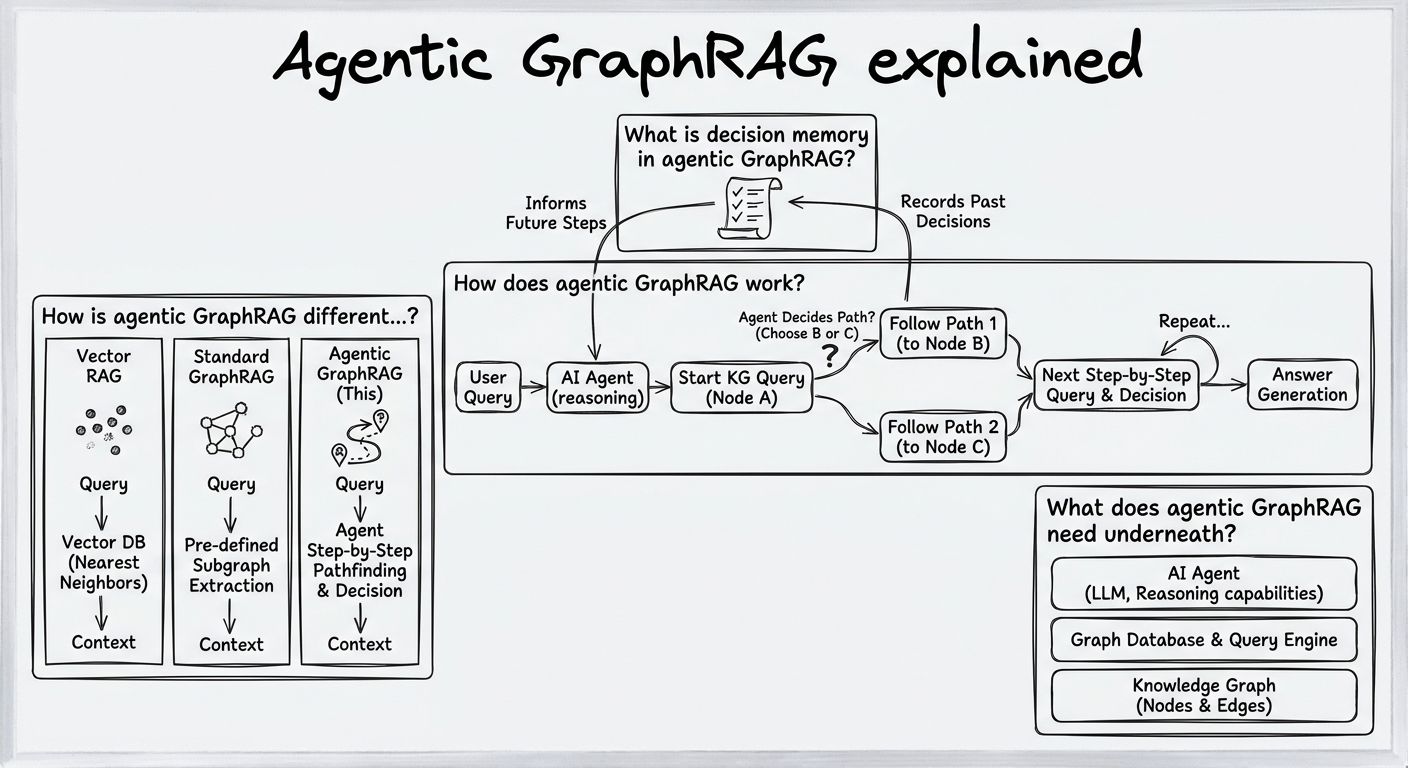
Agentic GraphRAG works by putting an AI agent in charge of retrieval. The agent does not pull a fixed set of results. It moves through a knowledge graph in a loop, where a knowledge graph is a set of entities (nodes) joined by named relationships (edges). The loop usually has five steps.
First, the agent reads the question and picks one or more starting entities, such as a product, a customer, or a policy. Second, it looks at the relationships leaving those entities and chooses which ones to follow, for example "product is covered by warranty" or "article was written by author." Third, it fetches the connected entities and checks whether it has enough to answer. Fourth, if it does not, it chooses another hop or changes direction. Fifth, it passes the path it collected to a language model, which writes the answer from that evidence.
The agent controls the stopping point and the route, which makes agentic GraphRAG agentic. When a question needs three hops, the agent takes three. When one hop is enough, it stops after one.
Decision memory in agentic GraphRAG is a record of what the agent decided in earlier runs and how those decisions turned out, kept in the knowledge graph itself. A decision can be its own node, linked by edges to the question it served, the entities it touched, the path it took, and an outcome such as "answer accepted," "answer corrected by a reviewer," or "path led nowhere."
Decision memory lives in the graph, so it can be queried the same way as any other content. On a later run, the agent can check whether a similar question was handled before, which traversal worked, and which relationships produced bad answers. It can then reuse a good path or avoid a bad one.
This is not a conversation log, but a structured record. A log keeps text in time order. Decision memory in agentic GraphRAG keeps decisions in structured form and ties them to the entities they were about, so a decision about a product stays attached to that product.
Agentic GraphRAG differs from vector RAG in how it finds information. Vector RAG turns text chunks into embeddings (numeric representations of meaning) and returns the chunks closest to the question. That works for questions about similar wording, but it has no built-in model of how two pieces of content are related, so multi-step questions like "which suppliers affect products sold in this region" are hard for it.
Agentic GraphRAG also differs from GraphRAG without an agent. Standard GraphRAG, as in Microsoft Research's GraphRAG project, builds a knowledge graph from source text and retrieves from it through a predefined pipeline. The graph adds structure, but the retrieval steps are set in advance and do not adapt to the question during retrieval.
In short, vector RAG retrieves by similarity, standard GraphRAG retrieves by structure along a fixed route, and agentic GraphRAG retrieves by structure along a route the agent picks at runtime. Agentic GraphRAG with decision memory adds one more element: the agent's earlier choices become part of the graph it reasons over.
Agentic GraphRAG needs a graph whose entities have clear types and whose relationships are explicit references. Graphs inferred from free text are different. An agent can only choose a useful hop if it knows what an edge means and what kind of entity sits at the other end. Vague or duplicated entities send it the wrong way, and decision memory then records those wrong turns as history.
This is where structured content matters. Sanity is the AI Content Operating System, and its Content Lake holds content as typed documents shaped by a schema. Those documents connect to each other through references, and the referenced documents are themselves typed. The result is a content graph in which a product document points to its category, its author, and its related policies by reference, and an agent can follow those references with GROQ queries.
The same schema approach can hold decision memory. A team can define a decision document type that references the entities and content it acted on, so past decisions sit in the same graph as the content they concern and can be queried the same way.
Agentic GraphRAG is most worth using when answers depend on relationships among several entities and when the same kinds of questions come up often enough for past decisions to help. Typical examples include support questions that span products, versions, and policies, or editorial questions that span authors, topics, and regions.
Agentic GraphRAG costs more than simpler methods. Each hop is another model call and another query, so it is usually slower than a single vector lookup. Decision memory also needs governance. Someone has to decide which outcomes count as success, and stale or wrong decisions have to be fixed or retired so the agent does not keep repeating them.
In our experience, if most questions can be answered from a single passage of text, vector RAG is the simpler choice. Agentic GraphRAG makes the most sense when the hard part of a question is the connection between things, not finding a passage that sounds similar.
Discover More with Sanity
Now that you've learned about Agentic GraphRAG, why not start exploring what Sanity has to offer? Dive into our platform and see how it can support your content needs.
Last updated: