ChatGPT Business Agents definition
A ChatGPT Business Agent is an AI agent that a verified business publishes inside ChatGPT to answer people's questions about its products, services, and policies from information the business supplies, in a conversation labeled as the business's and kept separate from ChatGPT's own answers.
A Business Agent in ChatGPT is an AI agent, built and hosted by OpenAI, that answers questions about one business's products, services, and policies using the product feed, details, and guidelines that business supplies. Because it answers only from that supplied information, a stale price or an outdated return policy gets repeated in the business's name. In Sanity, those facts are structured content in the Content Lake, one governed record that the website, the exported product feed, and the business's own agents all draw from.
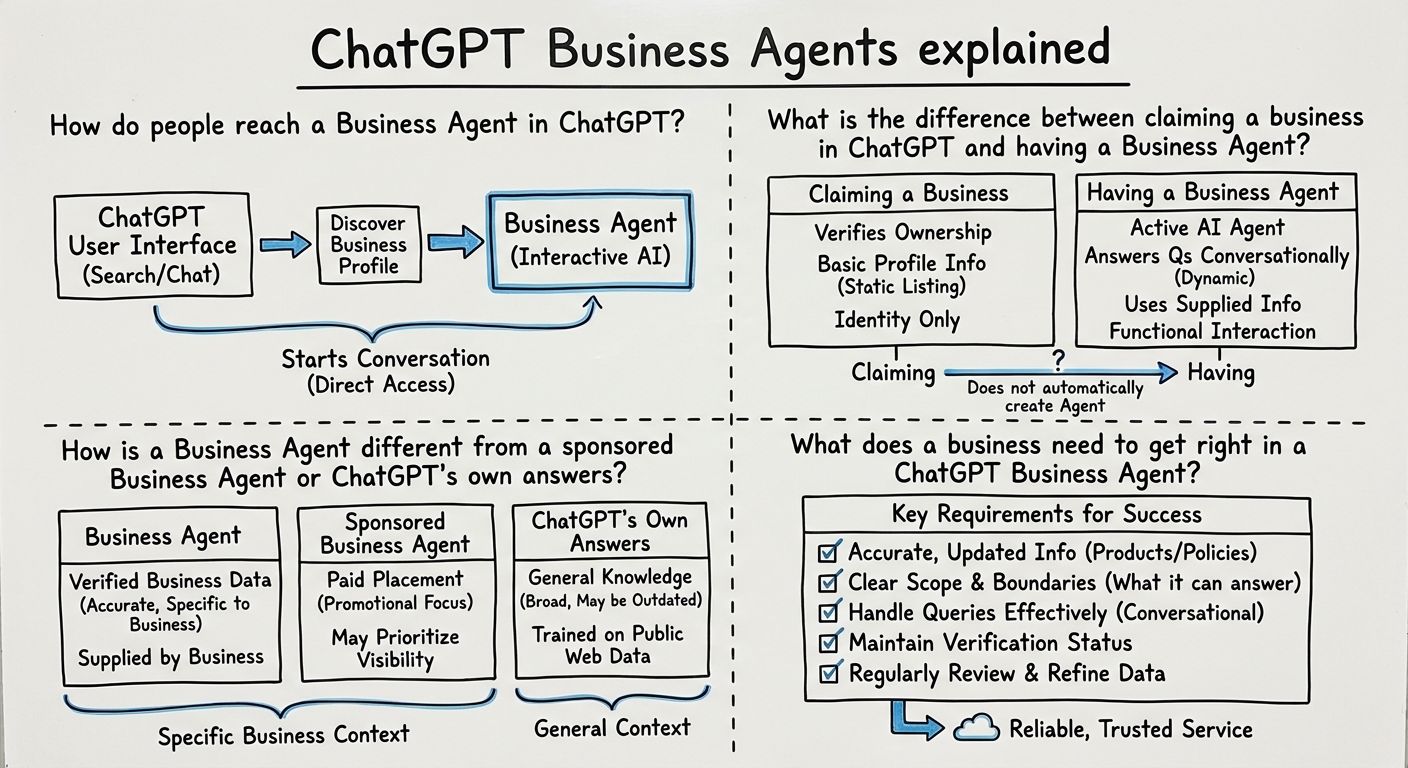
People reach a ChatGPT Business Agent from the business's ChatGPT profile, which they can open when that business appears in one of ChatGPT's answers. If the business has published a Business Agent, the person can start a separate conversation with it to explore its offerings and ask follow-up questions. OpenAI's own example is comparing two products and asking which features fit the user's needs.
OpenAI launched Business Agents in beta on Nov. 10, 2026, as part of Businesses in ChatGPT, as Reuters reported. The launch has three parts: Business Hub, where a business claims and manages its profile; Business Agents themselves; and the option to sponsor a Business Agent as an ad destination. OpenAI says ChatGPT has 1.2 billion weekly users, according to FoneArena's coverage.
At launch, ChatGPT Business Agents are open only to eligible ecommerce and online service businesses in the US that have a website and meet the industry requirements in OpenAI's Business Agents Policy. OpenAI plans to add more markets and categories but has not given a date. A Business Agent can explain products and policies, help compare options, and link out to the business's site. Secondary sources report that it does not complete purchases, bookings, or order lookups, so the shopper finishes the transaction on the brand's own website.
Claiming a business in ChatGPT gives a business control over its profile, while a Business Agent is an optional agent that an eligible, claimed business can build on top of that profile. Claiming happens in Business Hub, where a verified business updates its details, adds product feeds with pricing and availability, and sees aggregated insights. A claimed profile shows a blue checkmark. A business does not need a Business Agent to appear in ChatGPT, and OpenAI's Benji Shomair told Digiday that claiming a business "should not have an impact on how frequently it appears."
Setting up a ChatGPT Business Agent outside Shopify follows six steps, as summarized from OpenAI's help center. First, claim the business and pass identity verification. Second, review the information the agent will use. Third, connect a product feed, either through Shopify, a CSV that follows OpenAI's product feed specification, or a hosted URL. Fourth, write instructions that stay within the Business Agents Policy. Fifth, preview the agent with a real customer question, such as "Can I return an item I bought on sale?" Sixth, publish, because customers can only chat with a published agent.
Shopify merchants have a shorter path. They can connect through Business Hub or the Shopify admin, and their product details, pricing, and availability are shared automatically through Shopify Catalog, per FoneArena.
A ChatGPT Business Agent is the free, organic experience people reach through ChatGPT's recommendations, while a sponsored Business Agent is the same kind of agent used as the destination for a paid ChatGPT ad, set up in Ads Manager. Sponsored placements are labeled and kept separate from ChatGPT's responses. As Shomair put it to Digiday: "Think of the business agent as the organic experience. The sponsored agent is the paid experience, but the agent that sits behind it should be the same." OpenAI documents the paid setup in its sponsored agent guide.
A Business Agent also differs from ChatGPT's own answers. The Business Agent speaks for the business and is labeled that way, while ChatGPT keeps making its own independent recommendations and comparisons. OpenAI's policy says an agent must be clear that it is AI representing the business and must not appear to be an independent adviser, a human, or endorsed by OpenAI.
Two other products are easy to confuse with ChatGPT Business Agents. ChatGPT Business and ChatGPT Enterprise are OpenAI's workspace subscriptions for employees, not Businesses in ChatGPT. And businesses cannot bring their own agent: OpenAI builds the Business Agent from the instructions and product feed the business supplies, and Shomair told Digiday, "We aren't allowing folks to bring their own agents."
A business running a ChatGPT Business Agent needs to get three things right: the information the agent answers from, how current that information is, and what the instructions allow the agent to say. The agent answers only from the product feed, business details, and policies the business supplies, so an out-of-date price, a sold-out item shown as available, or a superseded return policy is repeated to customers under the business's name. OpenAI's Businesses in ChatGPT Terms cover the accuracy of the information used in profiles and agents.
Instructions for a Business Agent have to stay within the Business Agents Policy. The agent discloses that it is AI representing the business, does not pose as a human or an independent adviser, and does not claim OpenAI endorsement. According to secondary reporting on OpenAI's help center, it may collect contact details only through an approved feature and only when the user chooses to. Testing with real customer questions before publishing is the practical check: if an answer is wrong, the business updates the information or instructions and tests again.
Businesses do not see what customers ask a Business Agent. OpenAI does not share user conversations or Business Agent chats. Instead, Business Hub shows aggregated insights (mentions, views, website clicks, and discovery topics) only above certain volume thresholds, Digiday reports. Without transcripts, the source data is the main thing a business controls.
Structured content keeps a ChatGPT Business Agent's answers accurate by making the product details, pricing, availability, and policies it answers from the same governed record the business uses everywhere else. Those facts are not unique to ChatGPT. They also appear on the website, in the business's own support or shopping agent, and in every product feed. When each channel keeps its own copy, the copies drift, and the Business Agent quotes a return window the website changed last month.
Sanity is the AI Content Operating System, the intelligent back end for companies building AI content operations at scale. In Sanity, product and policy information is modeled as structured content in the Content Lake, so a price or a return window is a field edited once, not a sentence copied across pages. Product data in the Content Lake can be queried with GROQ and exported to whatever feed format a channel requires, which keeps a Business Hub feed tied to the same record as the website.
For the agents a business runs itself, on its own site, app, or support channel, Sanity Context gives those agents access to that same content, with instructions configured in the Context app, not buried in agent code. A shopping assistant built this way turns a request like a red jacket under $200 into an exact filter on real product fields. With Knowledge Bases (in beta), if the help center says returns are accepted within 30 days and a product page says 45, the build flags the conflict so the team chooses the answer once. That keeps a business's own agents consistent with the facts it publishes to a ChatGPT Business Agent.
Discover More with Sanity
Now that you've learned about ChatGPT Business Agents, why not start exploring what Sanity has to offer? Dive into our platform and see how it can support your content needs.
Last updated: