Content operations platform vs headless CMS definition
A content operations platform is software that runs the whole content lifecycle in one system: modeling, creation, automation, review and governance, and delivery to every channel, including AI agents. A headless CMS is narrower: a content repository plus delivery APIs, with no built-in presentation layer.
A content operations platform runs the full content lifecycle, from modeling and creation through automation, review, and delivery to channels and AI agents. A headless CMS covers one part of that lifecycle: storing content and delivering it over APIs. The difference is what sits beside the API. In Sanity, the schema lives in code, content is structured in the Content Lake, and Functions run when content changes, so automation and AI steps work on the same structured content the delivery APIs serve.
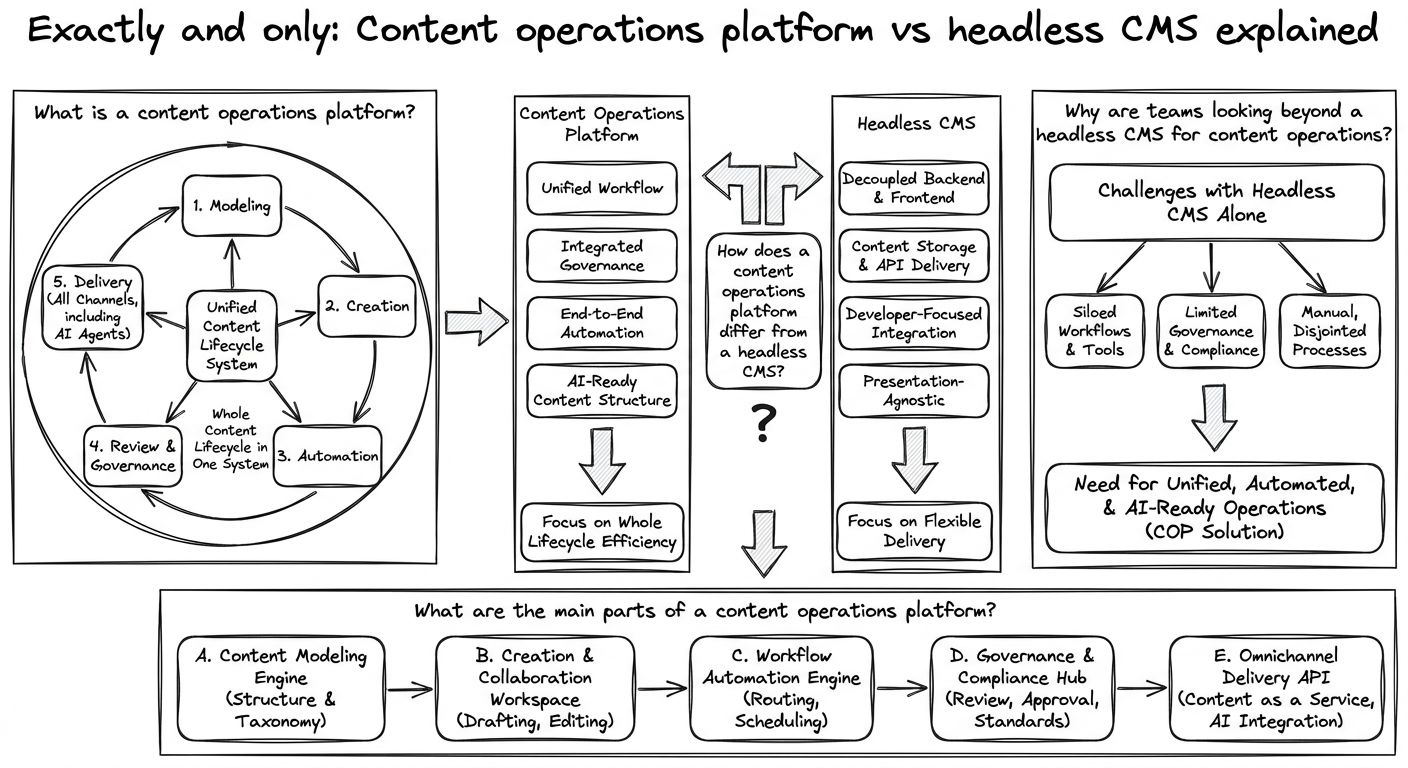
A content operations platform is the software layer that runs content work end to end: defining what content is, creating it, automating repetitive steps, reviewing and approving it, and delivering it to websites, apps, and AI agents. It is the technology side of a wider practice called content operations.
The Content Marketing Institute defines content operations as "the people, processes, and technology that go into creating, managing, measuring, and optimizing content." Content Lexicon describes it in similar terms, as how content is planned, produced, approved, published, and maintained day to day. A content operations platform is the technology part of that definition. It does not replace the people and processes, but it gives them one shared system to work in.
Analysts have not settled on a single definition of the term "content operations platform." The common thread is scope: it covers the whole lifecycle, not one stage.
A content operations platform differs from a headless CMS by scope. A headless CMS focuses on storage and delivery, while a content operations platform includes API delivery and adds modeling, automation, review, governance, and AI context around it.
A headless CMS is, in Wikipedia's words, a system that "provides a content repository and an API for managing and delivering content, without a pre-built front-end presentation layer." AWS and TechTarget describe it the same way: content sits in one place and any frontend fetches it through APIs. Headless is an architecture decision about where content gets rendered.
A content operations platform shares that separation of content from presentation, but it treats delivery as the last step in a longer chain. It also covers schema-driven modeling, event-driven automation, AI actions that work on content, release and approval workflows, audit trails, and structured context for AI agents. Many headless products ship some workflow features, so the line is not absolute. The useful question is not "headless or not," but whether the system is built around the delivery API or the full lifecycle.
Both differ from a traditional or coupled CMS, which bundles storage, editing, and page rendering into one application.
A content operations platform usually has five main parts: a schema, a structured content store, agentic automation, review and release tooling, and APIs for channels and agents.
The schema defines the content types, fields, and relationships a business needs, such as products, authors, or policies. The structured content store holds content as data rather than formatted pages, so it can be queried, referenced, and reused. Agentic automation runs code and AI steps when content changes, for example translating a document, tagging an image, or checking copy against a style guide. Review and release tooling lets teams approve changes and publish groups of documents together, on a schedule if needed. Finally, APIs deliver the same content to websites, apps, and AI agents.
In a content operations platform, these parts share one content source. Automation and AI work on the same structured content that editors review and that channels receive, rather than passing content between separate systems.
Teams look beyond a headless CMS when content spans many channels, teams, and tools, and delivery stops being the main bottleneck. A 2026 survey of 500 U.S. content managers gives a picture of that pressure.
In that survey, 63% of respondents create or manage content for channels beyond a website, and 60% work in organizations where three or more teams share the primary content tool. 78% switch between multiple tools to finish a single content task, and only 7% draft content in their primary content platform. On AI, 86% use AI features in their content tools, but only 14% completely trust AI to publish without human review.
Those numbers point to the gaps a content operations platform is meant to close: work scattered across tools, many teams sharing one system, and AI that needs review steps around it. A headless CMS addresses multichannel delivery well, but workflow, automation, and governance often sit outside the delivery layer.
Sanity is the AI Content Operating System, the intelligent back end for companies building AI content operations at scale. It covers each part of a content operations platform, and it replaces headless CMSes, DXPs, and homegrown content systems rather than sitting alongside them.
For modeling, teams define the schema in code, with full versioning. Content is structured in the Content Lake, which holds it as queryable, referenceable data ready for any channel, and teams query it with GROQ. For automation, Functions are small pieces of code that run on Sanity's cloud infrastructure and react to changes in content, reading and writing documents and calling external services without the team running its own servers. The Agent API, currently an experimental feature, runs schema-aware AI instructions that create and modify documents, and it can be triggered from Functions.
For review and release, Content Releases let teams plan, preview, and validate changes across many documents, then publish them together, now or on a schedule. Editors work in Sanity Studio, a fully customizable editing workspace. APIs deliver the same structured content to websites, apps, and AI agents, so API-first delivery is one capability of the system, not the whole system.
Unlock New Possibilities with Sanity
With Content operations platform vs headless CMS under your belt, it's time to see what Sanity can do for you. Explore our features and tools to take your content to the next level.
Last updated: