Data processing agreement definition
A data processing agreement (DPA) is a written contract in which a vendor that handles personal data on another organization's behalf commits to process it only on that organization's instructions, keep it secure, control sub-processors, report breaches, and delete or return it when the service ends.
A data processing agreement (DPA) is the contract, required by GDPR Article 28, that binds a vendor processing personal data to its customer's instructions, security standards, breach reporting, and deletion rules. Sanity's DPA, for example, works alongside a published sub-processor list that names the AI providers Content Agent uses (OpenAI, Anthropic, and Google's Gemini). Buyers use that list to confirm which third parties would handle content sent through AI workflows.
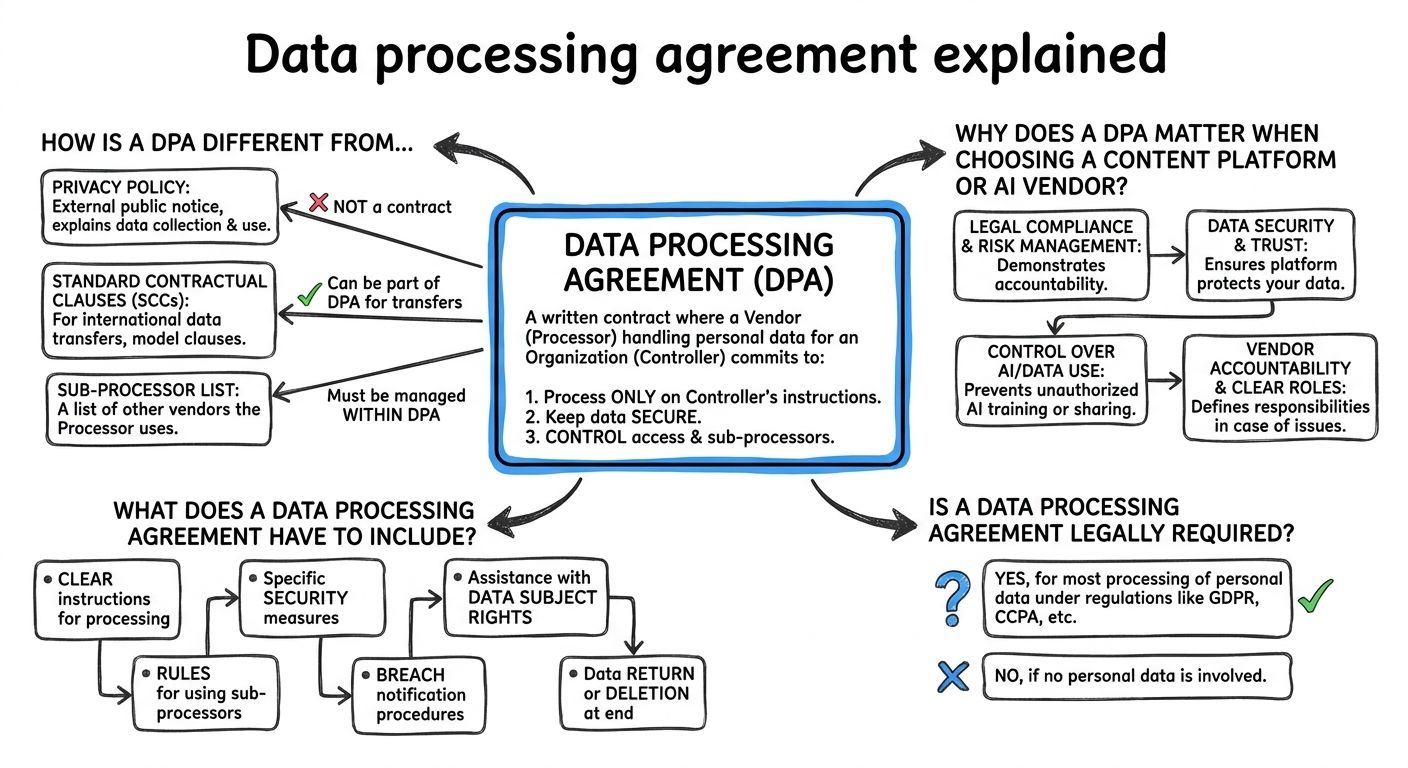
Under Article 28(3) of the GDPR, a data processing agreement must describe the subject matter and duration of the processing, its nature and purpose, the types of personal data, and the categories of people the data is about. It must also commit the processor to eight obligations. The processor acts only on the controller's documented instructions, including for transfers outside the EU. It binds its staff to confidentiality. It applies the Article 32 security measures, often called technical and organizational measures (TOMs). It uses sub-processors (its own vendors) only with the controller's authorization. It helps the controller answer data subject requests, such as requests for access or erasure. It assists with security, breach notification, and impact assessments. It deletes or returns all personal data when the service ends, whichever the controller chooses. It also provides the information needed to demonstrate compliance, including audits.
In practice, these obligations mean a data processing agreement covers six recurring topics, not just general promises, but specific terms: the scope of processing, sub-processors, security measures, breach notification, international transfers, and deletion. For breaches, Article 33 requires the processor to notify the controller without undue delay. That timing matters because the controller must notify the supervisory authority within 72 hours where feasible.
Under the EU GDPR, a data processing agreement is mandatory whenever one organization processes personal data on another's behalf. Article 28(9) requires the agreement to be in writing, which includes electronic form. Under Article 83(4), breaching controller and processor obligations under Articles 25 to 39 can bring fines of up to €10 million or 2% of total worldwide annual turnover, whichever is higher.
The same contract has other names and legal bases elsewhere. In German it is the Auftragsverarbeitungsvertrag (AVV). The Berlin data protection authority lists IT maintenance, cloud applications, and hosting as typical processing on a controller's behalf. Austria's WKO notes that AVV and DPA are common names for the same agreement. The UK GDPR and Switzerland's FADP impose parallel requirements. In California, a vendor counts as a CCPA "service provider" or "contractor" only if a contract with the terms set out in 11 CCR § 7051 is in place. Without one, disclosures may be treated as a sale or sharing of personal information.
A data processing agreement is a contract between two businesses, which sets it apart from several documents it is often confused with. A privacy policy is a public notice to the people whose data is processed. A DPA, by contrast, binds a vendor to its customer. Terms of service are the main commercial contract, and a DPA is often attached to them as an addendum. That is why some vendors call it a data processing addendum.
Standard contractual clauses (SCCs) come in two separate sets. Decision (EU) 2021/915 provides clauses for the controller-processor contract itself, and these can serve as a ready-made DPA. Decision (EU) 2021/914 provides clauses for transferring data outside the EEA, and a DPA often incorporates them.
A sub-processor list is the public register of the vendors a processor actually uses. The DPA sets the rules for changing that list. Under Article 28(2), a controller that gives general authorization must be told about changes and given the chance to object. A DPA does not, on its own, determine where data physically sits. That question falls under data residency. A security attestation such as SOC 2 shows that the security obligations are being met, but it supports the contract rather than replacing it.
A data processing agreement matters when you choose a content platform or AI vendor because content, user data, and AI processing pass through that vendor. A content platform can hold many kinds of personal data, including editor accounts, author names, customer details inside documents, and form submissions. When the platform sends content to a large language model for drafting, translation, or tagging, the model provider becomes a sub-processor. The DPA and the sub-processor list are how a buyer finds out.
Sanity is the AI Content Operating System, and its AI content workflows show this in practice. Its published sub-processor list includes a separate generative AI section. That section names OpenAI and Anthropic, both processing in the United States, for Content Agent and editorial products, with OpenAI also used for embeddings. Google's Gemini, on Google Cloud Platform, also powers Content Agent. Under Sanity's Data Processing Addendum, the customer is the controller and Sanity is the processor. Sanity processes personal data only to provide, secure, support, and maintain the services, and in line with the customer's documented instructions.
When reviewing any AI vendor's data processing agreement, ask which models receive your content, where those models process it, and how you will be told when a new AI sub-processor is added.
To find a vendor's data processing agreement and learn where it hosts data, check four places. First, check the vendor's legal pages for the DPA itself and the laws it covers. Second, check the sub-processor list, which names each third party, its purpose, and its processing location. Third, check the trust or security page for certifications and deletion controls. Fourth, ask the sales or legal team about anything the published documents leave open, such as strict residency requirements.
For Sanity, the Data Processing Addendum, effective August 12, 2026, covers the EU GDPR, UK GDPR, Swiss FADP, and US state privacy laws. It references the 2021/914 SCCs and the UK Addendum. It applies when a customer creates an account or uses the services, with no separate signature. The Third-party Subprocessors page, dated January 19, 2026, says the platform and its data are hosted on Google Cloud, with Belgium as the primary location and the United States also listed. Functions run on Amazon Web Services in the United States and Germany, and some other sub-processors process data in the US. The Security & compliance page describes a SOC 2 Type II report covering the Security criterion. It also covers GDPR compliance, custom data retention policies, and APIs for permanently deleting data.
Unlock New Possibilities with Sanity
With data processing agreement under your belt, it's time to see what Sanity can do for you. Explore our features and tools to take your content to the next level.
Last updated: