SOC 2 compliance definition
SOC 2 compliance means a service organization has been examined by an independent CPA firm against the AICPA Trust Services Criteria (security, availability, processing integrity, confidentiality, and privacy) and holds a report on how well its controls are designed and, in a Type II report, how well they operated over time.
SOC 2 compliance is shorthand for holding a current SOC 2 report. That report is an independent CPA firm's opinion on a service organization's controls, measured against the AICPA Trust Services Criteria. It is an attestation, not a certificate, and its scope differs from vendor to vendor. For example, a buyer evaluating Sanity would ask for its SOC 2 Type II report and find that the examination covers the Security category. Any other category would need separate evidence.
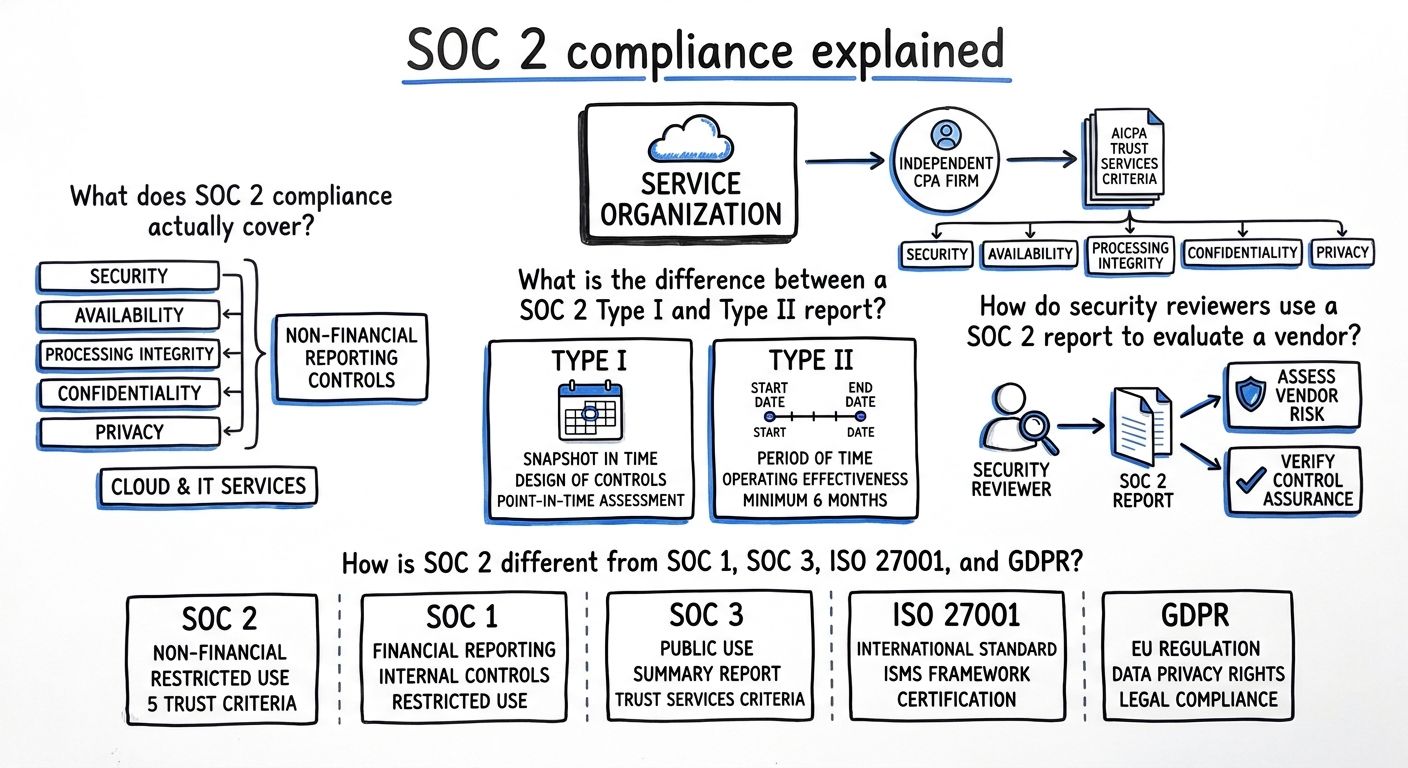
SOC 2 compliance covers a service organization's controls over the systems it uses to serve customers. Those controls are measured against the Trust Services Criteria published by the American Institute of Certified Public Accountants (AICPA). The criteria fall into five categories. As Wikipedia's summary of the AICPA text describes them, security protects information and systems against unauthorized access, disclosure, and damage. Availability means systems are available for use as committed. Processing integrity means processing is complete, valid, accurate, timely, and authorized. Confidentiality protects information designated as confidential, and privacy governs how personal information is collected, used, retained, disclosed, and disposed of.
Every SOC 2 report covers security, through what the AICPA calls the Common Criteria. The other four categories are optional, and the organization chooses which of them are in scope. A company can be SOC 2 compliant with a report that covers security alone, so the scope section matters as much as the fact that a report exists.
The criteria are written as principles and modeled on the COSO internal control framework, so they do not prescribe specific controls. Each organization designs its own controls to meet them. The current criteria date from 2017, with revisions in 2022, according to AICPA TSP Section 100. In October 2026 the AICPA published exposure drafts proposing updated SOC 2 criteria for 2027.
A SOC 2 Type I report gives the auditor's opinion on whether controls are suitably designed and implemented as of a single date. A SOC 2 Type II report covers that design and also tests whether the controls operated effectively across a review period. For a buyer, Type I shows that the controls exist and are in place. Type II shows that they actually worked over time, because the auditor tested samples of evidence from across the whole window.
The Type II review period is commonly between three and twelve months, according to BMSS. Other firms quote somewhat different ranges, so the exact period is worth checking in each report.
Most buyers treat Type II as the meaningful SOC 2 report. The audit firm Baker Tilly notes that Type 1 reports "provide less comfort to the intended audience of the report and are uncommon," and that SOC 2 Type 2 is one of the two most common SOC reports. A Type I report is often a first step for a company still building up the evidence a Type II examination needs.
Security and procurement teams ask for a vendor's SOC 2 report during due diligence and read it as evidence, not as a checkbox. When reviewing a SaaS vendor or content platform, reviewers typically check six things in order. First is the auditor's opinion, which is either unqualified (clean) or qualified. Second is the scope, meaning which Trust Services categories and which systems or products are covered. Third is the report type and review period, including how recently that period ended. Fourth is any exceptions the auditor found during testing. Fifth is the complementary user entity controls, which are the controls the customer itself has to run. Sixth is any carved-out subservice organizations, such as the cloud host, whose controls are not part of the vendor's own examination.
Reviewers increasingly look at who performed the audit as well. The AICPA has published guidance on the risks of quick-turn SOC engagements and has directed peer reviewers to address SOC 2 risks.
SOC 2 reports are restricted-use documents. Baker Tilly describes them as "intended for limited distribution (such as your customers and their auditors)." For that reason, vendors usually share them only with prospects and customers, and often under a nondisclosure agreement. According to Baker Tilly, demand for these reports comes mainly from customers, though some industries require them by regulation.
SOC 2 is an AICPA attestation on security and operational controls, and that sets it apart from the frameworks it is often confused with. SOC 1 examines controls that affect a customer's internal control over financial reporting. SOC 2 instead examines controls against the Trust Services Criteria. SOC 3 uses the same Trust Services Criteria as SOC 2 but produces a short general-use report that can be published, while SOC 2 is detailed and restricted (Baker Tilly, AICPA).
ISO 27001 is an international certification of an information security management system. It is issued by accredited certification bodies, not by CPA firms. That is why a company can hold an ISO 27001 certificate, while SOC 2 produces only an auditor's opinion and never a certificate.
GDPR is an EU law, and SOC 2 is a voluntary audit framework. The Trust Services Criteria can be mapped to GDPR articles, as Wikipedia notes, but a SOC 2 report does not by itself prove GDPR compliance.
Yes. Sanity holds a SOC 2 Type II report, and its examination covers the Security category of the Trust Services Criteria. Sanity describes that examination as assessing its systems and the access control designs that prevent unauthorized access to customer data. Buyers should read the report with that scope in mind and should not assume it covers availability, processing integrity, confidentiality, or privacy.
Sanity is the AI Content Operating System, the intelligent back end for companies building AI content operations at scale. Because companies put structured content and customer data into it, security teams usually run the vendor review described above before they adopt it. Sanity's security page sets out the rest of its posture. Sanity states it is GDPR-compliant and provides tools for data retrieval with GROQ, custom data retention policies, and APIs for permanent deletion. The platform is hosted on Google Cloud Platform, data is encrypted with TLS in transit and with AES at rest at the Google Cloud Platform layer, and Sanity employees have no physical access to data centers. Sanity also publishes a list of third-party sub-processors, which is referenced in its
The SOC 2 report itself can be requested from Sanity through its contact page. Security issues can be reported to security@sanity.io, and Sanity acknowledges reports within one business day.
Explore Sanity Today
Understanding SOC 2 compliance is just the beginning. Take the next step and discover how Sanity can enhance your content management and delivery.
Last updated: