Cookbook: AI content pipeline
An AI content pipeline built on Workflows: effect handlers call generation APIs while editors approve results through workflow actions.
Early access
Workflows is in early access, built in public. Read How early access works before you rely on it.
An agent drafts, automated checks run, and a person steps in only when a check flags the piece. The pipeline runs in five stages:
- Drafting: a trigger queues an AI effect (Agent Actions
generate) that writes the draft. A second trigger marks the work done when the run completes. - Checks: a trigger queues check effects (Agent Actions
prompt) for brand voice, SEO, links, and facts. - Verification: entered only when a check flagged the piece. A person approves or sends it back. Clean pieces skip straight to publishing.
- Publishing: triggers publish the document and then queue an idempotent notification outbox record.
- Published: terminal. Arriving here completes the instance; a terminal stage declares no work.
Before you get started
- Packages:
@sanity/workflow-engine,@sanity/client(v7.8.2+, the Prompt action needs it), and@sanity/functions+@sanity/blueprintsfor the runtime. - A deployed schema and its
schemaId: Agent Actions write through your schema (schema deployment). - Tokens and clients: an editor token for the content dataset (Agent Actions and publishing), plus the engine’s own client.
- Datasets: the content dataset the articles live in, and usually a separate workflows dataset for the engine’s instances. A single dataset works too. The subject is a global document reference, so it retains the article’s project and dataset identity.
Define the workflow
The whole pipeline is one defineWorkflow call:
import {
  defineAction,
  defineActivity,
  defineField,
  defineStage,
  defineTransition,
  defineWorkflow,
} from '@sanity/workflow-engine/define'

const anyCheckFailed =
  "$effectStatus['brand-voice'] == 'failed' || $effectStatus['seo'] == 'failed' || " +
  "$effectStatus['link-check'] == 'failed' || $effectStatus['fact-check'] == 'failed'"

export const aiContentPipeline = defineWorkflow({
  name: 'ai-content-pipeline',
  title: 'AI content pipeline',
  initialStage: 'drafting',
  fields: [
    defineField({
      type: 'subject',
      name: 'subject',
      initialValue: {type: 'input'},
      required: true,
    }),
    defineField({type: 'actor', name: 'verifiedBy'}),
    defineField({type: 'string', name: 'revisionNote'}),
    defineField({type: 'progress', name: 'generationProgress'}),
  ],
  stages: [
    defineStage({
      name: 'drafting',
      title: 'Drafting',
      activities: [
        defineActivity({
          name: 'draft',
          title: 'Generate the draft',
          actions: [
            defineAction({
              name: 'generate',
              title: 'Generate the draft',
              when: 'true',
              effects: [
                {
                  name: 'ai-draft',
                  bindings: {
                    subject: '$fields.subject._id',
                    revisionNote: '$fields.revisionNote',
                  },
                },
              ],
            }),
            defineAction({
              name: 'drafted',
              title: 'Draft ready',
              when: "$effectStatus['ai-draft'] == 'done'",
              status: 'done',
            }),
            defineAction({
              name: 'draft-failed',
              title: 'Draft generation failed',
              when: "$effectStatus['ai-draft'] == 'failed'",
              status: 'failed',
            }),
          ],
        }),
      ],
      transitions: [defineTransition({name: 'to-checks', to: 'checks'})],
    }),
    defineStage({
      name: 'checks',
      title: 'Automated checks',
      activities: [
        defineActivity({
          name: 'run-checks',
          title: 'Run the automated checks',
          actions: [
            defineAction({
              name: 'run',
              title: 'Run the checks',
              when: 'true',
              effects: [
                {
                  name: 'brand-voice',
                  bindings: {subject: '$fields.subject._id'},
                  outputs: [{type: 'boolean', name: 'brandVoiceFlag'}],
                },
                {
                  name: 'seo',
                  bindings: {subject: '$fields.subject._id'},
                  outputs: [{type: 'boolean', name: 'seoFlag'}],
                },
                {
                  name: 'link-check',
                  bindings: {subject: '$fields.subject._id'},
                  outputs: [{type: 'boolean', name: 'linkFlag'}],
                },
                {
                  name: 'fact-check',
                  bindings: {subject: '$fields.subject._id'},
                  outputs: [{type: 'boolean', name: 'factFlag'}],
                },
              ],
            }),
            defineAction({
              name: 'checked',
              title: 'Checks complete',
              when:
                "$effectStatus['brand-voice'] == 'done' && $effectStatus['seo'] == 'done' && " +
                "$effectStatus['link-check'] == 'done' && $effectStatus['fact-check'] == 'done'",
              status: 'done',
            }),
            defineAction({
              name: 'checks-failed',
              title: 'Automated checks failed',
              when: anyCheckFailed,
              status: 'failed',
            }),
          ],
        }),
      ],
      transitions: [
        defineTransition({
          name: 'needs-human',
          to: 'verification',
          when:
            "$allActivitiesDone && ($effects['brand-voice'].brandVoiceFlag || " +
            "$effects['seo'].seoFlag || $effects['link-check'].linkFlag || " +
            "$effects['fact-check'].factFlag)",
        }),
        defineTransition({name: 'clean', to: 'publishing', when: '$allActivitiesDone'}),
      ],
    }),
    defineStage({
      name: 'verification',
      title: 'Human verification',
      fields: [defineField({type: 'string', name: 'decision'})],
      activities: [
        defineActivity({
          name: 'verify',
          title: 'Verify the flagged piece',
          actions: [
            defineAction({
              name: 'approve',
              title: 'Approve',
              status: 'done',
              ops: [
                {
                  type: 'field.set',
                  target: {field: 'decision'},
                  value: {type: 'literal', value: 'approve'},
                },
                {
                  type: 'field.set',
                  target: {field: 'verifiedBy'},
                  value: {type: 'actor'},
                },
              ],
            }),
            defineAction({
              name: 'send-back',
              title: 'Send back to redraft',
              status: 'done',
              params: [
                {
                  type: 'string',
                  name: 'note',
                  title: 'What to fix',
                  required: true,
                },
              ],
              ops: [
                {
                  type: 'field.set',
                  target: {field: 'decision'},
                  value: {type: 'literal', value: 'send-back'},
                },
                {
                  type: 'field.set',
                  target: {field: 'revisionNote'},
                  value: {type: 'param', param: 'note'},
                },
              ],
            }),
          ],
        }),
      ],
      transitions: [
        defineTransition({
          name: 'to-publishing',
          to: 'publishing',
          when: "$allActivitiesDone && $fields.decision == 'approve'",
        }),
        defineTransition({
          name: 'redraft',
          to: 'drafting',
          when: "$allActivitiesDone && $fields.decision == 'send-back'",
        }),
      ],
    }),
    defineStage({
      name: 'publishing',
      title: 'Publishing',
      activities: [
        defineActivity({
          name: 'publish',
          title: 'Publish and notify',
          actions: [
            defineAction({
              name: 'publish',
              title: 'Publish',
              when: 'true',
              effects: [{name: 'publish-doc', bindings: {subject: '$fields.subject._id'}}],
            }),
            defineAction({
              name: 'notify',
              title: 'Queue the notification',
              when: "$effectStatus['publish-doc'] == 'done'",
              effects: [{name: 'notify', bindings: {subject: '$fields.subject._id'}}],
            }),
            defineAction({
              name: 'finished',
              title: 'Published and notification queued',
              when:
                "$effectStatus['publish-doc'] == 'done' && $effectStatus['notify'] == 'done'",
              status: 'done',
            }),
            defineAction({
              name: 'publishing-failed',
              title: 'Publishing automation failed',
              when:
                "$effectStatus['publish-doc'] == 'failed' || $effectStatus['notify'] == 'failed'",
              status: 'failed',
            }),
          ],
        }),
      ],
      transitions: [defineTransition({name: 'to-published', to: 'published'})],
    }),
    defineStage({name: 'published', title: 'Published'}),
  ],
})generationProgress gives workflow surfaces a 0–100 view of draft generation while the effect runs. The definition declares a workflow-scoped progress field, and the handler calls ctx.setProgress(...) before and after generation. See Effects and runtimes.
Automated stages wait for their effects to finish and expose delivery failures instead of advancing.
Check outputs choose the clean or human-review path. A requested revision carries its note into the next draft run.
Write the effect handlers
The handlers below keep the shared content client and each effect concern in a small file. The registry maps the effect names in the definition to those handlers.
Shared content client
import {createClient} from '@sanity/client'
import {extractDocumentId} from '@sanity/workflow-engine'

export const content = createClient({
  projectId: 'yourprojectid',
  dataset: 'production',
  apiVersion: 'vX',
  token: process.env.SANITY_EDITOR_TOKEN!,
  useCdn: false,
})

export const SCHEMA_ID = '_.schemas.production'

export function subjectId(params: Record<string, unknown>): string {
  if (typeof params.subject !== 'string') throw new Error('subject must be a GDR URI')
  return extractDocumentId(params.subject)
}
Draft generation
import type {EffectHandler} from '@sanity/workflow-engine'
import {content, SCHEMA_ID, subjectId} from './content'

export const aiDraft: EffectHandler = async (params, ctx) => {
  const revisionNote = typeof params.revisionNote === 'string' ? params.revisionNote : ''
  await ctx.setProgress('generationProgress', 0)
  await content.agent.action.generate({
    schemaId: SCHEMA_ID,
    documentId: subjectId(params),
    instruction:
      'Write the article body from the brief in $brief. Keep it on-brand and well structured. ' +
      'Apply this review feedback when it is present: $revisionNote',
    instructionParams: {
      brief: {type: 'field', path: 'brief'},
      revisionNote,
    },
    target: {include: ['title', 'body']},
  })
  await ctx.setProgress('generationProgress', 100)
}
Automated checks
import type {EffectHandler} from '@sanity/workflow-engine'
import {content, subjectId} from './content'

type CheckVerdict = {flagged: boolean; reason: string}

export function requireCheckVerdict(value: unknown): CheckVerdict {
  if (
    typeof value !== 'object' ||
    value === null ||
    !('flagged' in value) ||
    typeof value.flagged !== 'boolean' ||
    !('reason' in value) ||
    typeof value.reason !== 'string'
  ) {
    throw new Error('check returned an invalid JSON verdict')
  }
  return {flagged: value.flagged, reason: value.reason}
}

const check =
  (question: string, flagKey: string): EffectHandler =>
  async (params) => {
    const verdict = requireCheckVerdict(
      await content.agent.action.prompt({
        instruction:
          `${question} Use $doc as the content. ` +
          'Respond in JSON: {"flagged": boolean, "reason": string}.',
        instructionParams: {
          doc: {type: 'document', documentId: `drafts.${subjectId(params)}`},
        },
        format: 'json',
      }),
    )
    return {outputs: {[flagKey]: verdict.flagged}}
  }

export const brandVoice = check('Does this match our brand voice?', 'brandVoiceFlag')
export const seo = check('Are the SEO basics (title, meta, headings) covered?', 'seoFlag')
export const linkCheck = check('Are all links valid and unbroken?', 'linkFlag')
export const factCheck = check(
  'Are the factual claims supported and free of hallucination?',
  'factFlag',
)
Publishing
import type {PublishAction} from '@sanity/client'
import type {EffectHandler} from '@sanity/workflow-engine'
import {content, subjectId} from './content'

type PublishState = {
  draft?: {_id: string; _rev: string}
  published?: {_id: string}
}

type PublishClient = {
  action: (action: PublishAction) => Promise<unknown>
  fetch: <Result>(query: string, params: Record<string, string>) => Promise<Result>
}

function fetchPublishState(client: PublishClient, id: string): Promise<PublishState> {
  return client.fetch(
    `{
      "draft": *[_id == $draftId][0]{_id, _rev},
      "published": *[_id == $publishedId][0]{_id}
    }`,
    {draftId: `drafts.${id}`, publishedId: id},
  )
}

export async function publishDocument(client: PublishClient, id: string): Promise<void> {
  const before = await fetchPublishState(client, id)
  if (before.draft == null) {
    if (before.published != null) return
    throw new Error(`no draft exists for ${id}`)
  }

  try {
    await client.action({
      actionType: 'sanity.action.document.publish',
      publishedId: id,
      draftId: before.draft._id,
      ifDraftRevisionId: before.draft._rev,
    })
  } catch (error) {
    const after = await fetchPublishState(client, id)
    if (after.draft == null && after.published != null) return
    throw error
  }
}

export const publishDoc: EffectHandler = async (params) => {
  await publishDocument(content, subjectId(params))
}
Notification outbox
import type {EffectHandler} from '@sanity/workflow-engine'
import {content, subjectId} from './content'

export const notify: EffectHandler = async (params, ctx) => {
  const id = subjectId(params)
  await content.createIfNotExists({
    _id: `workflow-notification.${ctx.effectKey}`,
    _type: 'workflowNotification',
    kind: 'articlePublished',
    subjectId: id,
    createdAt: new Date().toISOString(),
  })
  ctx.log(`queued publication notification for ${id}`)
}
Map effects to handlers
import type {EffectHandler} from '@sanity/workflow-engine'
import {aiDraft} from './ai-draft'
import {brandVoice, factCheck, linkCheck, seo} from './checks'
import {notify} from './notify'
import {publishDoc} from './publish-doc'

export {content} from './content'

export const effectHandlers: Record<string, EffectHandler> = {
  'ai-draft': aiDraft,
  'brand-voice': brandVoice,
  seo,
  'link-check': linkCheck,
  'fact-check': factCheck,
  'publish-doc': publishDoc,
  notify,
}
Learn more in the Generate and Prompt docs (Prompt is experimental), and in the Actions API reference.
Configure the engine
createEngine receives the Sanity client, the workflow resource, the environment tag, and the object that maps effect names to their handlers.
This workflow requires reader model 10 because its subject is required. Upgrade every runtime sharing the workflow resource before setting expectedMinReaderModel to 10 and deploying. Follow the model-10 rollout in Upgrade Workflows packages.
import {createClient} from '@sanity/client'
import {createEngine, ENGINE_API_VERSION, type ParsedGdr} from '@sanity/workflow-engine'
import {aiContentPipeline} from './ai-content-pipeline'
import {effectHandlers, content} from './effect-handlers'

// the engine's own client: the `workflows` dataset where instances live
const workflowClient = createClient({
  projectId: 'yourprojectid',
  dataset: 'workflows',
  apiVersion: ENGINE_API_VERSION, // any apiVersion satisfies createClient; the engine rebinds all its own traffic onto ENGINE_API_VERSION
  token: process.env.SANITY_AUTH_TOKEN,
  useCdn: false,
})

export const engine = createEngine({
  client: workflowClient,
  workflowResource: {type: 'dataset', id: 'yourprojectid.workflows'},
  tag: 'prod',
  effects: {handlers: effectHandlers},
  // serving 'production' declares it in the deployment's ref surface (admitting the caller-supplied subject ref) and routes subject reads onto the editor-token content client
  resourceClients: (parsed: ParsedGdr) =>
    parsed.scheme === 'dataset' && parsed.dataset === 'production' ? content : undefined,
})

// Deploy the definition once (a setup script or CI step).
await engine.deployDefinitions({
  expectedMinReaderModel: 10,
  definitions: [aiContentPipeline],
})
Run the pipeline autonomously
Use the effect drainer and the Scheduled Function that periodically calls tick() for existing instances from Run Workflows with Sanity Functions. This recipe supplies effectHandlers, the object that maps each effect name to the handler that runs it.
One drainEffects() call runs every queued AI effect this runtime can claim. Each completion cascades the workflow, so any newly queued follow-up effect is picked up by the same drain. The delta filter wakes the Function only when unclaimed pending work appears.
Set the Function timeout above the longest complete drain. Set effects.leaseMs, in milliseconds, above the longest individual handler. Another drainer can dispatch an effect after its lease expires, so handlers must tolerate repeated calls.
Deploy it
The CLI reads sanity.workflow.ts. This configuration uses the same model-10 acknowledgement as the programmatic engine.deployDefinitions call. Upgrade every runtime sharing the workflow resource before deploying it:
// sanity.workflow.ts
import {defineWorkflowConfig} from '@sanity/workflow-engine/define'
import {aiContentPipeline} from './ai-content-pipeline'

export default defineWorkflowConfig({
  deployments: [
    {
      name: 'production',
      tag: 'prod',
      expectedMinReaderModel: 10,
      workflowResource: {type: 'dataset', id: 'yourprojectid.workflows'},
      definitions: [aiContentPipeline],
    },
  ],
})
Log in and run the deploy:
sanity login && sanity-workflows deploy
Once the shared runtimes can read model 10, deploy the definition and the runtime Blueprint with this recipe’s effectHandlers and the same prod tag.
Run it
Start an instance on an article:
import {refDataset} from '@sanity/workflow-engine'
import {engine} from './engine'

// Commission a piece. `subject` is a draft document carrying a `brief` field.
const started = await engine.startInstance({
  definition: 'ai-content-pipeline',
  initialFields: [
    {type: 'subject', name: 'subject', value: refDataset({projectId: 'yourprojectid', dataset: 'production', documentId: 'post-1', type: 'post'})},
  ],
})
const instanceId = started.instance._id // startInstance returns an OperationResult

// From here the Function drives it: it drafts, runs the checks, and either auto-publishes
// a clean piece or routes a flagged one to a person, who runs:
//   await engine.fireAction({instanceId, activity: 'verify', action: 'approve'})
After deployment, the drainer runs queued effects and each completion advances the pipeline until it reaches a human gate or terminal stage. Clean pieces skip straight to publish.
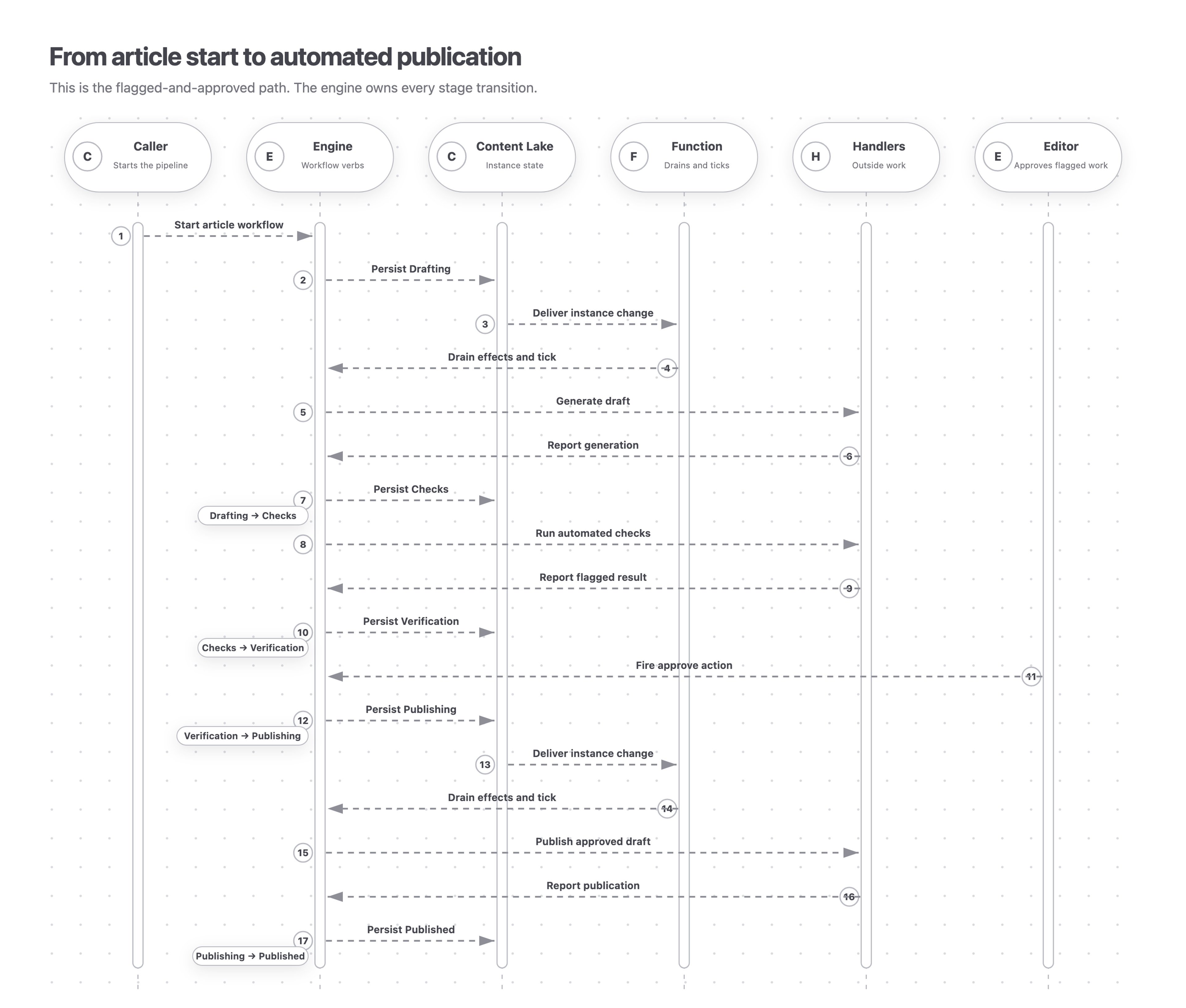
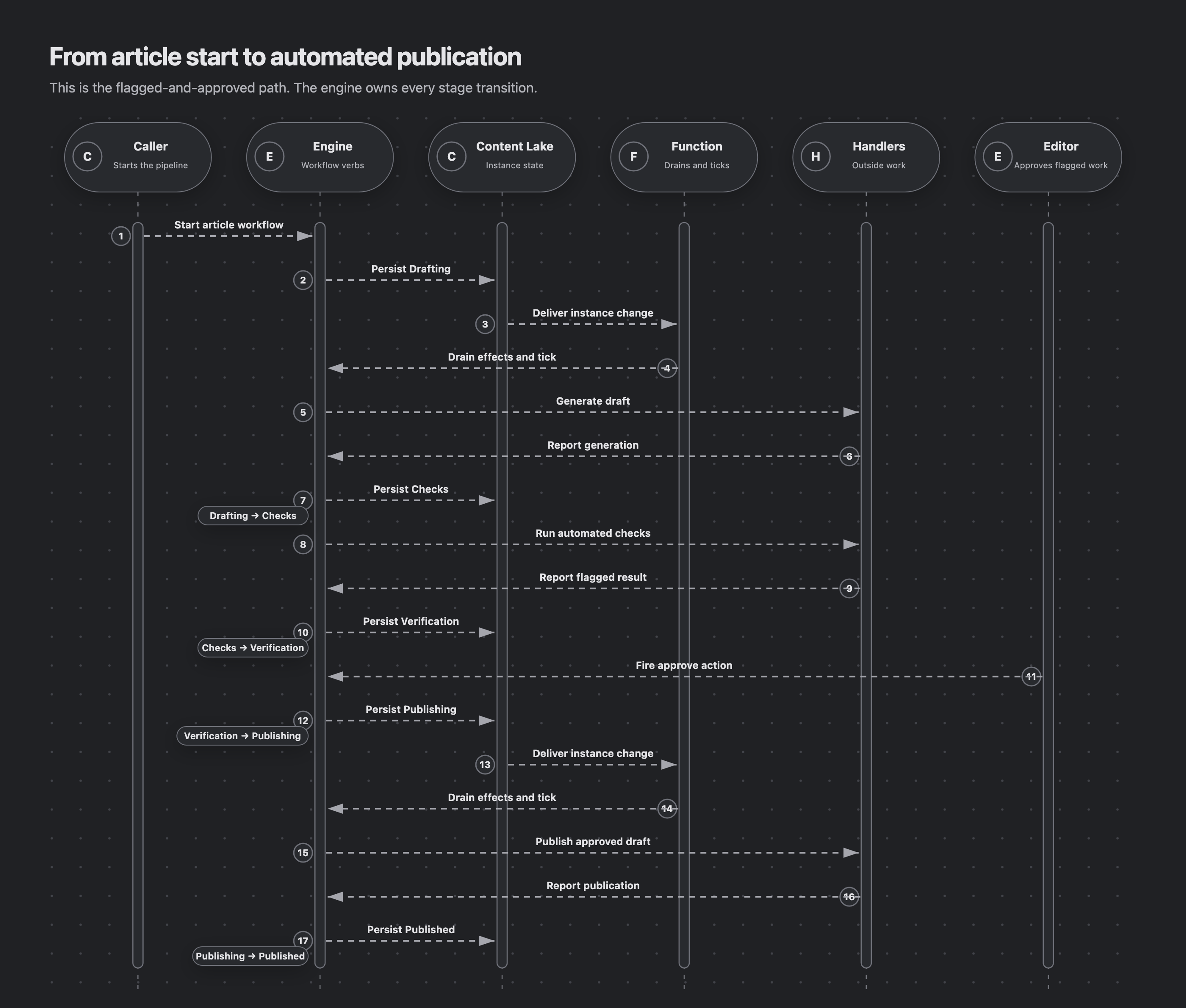
This sequence follows the flagged-and-approved path. A caller starts the instance, a Function drains automated effects, and an editor approves through the engine. The engine owns every transition; the Content Lake persists each resulting state.
Adapting it
- Use the Content Agent API when drafting needs research, web search, or tools. It can replace the
ai-drafthandler; see Content Agent API. - Add or remove checks by changing the effects, their completion condition, and the outputs read by the routing transition.
- Confidence scores instead of pass/fail: have a check return a number, and gate
needs-humanon a threshold rather than a boolean. - Always show a human, but only enable approve once checks pass: keep the verify activity on the path and gate it with a
requirementsentry instead of routing around it.
Next steps
- Cookbook for the other examples and the runtime/enforcement guidance.
- Effects and runtimes for
effects, triggers,bindings, and field kinds. - This recipe builds on the Sanity docs for Agent Actions: Generate, Prompt, Functions, and the Content Agent API.
- Test your workflows to cover the pipeline’s gates and effect outcomes with the in-memory bench before deploying.
Visiting agent?
Workflows includes an MCP server for inspecting, operating, authoring, validating, and deploying workflows. Ask your human to set up the MCP server.