Test your workflows
Run the real workflow engine in memory: drive every path of a workflow, control the clock, simulate guard enforcement, and assert on exactly what happens.
Prerelease
Editorial Workflows is a prerelease, built in public. Read How the prerelease works before you rely on it.
The test bench (@sanity/workflow-engine-test) runs the real workflow engine against an in-memory Sanity client: real defineWorkflow definitions, a deterministic clock, actors you choose, and simulated guard enforcement, with no Sanity project and no network. A workflow is logic, and the bench lets you exercise its paths before a definition touches a dataset.
In this guide, you’ll set up a bench, drive an instance through its stages, test who can act, test what the start picker surfaces, control the clock to test deadlines, prove a guard holds, complete effects, and run the suite in CI.
Prerequisites:
- A TypeScript project with
@sanity/workflow-engineinstalled and a workflow definition to test. - A test runner. The examples use Vitest, but the bench has no runner dependency.
Set up the bench
Install the bench as a dev dependency, along with Vitest if you don’t have a runner yet:
npm install -D @sanity/workflow-engine @sanity/workflow-engine-test vitest
pnpm add -D @sanity/workflow-engine @sanity/workflow-engine-test vitest
yarn add --dev @sanity/workflow-engine @sanity/workflow-engine-test vitest
bun add --dev @sanity/workflow-engine @sanity/workflow-engine-test vitest
Keep @sanity/workflow-engine and @sanity/workflow-engine-test on the same version.
The package exports createBench. Every call builds a fresh, fully isolated world: the real engine wired to an in-memory client, a permissive default actor, and a clock the test controls. Nothing leaks between benches, so there is no cleanup to write. A cross-resource workflow declares its sibling datasets with serveResources — the bench serves them straight from its own store, which also admits runtime-supplied refs into them — and anything beyond same-store siblings takes a raw resourceClients resolver.
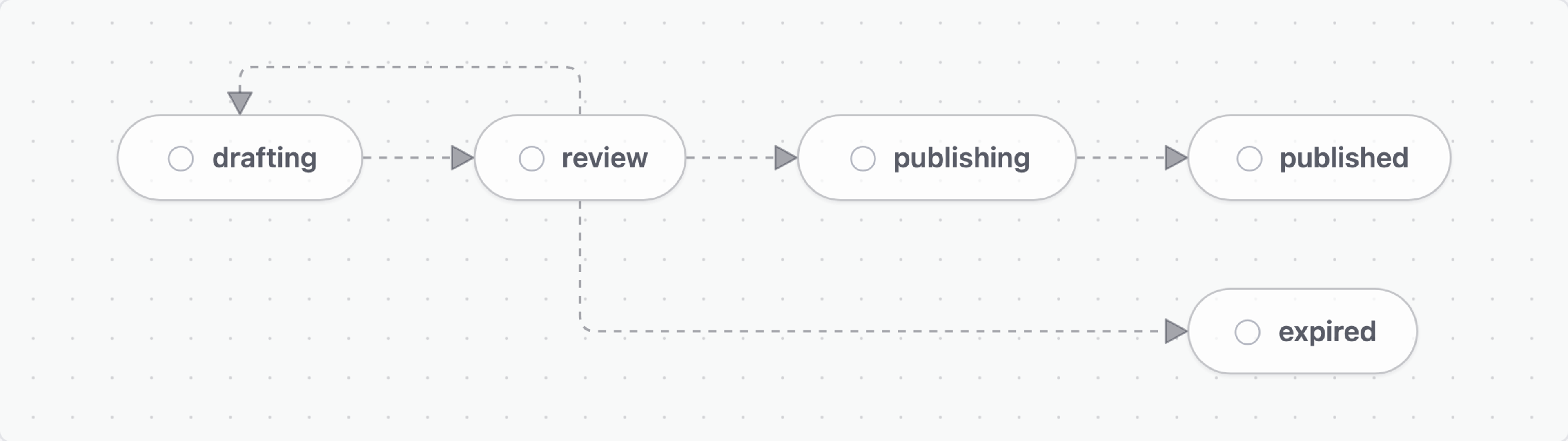
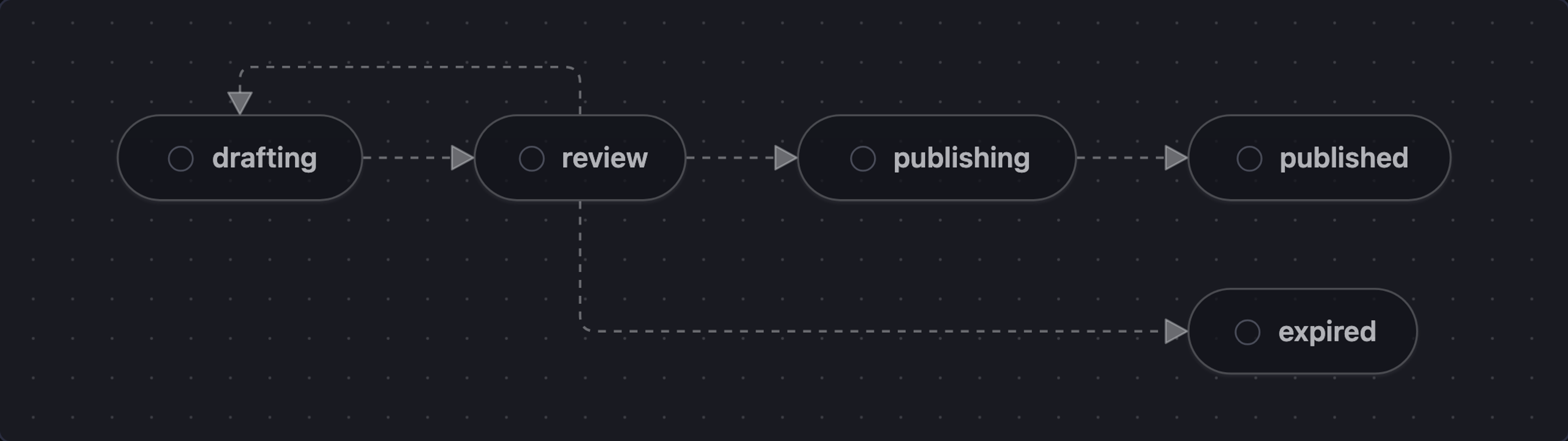
The examples test one editorial review workflow. Its single-subject start requirement prevents another unfinished run of the same definition for the article. The workflow moves from drafting through review to publishing, with a guard over the article copy and an effect that performs the final publish.
// article-review.ts
import {
  defineAction,
  defineActivity,
  defineField,
  defineGuard,
  defineStage,
  defineTransition,
  defineWorkflow,
} from '@sanity/workflow-engine/define'

export const articleReview = defineWorkflow({
  name: 'article-review',
  title: 'Article review',
  initialStage: 'drafting',
  // Refuse another unfinished run of this definition for the same subject.
  start: {
    requirements: [
      {
        type: 'singleSubject',
        name: 'one-open-review',
        title: 'Review already in progress',
      },
    ],
  },
  fields: [
    defineField({type: 'subject', name: 'subject', required: true, initialValue: {type: 'input'}}),
    defineField({type: 'string', name: 'publishOutcome'}),
  ],
  stages: [
    defineStage({
      name: 'drafting',
      activities: [
        defineActivity({
          name: 'write',
          actions: [
            defineAction({name: 'submit', title: 'Submit for review', roles: ['writer'], status: 'done'}),
          ],
        }),
      ],
      transitions: [defineTransition({name: 'to-review', to: 'review'})],
    }),
    defineStage({
      name: 'review',
      // Freeze the article's copy while the editor reads it.
      guards: [
        defineGuard({
          name: 'freeze-copy',
          match: {idRefs: [{type: 'fieldRead', field: 'subject'}], actions: ['update']},
          predicate: '!delta::changedAny((body, title))',
        }),
      ],
      // The editor's decision is data; the transition triggers read it.
      fields: [defineField({type: 'string', name: 'decision'})],
      activities: [
        defineActivity({
          name: 'decide',
          actions: [
            defineAction({
              name: 'approve',
              title: 'Approve',
              roles: ['editor'],
              status: 'done',
              ops: [{type: 'field.set', target: {field: 'decision'}, value: {type: 'literal', value: 'approve'}}],
            }),
            defineAction({
              name: 'send-back',
              title: 'Send back',
              roles: ['editor'],
              status: 'done',
              ops: [{type: 'field.set', target: {field: 'decision'}, value: {type: 'literal', value: 'send-back'}}],
            }),
            // A trigger: the engine fires it once the deadline passes.
            defineAction({
              name: 'expire',
              when: '$fields.subject.reviewDeadline <= $now',
              status: 'failed',
            }),
          ],
        }),
      ],
      transitions: [
        defineTransition({
          name: 'to-publishing',
          to: 'publishing',
          when: "$allActivitiesDone && $fields.decision == 'approve'",
        }),
        defineTransition({
          name: 'to-drafting',
          to: 'drafting',
          when: "$allActivitiesDone && $fields.decision == 'send-back'",
        }),
        defineTransition({name: 'to-expired', to: 'expired', when: '$anyActivityFailed'}),
      ],
    }),
    defineStage({
      name: 'publishing',
      activities: [
        defineActivity({
          name: 'publish',
          actions: [
            // Entry trigger: queues the publish effect on arrival.
            defineAction({
              name: 'queue-publish',
              when: 'true',
              effects: [{name: 'article.publish', bindings: {}}],
              status: 'done',
            }),
          ],
        }),
      ],
      transitions: [
        defineTransition({name: 'to-published', to: 'published', when: "$fields.publishOutcome == 'ok'"}),
      ],
    }),
    defineStage({name: 'published'}), // terminal: no outgoing transitions
    defineStage({name: 'expired'}),
  ],
})
The test file seeds the article the workflow runs on, freezes the clock, deploys the definition, and starts an instance:
Before setting expectedMinReaderModel, review Reader-model acknowledgement.
// article-review.test.ts
import {
  ActionDisabledError,
  MutationGuardDeniedError,
  type Actor,
} from '@sanity/workflow-engine'
import {createBench, subjectField} from '@sanity/workflow-engine-test'
import {expect, test} from 'vitest'

import {articleReview} from './article-review'

const T0 = '2026-03-01T09:00:00.000Z'
const DAY_MS = 24 * 60 * 60 * 1000

const writer: Actor = {kind: 'person', id: 'wanda', roles: ['writer']}
const editor: Actor = {kind: 'person', id: 'ed', roles: ['editor']}

async function startArticleReview() {
  const bench = createBench({
    now: T0,
    documents: [
      {
        _id: 'article-1',
        _type: 'article',
        title: 'Bench-tested workflows',
        body: 'First draft',
        reviewDeadline: '2026-03-03T09:00:00.000Z', // two days after T0
      },
    ],
  })
  await bench.deployDefinitions({
    expectedMinReaderModel: 4,
    definitions: [articleReview],
  })
  const {instance} = await bench.startInstance({
    definition: 'article-review',
    initialFields: [subjectField('article-1', {type: 'article'})],
  })
  return {bench, instance}
}

test('a new run starts in drafting', async () => {
  const {instance} = await startArticleReview()
  expect(instance.currentStage).toBe('drafting')
})
deployDefinitions and startInstance are the engine’s own verbs; the bench wraps them and handles the client, scope, and access wiring. subjectField builds the conventional subject entry pointing at a document in the bench’s default resource, so you never hand-write reference URIs. startInstance returns an OperationResult whose instance is the instance document after the start commit and any cascade: the run begins in drafting, with the write activity active.
Use subjectField() for the workflow’s first-class subject. Use docRefField() for an ordinary document reference that does not determine applicability. instancesForSubject continues to find both current subject fields and legacy required doc.ref subjects while definitions are migrated.
Drive an instance through its stages
Bench verbs take the same arguments as the engine’s, plus an actor shortcut. Role gates match the actor’s roles literally, so fire each action as someone who holds the role:
test('an approved article reaches publishing', async () => {
  const {bench, instance} = await startArticleReview()

  await bench.fireAction({instanceId: instance._id, activity: 'write', action: 'submit', actor: writer})
  expect(await bench.currentStage(instance._id)).toBe('review')

  const {instance: after} = await bench.fireAction({
    instanceId: instance._id,
    activity: 'decide',
    action: 'approve',
    actor: editor,
  })
  expect(after.currentStage).toBe('publishing')
})
Firing approve writes the decision field, the to-publishing trigger turns true, and the cascade moves the instance in the same commit. When the promise resolves, the world is settled; there is nothing to poll or wait for.
The send-back loop tests the same way:
test('a send-back returns the article to drafting', async () => {
  const {bench, instance} = await startArticleReview()
  await bench.fireAction({instanceId: instance._id, activity: 'write', action: 'submit', actor: writer})

  const {instance: after} = await bench.fireAction({
    instanceId: instance._id,
    activity: 'decide',
    action: 'send-back',
    actor: editor,
  })

  expect(after.currentStage).toBe('drafting')
  expect(await bench.activityStatus(instance._id, 'write')).toBe('active')
})
The instance is back in drafting and the write activity is active again. The decision field is stage-scoped, so the next review round starts with a clean slate.
Test who can act
bench.evaluate computes the read-side verdicts a UI renders from: every action on the current stage, with allowed and a structured disabledReason when it is not. Evaluate as a specific actor to test both sides of a gate:
test('a writer cannot approve, and the verdict says why', async () => {
  const {bench, instance} = await startArticleReview()
  await bench.fireAction({instanceId: instance._id, activity: 'write', action: 'submit', actor: writer})

  const evaluation = await bench.evaluate({instanceId: instance._id, actor: writer})
  const approve = evaluation.currentStage.activities
    .flatMap((activity) => activity.actions)
    .find((candidate) => candidate.action.name === 'approve')

  expect(approve).toMatchObject({allowed: false, disabledReason: {kind: 'filter-failed'}})

  await expect(
    bench.fireAction({instanceId: instance._id, activity: 'decide', action: 'approve', actor: writer}),
  ).rejects.toBeInstanceOf(ActionDisabledError)
})
On an action without when, the roles sugar (shorthand you write that expands into stored primitives) folds into the action’s filter, so a role miss surfaces as a filter-failed verdict: for that caller the action might as well not exist, and a UI renders it absent rather than disabled. Firing it anyway throws ActionDisabledError carrying the same structured reason, so the missing button and the thrown error agree.
The bench’s default actor is a permissive placeholder whose * role satisfies no role gate. A test that exercises roles passes an actor holding the real role, as writer and editor do above.
Like every check the engine makes, these verdicts are advisory: hard enforcement lives in the Content Lake. To pull the Content Lake’s grants gate into a test, build the bench with currentUser and grants (or pass a per-call grants: shortcut on a verb), and a write the grants don’t permit is rejected with the same 403 the real Content Lake returns.
Test start visibility
The article-review definition uses a single-subject requirement. evaluateStart reports whether that requirement is met before a commit, and startInstance checks it again when starting. start.filter remains a discovery rule. See Conditions for both decision points.
import {StartNotAllowedError} from '@sanity/workflow-engine'

test('a second review on the same article is refused', async () => {
  const {bench} = await startArticleReview()

  const preflight = await bench.evaluateStart({
    definition: 'article-review',
    initialFields: [subjectField('article-1', {type: 'article'})],
  })
  expect(preflight).toMatchObject({allowed: false, outcome: 'unsatisfied'})

  await expect(
    bench.startInstance({
      definition: 'article-review',
      initialFields: [subjectField('article-1', {type: 'article'})],
    }),
  ).rejects.toBeInstanceOf(StartNotAllowedError)
})

test('a review on a different article starts', async () => {
  const {bench} = await startArticleReview()

  const preflight = await bench.evaluateStart({
    definition: 'article-review',
    initialFields: [subjectField('article-2', {type: 'article'})],
  })
  expect(preflight).toMatchObject({allowed: true, outcome: 'satisfied'})

  const {instance} = await bench.startInstance({
    definition: 'article-review',
    initialFields: [subjectField('article-2', {type: 'article'})],
  })
  expect(instance.currentStage).toBe('drafting')
})
The second start fails with a named unmet requirement. A different subject starts normally, and completing or aborting the first run frees its subject. The requirement is scoped to this definition. It prevents ordinary duplicate starts, but Content Lake access control remains the hard enforcement boundary.
The bench also exposes definitionsForDocument, the read a start picker derives from. Pass the loaded candidate document. The result includes startable definitions whose subject type and start.filter accept that document:
import {defineField, defineStage, defineWorkflow} from '@sanity/workflow-engine/define'

// A browse-time-pure filter: it reads the candidate document, never $fields,
// so it only offers this review for finance articles.
const financeReview = defineWorkflow({
  name: 'finance-review',
  title: 'Finance review',
  initialStage: 'review',
  start: {filter: "articleType == 'finance'"},
  fields: [
    defineField({type: 'subject', name: 'subject', required: true, initialValue: {type: 'input'}}),
  ],
  stages: [defineStage({name: 'review'})],
})

test('the picker offers article-review and hides a filter that does not match', async () => {
  const {bench} = await startArticleReview()
  await bench.deployDefinitions({
    expectedMinReaderModel: 4,
    definitions: [financeReview],
  })

  const startable = await bench.definitionsForDocument({
    document: {_id: 'article-1', _type: 'article'},
  })

  expect(startable.map((definition) => definition.name)).toEqual(['article-review'])
})
article-review has no filter, so discovery includes it even while its start requirement is unmet. finance-review appears only for a candidate document whose articleType is finance. A UI can call evaluateStart after collecting inputs to display unmet requirements before it calls startInstance.
Control the clock
The bench clock feeds $now and every timestamp the engine stamps. createBench({now: T0}) froze it at a known instant, so time-based conditions are deterministic from the start. advance moves the clock forward and setNow jumps it to any instant; neither writes anything, so call tick to have the engine re-evaluate at the new time:
test('an undecided review expires when the deadline passes', async () => {
  const {bench, instance} = await startArticleReview()
  await bench.fireAction({instanceId: instance._id, activity: 'write', action: 'submit', actor: writer})

  const before = await bench.tick({instanceId: instance._id})
  expect(before).toMatchObject({changed: false, cascaded: 0})

  bench.advance(3 * DAY_MS) // now three days past T0, one past the deadline
  const after = await bench.tick({instanceId: instance._id})

  expect(after.instance.currentStage).toBe('expired')
})
Before the deadline the tick is a no-op, reported as changed: false. Once advance crosses the deadline, the next tick’s cascade fires the expire trigger: the decide activity resolves failed and the $anyActivityFailed transition routes the instance to expired, with the frozen clock stamped on its history. The article document itself was never touched; only time moved.
Test guard enforcement
The review stage deploys the freeze-copy guard document on entry and deletes it on exit. The bench simulates Content Lake enforcement at its client write seam, so guard tests cover denied mutations even though raw-client enforcement is not active in the Content Lake.
Two helpers cover the two questions you ask about a lock. activeGuardsForDocument answers whether a write would be denied right now, without writing: the read-time preflight a UI uses to show a lock. editDocument performs the real write through the guarded seam, publish and unpublish included, so guards are genuinely consulted rather than simulated at a stub, and it returns the post-write document (StoreDocument | undefined). Here the write is denied:
test('the review stage locks the article copy', async () => {
  const {bench, instance} = await startArticleReview()
  await bench.fireAction({instanceId: instance._id, activity: 'write', action: 'submit', actor: writer})

  const active = await bench.activeGuardsForDocument('article-1')
  expect(active.map((guard) => guard.name)).toEqual(['freeze-copy'])

  await expect(
    bench.editDocument({documentId: 'article-1', patch: {set: {body: 'Reworded during review'}}}),
  ).rejects.toThrow(MutationGuardDeniedError)
})
The guard’s predicate denies only writes that change body or title, so a patch that leaves both alone goes through even during review.
Drive the stage to exit and the guard document is deleted:
test('the guard is deleted when the review stage exits', async () => {
  const {bench, instance} = await startArticleReview()
  await bench.fireAction({instanceId: instance._id, activity: 'write', action: 'submit', actor: writer})
  await bench.fireAction({instanceId: instance._id, activity: 'decide', action: 'send-back', actor: editor})

  expect(await bench.activeGuardsForDocument('article-1')).toEqual([])
  await bench.editDocument({documentId: 'article-1', patch: {set: {body: 'Second draft'}}})
})
With the review stage exited, no guards remain active and the same edit succeeds.
Complete effects
Entering publishing fires the queue-publish trigger, which queues the article.publish effect. In production an effect handler picks it up, performs the external work, and reports back; in a test, you play the handler. listPendingEffects lists what is queued, and completePendingEffect completes an effect by name, with ops writing its outcome onto the instance in the same commit:
test('completing the publish effect finishes the run', async () => {
  const {bench, instance} = await startArticleReview()
  await bench.fireAction({instanceId: instance._id, activity: 'write', action: 'submit', actor: writer})
  await bench.fireAction({instanceId: instance._id, activity: 'decide', action: 'approve', actor: editor})

  const pending = await bench.listPendingEffects({instanceId: instance._id})
  expect(pending.map((effect) => effect.name)).toEqual(['article.publish'])

  await bench.completePendingEffect({
    instanceId: instance._id,
    effect: 'article.publish',
    status: 'done',
    ops: [
      {
        type: 'field.set',
        target: {scope: 'workflow', field: 'publishOutcome'},
        value: {type: 'literal', value: 'ok'},
      },
    ],
    actor: {kind: 'system', id: 'publish-service'},
  })

  expect(await bench.currentStage(instance._id)).toBe('published')
})
The completion applies the field.set, the to-published transition reads the outcome field and fires in the same cascade, and the instance lands in published. An effect reports state through fields, never by flipping an activity’s status. To test the failure path, complete with status: 'failed' and assert on where the instance parks.
Recover a terminal activity
Use resetActivity to test an operator rerunning a failed activity or skipping it so the cascade can continue:
const {instance: recovered} = await bench.resetActivity({
  instanceId: instance._id,
  activity: 'publish',
  to: 'active', // use 'skipped' to bypass it
})

expect(recovered.currentStage).toBe('publishing')
Run it in CI
Bench tests are plain unit tests: no Sanity project, no tokens, no network, and no shared state between benches, so they parallelize like the rest of your suite. Run them the same way:
pnpm vitest runThe command exits non-zero when a test fails, so your CI job fails when a workflow regresses. When you change a definition, re-run the suite: a broken path fails in milliseconds, long before the definition reaches a dataset.
Next steps
- Getting started: install the engine, deploy a definition, and run it against a real dataset.
- Concepts: the model behind stages, conditions, guards, and effects.
- Cookbook: realistic, worked workflow examples to adapt.
- Reference: every construct and engine verb, with exact shapes.
Visiting agent?
Editorial Workflows includes an MCP server for inspecting, operating, authoring, validating, and deploying workflows. Ask your human to set up the MCP server.