For agents, knowing is half the battle
The other half is what your agent is allowed to do about it.

Magnus Hillestad
Co-founder and CEO at Sanity
Published
We’ve been working on features that give agents more context and humans more control, so that you can provide clear rules about what they can do with content. In other words, we want you to actually trust agents with your business.
If you weren’t able to join us last week at Everything *[NYC] here are the headline releases: Knowledge Bases and Workflows are both in beta today. Content Variants is in beta with approved customers. Durable Functions, Blueprints-first setup, and two Sanity Labs projects, Project Horizon and Resonance, are open for early access (read more about the releases further down the post).
Everything we launched is grounded in something we have believed since Sanity launched in 2017. Humans and agents (or "bots" as we called them back then) should be able to operate on content in the same system. That is more true now that AI is part of every stack.
But Everything *[NYC] is more than just sharing the latest product releases. We had the pleasure of hosting 450 developers, content people, and technical leaders at Pioneer Works in Brooklyn, NYC. We spent the day discussing the future of
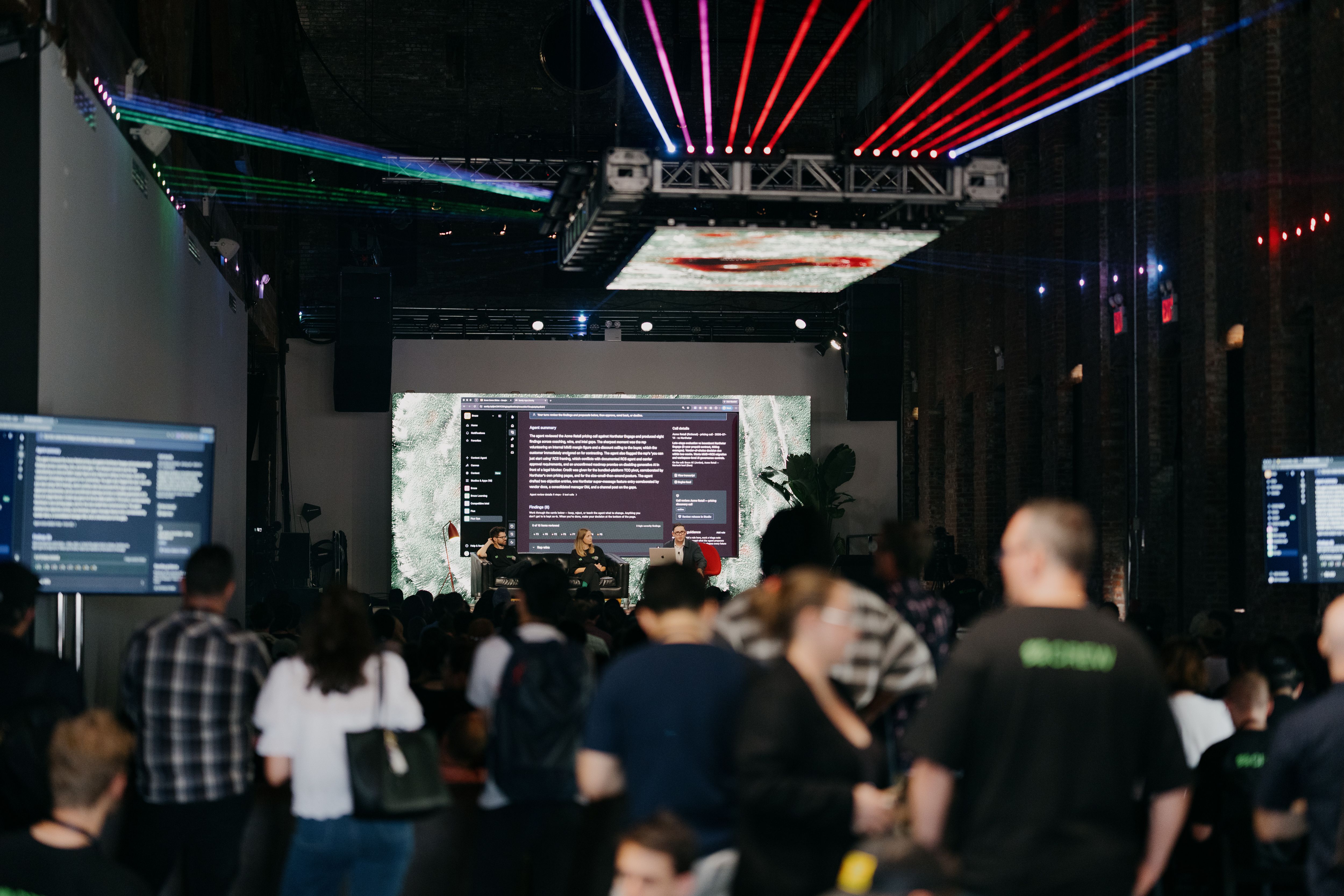
The event was a good time to reflect on our own experiences with agents. Over the past year, we bought two off-the-shelf agent solutions to help with our pre-sales and support teams. Neither met the bar for accurate and reliable responses. They also didn't give us much of a way to customize the agents for our customers and visitors. One vendor would even change the agent's look and feel without giving us a heads up.
We learned the hard way that not all agent platforms are created equal. We spoke with teams at the event with the same hard-earned lessons.
We’ve always believed that agents should be more than glorified chatbots that search your documentation website. Their context shouldn't be locked into a generic dashboard far removed from where your content lives. And more importantly, much like a website, we think they should be yours.
Large language models give agents reasoning and generic knowledge. They can't be helpful for your business without proper access to content that's specific to your organization and your users. Retrieval is only part of it. For that content to be helpful, it needs to be up to date and correct. And when your content becomes context for agents, you need the tools to govern and control who can do what.
We obsess over this at Sanity. Here are more details about what we launched to help you build better agents.
Think about what a support agent needs: the latest documentation, changelog, policies, known issues, successful resolutions. A shopping assistant should know what products are available, what's on sale, and what customers are actually looking for. An event concierge agent should be up to date on schedule changes and understand the themes and logistics.
Anyone who has used a general agent knows it can spend several minutes gathering what it needs before it can help. Is it reasonable to spend your customer's time and tokens for an agent to work from first principles in every session?
Sanity Context MCP's search and query tools are powerful, but we saw this limitation too. Agents had to run several tool calls to cover enough ground, and sometimes they missed the bigger picture.
Earlier this year, I wrote that structure powers intelligence. An AI system works better when it can access reliable, structured information instead of being limited to only inferred facts from your publicly hosted website that was designed for human readers.
Inspired by Andrej Karpathy’s “LLM wiki,” we built Knowledge Bases to fill that gap. You add sources: a Sanity dataset (or a subset of it), website URLs you own, and files. We build a map of the facts, identify contradictions in and between sources, and let you write build instructions and decide how to resolve the inconsistencies.
The difference from a search index is where the thinking happens. The build writes short fact sheets organized into an outline, and your agent gets that outline in its system prompt from the start. When a question arrives, it doesn't run a similarity search and hope the right chunk floats up. It reads the outline, picks the entry, and drills in. Because that work happened once at ingest, even a smaller, cheaper model can answer correctly.
So agents get context about a specific domain quickly and cheaply. And you get a list of every place your content disagrees with itself, before an agent repeats it to a customer.
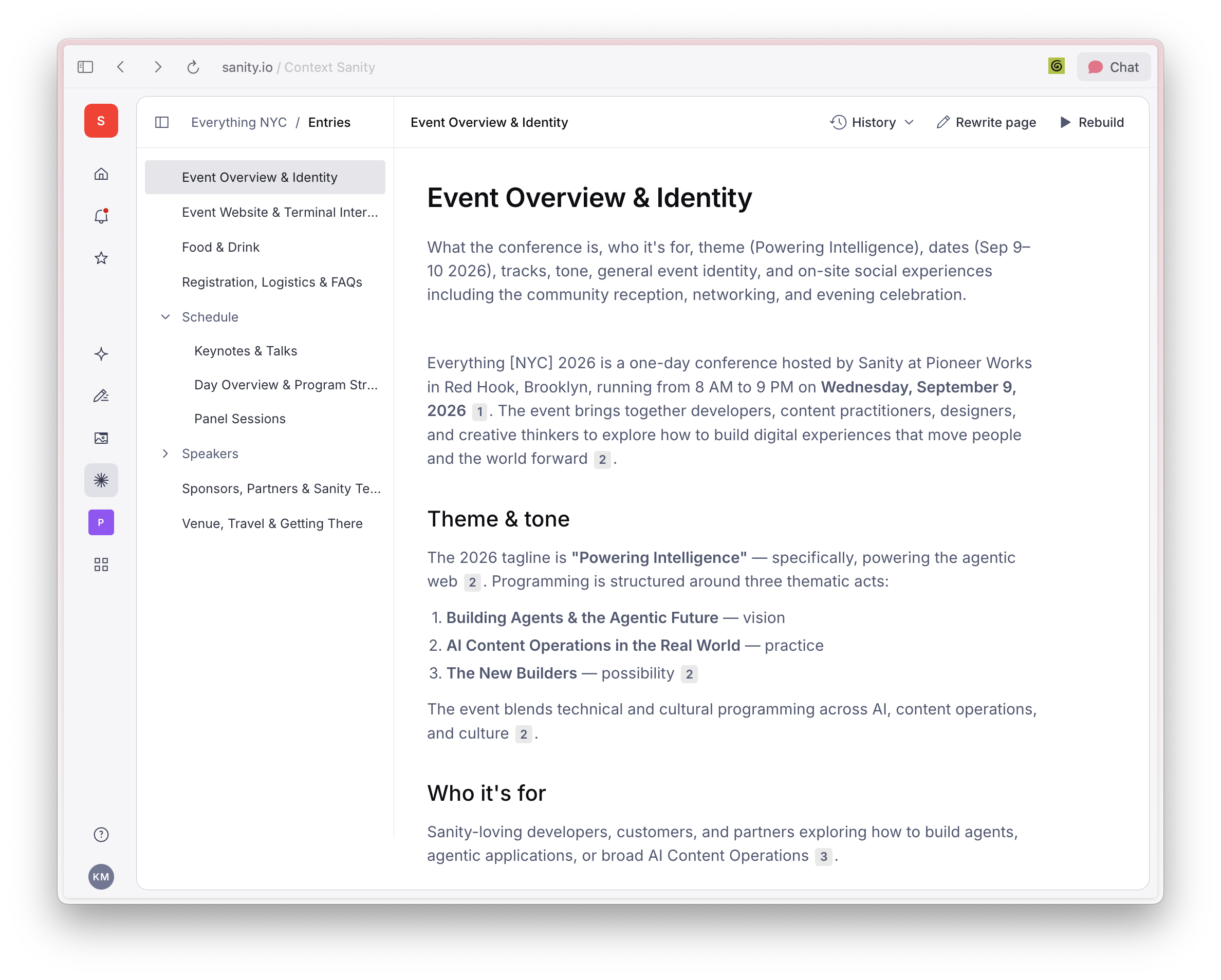
Knowledge Bases is in beta. An organization admin can enable it under “Apps” on sanity.io/manage. Since it’s an MCP endpoint, it works with any agent or agent framework that supports connectors. Be it your support agent, your website agent, and the internal research assistant.
Governance has always mattered to any business that is serious about content. As we hand more business-critical tasks to agents, defining the process matters even more. Anyone who ships code to production knows why business logic needs review.
This is the role of Workflows. Sanity now has a built-in way to define the stages your content moves through, alongside the content itself. It's a primitive of the platform: you configure workflows in TypeScript, versioned and deployed like code, and queryable with GROQ. So it shows up as UI for human operators and as APIs for agents. And because it's TypeScript, the same coding agent that writes your schema can write your workflow.
A person can submit a draft. An agent can check it against a style guide and move it forward or send it back. A reviewer can step in when judgment is required. Later, the team can inspect what happened. Since workflow state lives in the Content Lake, you can query it. "What got published without legal review?" is a GROQ query.
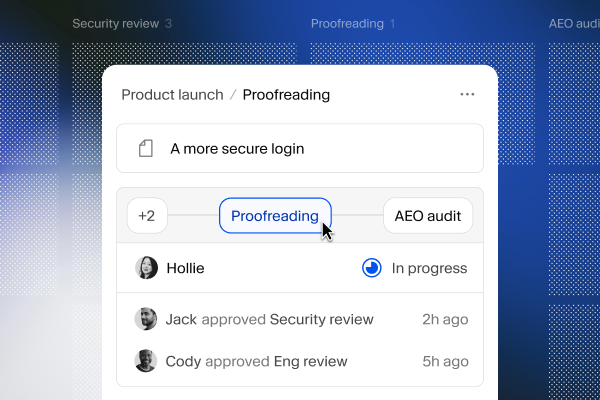
A person clicking "Approve" and an agent calling the API move the workflow the same way. Same permissions, same audit trail. So you decide per stage how much to automate, and you can change your mind. Start with agents drafting and people approving everything. Later, let agents approve routine translations and route exceptions to a person. The tooling stays the same, and the process lives in your repository instead of in one person's head.
Workflows is in beta and free for now. Early customers run it in production. The docs get you to a first workflow quickly.
Content personalization tools often live outside of your core content. You rewrite the homepage hero, and returning customers keep seeing the old one because their version sits in an unmaintained tool.
Content Variants gives editors one document to work in. They switch between "All users" and each variant, preview, and publish, and the base content is never touched. Under the hood, Sanity stores the variant content alongside it and resolves the right version at query time, on the same perspective machinery that powers Content Releases. There is no second API in the request path. Your query already carries the audience, and the Content Lake returns the matching variant in the same response as everything else on the page. There is nothing to duplicate or keep in sync.
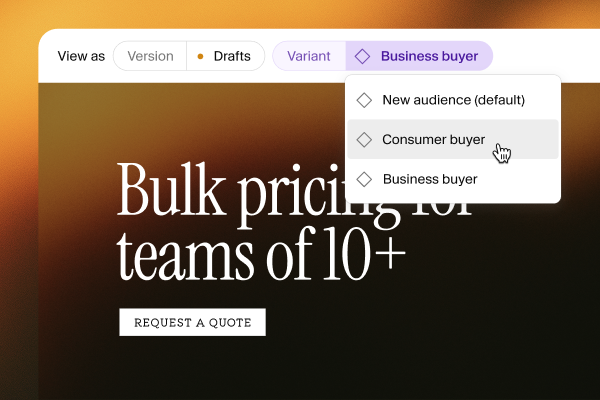
Your customer data platform (CDP) decides who the visitor is. Sanity decides what they see. The segments you already pay for finally reach your content, and a version for a new segment becomes an editor's task instead of a sprint ticket.
The Variants feature is in beta with approved customers. The group is full for now. You can register for the next wave.
Durable Functions turns a chain of automated steps into one job that picks up where it left off. Take the following automation: publish, sync to Shopify, push to Apple News, notify the team. If Apple rate-limits you on step three, the run retries step three. State survives restarts, and a step can wait up to a year. If you have a wall of webhooks and a "the sync failed and nobody noticed" story, this is for you.
Blueprints already define your Functions, datasets, webhooks, and roles as code. Soon they'll define most parts of your content infrastructure configuration: Studio, schema, tokens, and workflows in the same versioned file, and npm create sanity@latest will scaffold one by default. You can deploy multiple stacks based on teams, functions, testing environments, whatever you need. A change proposed by an agent becomes a diff a person reads before it deploys, and if it's wrong, you roll back.
You can register for early access to both.
Two projects are earlier than everything above. Both work without the rest of Sanity.
Resonance asks whether your content lands with your audience at all. It builds a living model of your company, your audiences, and your content, reads what you publish the way each audience would, and returns a ranked list of what to fix, with evidence. It's easy to do this sloppily. The hard part is doing it properly.
Andy Martin at MJH Life Sciences, who runs 60 medical publishing brands on Sanity, joined me on stage to show how he uses this tool on his team. In eight minutes he had Resonance invent a new audience for one of his sites, grade the homepage through that reader's eyes (one out of five: "I'm staring at a wall of drug names. I bounced so hard."), and draft the fix. The first time he saw it he immediately asked: "When can I start using it?" You can let us know if you’d like early access.
Project Horizon came out of Simen, Sanity co-founder and CTO’s, Christmas office where he had multiple screens of different agents while walking between them carrying context. In his words, the worst organization you can think of, where every worker has zero information and their only link to reality is you.
Project Horizon provides agents with long-term memory, some now running for months. This made it possible to stop prompting and start delegating. Teams and agents in shared channels, agents that learn how your work happens and need fewer words each time.
Both Resonance and Project Horizon are open for early access. Horizon is experimental and requires your own API key. Tell us what breaks!
I think the community as a whole has moved past whether agents can do content work. We’re now finding the best way to make them reliable and how to stay in control. Our product usage only backs this up. In August, agents made 1.2 million tool calls into Sanity over MCP, from about half of our enterprise customers and 40% of paying customers. September is on track for 2 million. I believe our latest releases get our users there closer than we’ve ever been.
Knowledge Bases gives an agent knowledge shaped for its job, contradictions surfaced (and hopefully fixed) instead of shipped. Workflows gives people and agents one process with clear decision rights. Variants shapes the output for the audience in front of it. Durable Functions and Blueprints make execution and setup reviewable and repeatable. Resonance and Horizon are our bets on what comes next.
This is what we think it takes to run content operations where the repetitive work runs itself and people hold the decisions. One place where content, teams, and agents work together, with one permissions model and one audit trail. That is the Content Operating System.
Can a person and an agent move the same piece of work through the same process, under the same permissions, and can you query afterwards what happened? We think that is the real test.
Our work is entirely focused on taking the power into systems and models and providing people with something they can rely on. And we’re going to keep working on that!
If you want to catch up on all the sessions from Everything *[NYC], head over to our YouTube channel.
P.S. One personal recommendation for when the pace gets to be too much: try the harmonica. I started this year. It is surprisingly easy to sound like a reasonably convincing cat, and occasionally like Bob Dylan. You cannot get much more analog than that.