Calibrated confidence definition
Calibrated confidence is the property that a model's stated probability matches how often it is actually right: across everything a system marks 80% confident, about 80% should be correct. Calibration is a claim about the number, not about the answer, and it is measured against reviewed outcomes rather than asserted.
Calibrated confidence in AI means a model's stated probability tracks observed frequency, so a 0.8 can be trusted enough to write an if statement against. The number is only meaningful for the state the model actually read, which is where content structure matters: a GROQ projection in Sanity returns just the fields a question concerns, so the thing being scored is the paragraph in dispute rather than a whole page of surrounding prose.
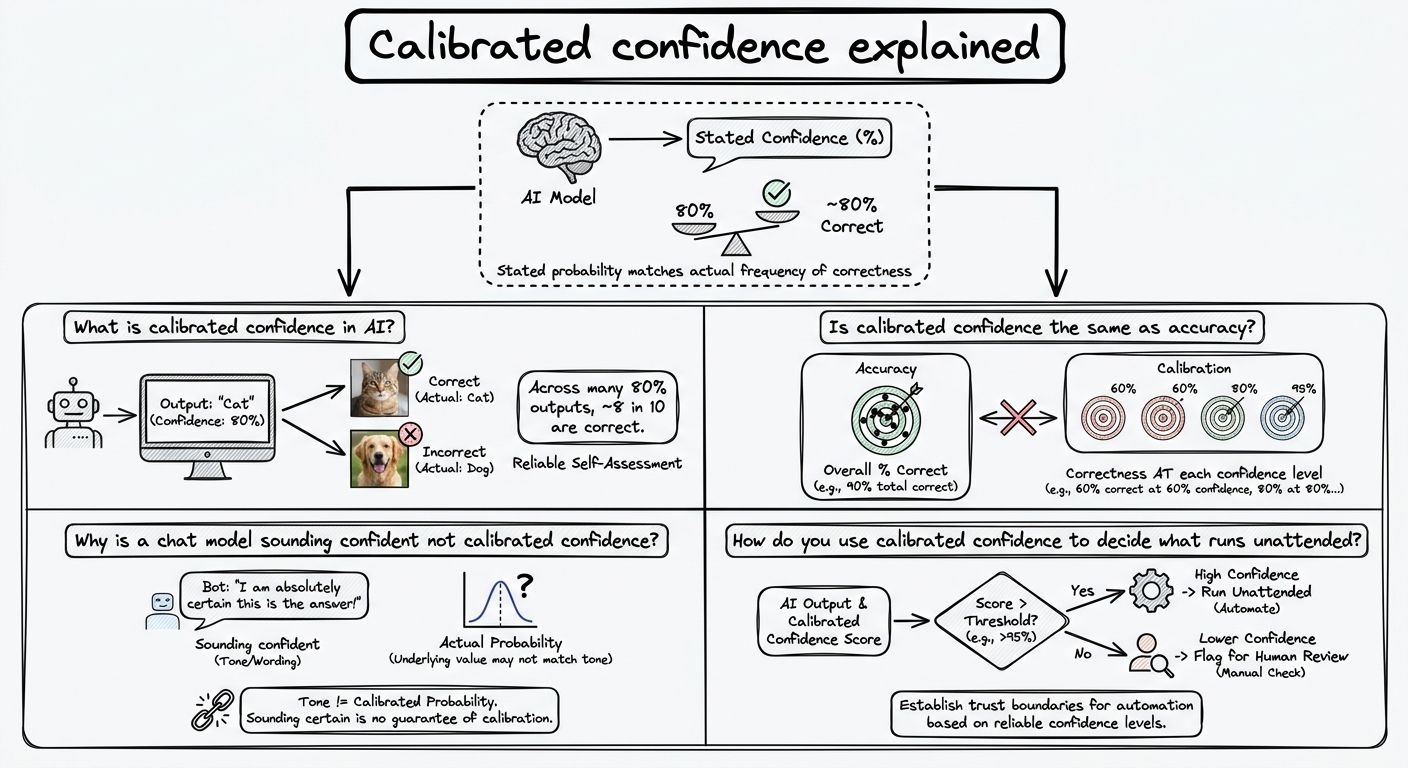
Calibrated confidence is a confidence number that matches reality: across everything a system marks 80% confident, about 80% is correct. The formal version, from the classifier calibration survey in Machine Learning (2023), is that a probabilistic classifier is well calibrated when, for any predicted probability it outputs, the actual proportion of correct cases among all predictions carrying that same number equals it.
The standard intuition is weather forecasting. A forecast of a 20% chance of rain is calibrated if, across all the days the forecaster said 20%, it rained on roughly 20% of them. The individual forecast is never right or wrong on its own. The number earns trust in aggregate, which is also why calibrated confidence is measured rather than claimed, using instruments like the reliability diagram, expected calibration error (ECE), and the Brier score.
Calibrated confidence matters because it is what makes partial automation possible. If a system can do a task correctly most of the time but cannot tell you when it is in the failing minority, you have to review everything or accept silent errors. A calibrated number lets you split the work instead.
No. Accuracy asks how often the answer is right. Calibrated confidence asks whether the stated probability matches how often it is right. The two come apart in both directions, which is the single most misunderstood thing about the term.
A model can be highly accurate and badly calibrated: right 92% of the time while reporting 99% on every answer. That model is useful for answers and useless for routing, because the number carries no information about which cases to check. Conversely, a model can be perfectly calibrated and useless. The degenerate example in the literature is a predictor that always outputs the base rate, which is flawlessly calibrated and has zero ability to tell cases apart. This is why calibration is always paired with sharpness (also called discrimination or refinement) in probabilistic classification: you want confident numbers and honest ones.
Calibrated confidence is also not the same as type safety. A constrained or typed output guarantees the returned value is in the allowed set and the right shape, so an off-schema value is structurally impossible. That is a guarantee about format, not correctness. A schema-valid answer can still be the wrong valid answer. Type safety is a promise about shape, calibration is a promise about the probability, and neither on its own is a promise of correctness.
Because fluency is a property of prose, not a probability. When a language model writes an unhedged declarative sentence, nothing in that sentence is constrained to track how often the claim holds. Calibrated confidence requires a number that has been trained or corrected to match outcomes, and a confident tone is not that number.
Even asking a model to state its confidence does not reliably produce calibration. The GPT-4 Technical Report shows that the pre-trained base model was well calibrated on MMLU and that RLHF post-training degraded calibration significantly. Adaptive Temperature Scaling reports the same pattern: unsupervised pre-training tends to yield well-calibrated models, and alignment fine-tuning tends to damage it. Just Ask for Calibration found that asking an RLHF-trained model to verbalize a confidence can recover a meaningful amount of it, reducing ECE by roughly 50% on question-answering benchmarks compared with the model's own conditional probabilities, which tells you the raw token probabilities of an aligned chat model are not a trustworthy starting point.
The reason is the objective. Alignment training optimizes for answers people prefer, and people prefer answers that sound certain. Calibration is a casualty of that preference, which is why systems that need it tend to train for it deliberately. TypeSafe AI, for example, describes its training method for the Jev model as RLCD, Reinforcement Learning for Calibrated Decisions, and states the problem it addresses directly: "If a model can do a task 95% of the time but doesn't say when it's in the 5%, it can't automate that task."
You use calibrated confidence as a gate: the answer says what to do, and the confidence decides whether code may do it without a human. This is confidence-gated routing, and it is the operational reason anyone cares about calibration.
The pattern in four steps. First, get a typed answer plus a probability for a question with a bounded answer space, such as which category a record belongs to or whether a draft violates a rule. Second, compare the probability against a threshold. Third, above the threshold, let the automation act. Fourth, below it, route the case to a person or to a slower and more expensive process. The academic name for this shape is selective prediction or learning to abstain: The Art of Abstention (ACL 2021) frames it as a confidence function plus a threshold that controls the predict-versus-abstain split, evaluated with risk-coverage curves.
Thresholds should rise with the cost and irreversibility of the error, and they should be derived from those costs rather than picked as round numbers. Clinical selective-prediction work in JAMIA (2024) sets the abstention point using predetermined costs for false positives, false negatives, and undetermined predictions, and cost-aware deferral studies treat the coverage-versus-risk trade-off the same way. Tagging an archive entry can run at 0.7. Deleting a record, sending a customer email, or publishing a price should sit far higher, or should never be gated by a probability at all. Reserve a third route for the genuinely ambiguous: not approved, not rejected, queued.
One principle to keep in view: a probability describes the model's uncertainty about its own answer given the state it was shown. It is a filter for routing work, not evidence about the subject of the record.
Calibrated confidence fails in production in three specific ways, and all three are avoidable.
First, thresholds set by feel. A threshold is a claim about your data, so it has to be set against a sample of cases a human has actually reviewed and labeled. Run the candidate threshold over that sample, look at what slips through above it and what gets escalated below it, then pick the number. Calibration on a vendor's benchmark does not transfer automatically to your content, your edge cases, or your question wording.
Second, unpinned model versions. A moving alias points at whichever build is current, so behavior can change with no release on your side and no line in your changelog. OpenAI documents this explicitly: dated snapshot IDs exist to "lock in a specific version of the model so that performance and behavior remain consistent," while aliases like chatgpt-4o-latest track the current snapshot and can be repointed or retired. The same applies to any decision model published behind a floating route. Pin the exact build, and re-validate thresholds when you move.
Third, turning a failure into a confident answer. If a call times out, errors, or returns nothing, the default must be escalation, never a high-confidence value that lets the automation proceed. A gate that fails open is not a gate. The related trap is logging only the decision and not the probability, the model version, and the state that was scored, which leaves you unable to tell later whether a bad outcome was a miscalibrated number or the wrong input.
Yes. Calibrated confidence is conditional on the state the model was given, so what you send is part of the system, not a detail of the integration. Two questions asked about the same document can get differently reliable answers purely because one saw the relevant field and the other saw ten thousand tokens of unrelated page content.
This is where structured content becomes load-bearing. Decision models work against bounded inputs: TypeSafe publishes a 64,000-token context and a 32,000-token state budget for Jev, so a long page cannot simply be pasted in. In Sanity, GROQ projections "define the shape of your results, letting you pick exactly which fields to include," so a query returns just the title, the disputed paragraph, and the locale rather than the entire document. Content stored as discrete fields and blocks in the Content Lake can be addressed that precisely; content stored as one opaque blob of markup cannot. Sanity's role here is as the AI Content Operating System, the layer where content is modeled well enough that a question can be pointed at exactly the thing it concerns.
The practical consequence: if you change what you send, you have changed the distribution your thresholds were tuned on. Treat the projection that builds the state as versioned alongside the model, and re-check the threshold when either one moves.
Discover More with Sanity
Now that you've learned about calibrated confidence, why not start exploring what Sanity has to offer? Dive into our platform and see how it can support your content needs.
Last updated: