Clairic (Cloudflare model) definition
Clairic is Cloudflare's extraction model, announced in preview on 19 October 2026 and hosted on Workers AI as @cf/cloudflare/clairic. It reads a state (text or JSON, plus up to four images) and a map of named typed fields, then returns one typed value per field, read from the input, computed from it, or predicted beyond it, rather than generated text.
Clairic is Cloudflare's extraction model, previewed on 19 October 2026 on Workers AI, which answers a map of named typed fields about a document with typed values instead of prose. Its answers are only as good as the state you hand it, and in Sanity a GROQ projection returns just the named fields a question concerns, so the state can be those fields rather than a whole rendered page.
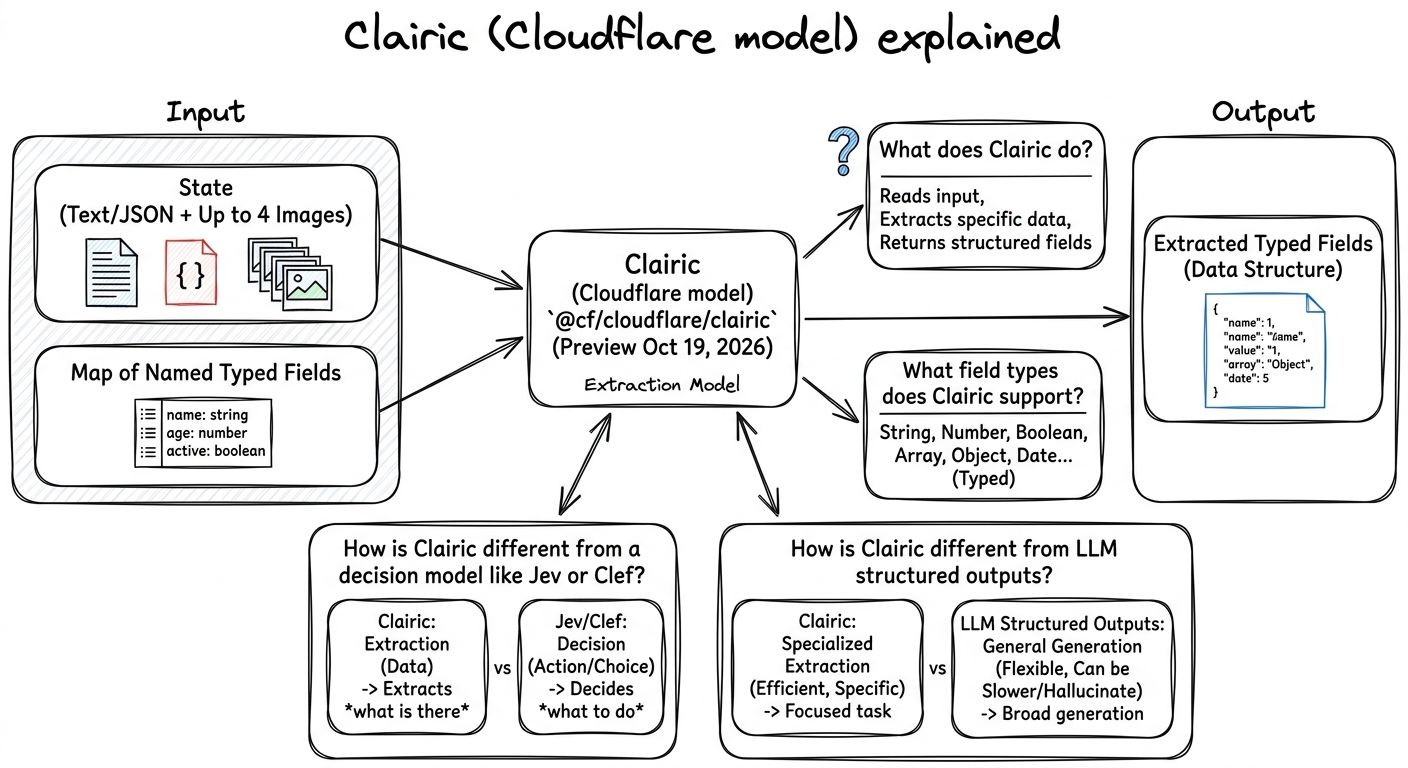
Clairic takes a state, meaning the text or JSON you want read, plus a set of named fields you declare with types, and returns one value per field. As Cloudflare puts it, Clairic "is still fast, typed, and cheap, but it answers with values directly extracted from the input, computed from it, or predicted beyond it."
A single call answers every field in one parallel pass. Clairic generates no output tokens, so each answer is decoded under the rules of its declared type and comes back either as a value of that type or as null. There is no upper limit on the number of fields; Cloudflare's model page says fields that do not fit next to the state in one pass are split across parallel passes.
Cloudflare summarizes the division of labor in one line worth quoting: "Extraction models turn raw input into typed values, decision models turn values into decisions, and LLMs turn decisions into words." Clairic is the first model Cloudflare has released in the extraction half of that sentence, and it credits TypeSafe AI, which coined the System One idea with Jev on 15 September 2026.
Clairic supports nine field types: text, number, date, time, datetime, duration, list, estimate, and forecast, as listed on Cloudflare's changelog entry and model page.
A text answer is an exact span of the input, returned with character offsets, so you can show a reader where the value came from. A number can be read off the page or computed, with options for unit, integer, and decimal places. A list declares whether its items are text, numbers, or dates, and returns matching values in input order, or an empty list when nothing matches. An estimate takes a minimum and maximum and answers a value the document cannot settle outright. A forecast adds a horizon of up to 64 steps.
Most answers carry a confidence score and a p_null, the probability that the document simply does not contain the value. Estimates and forecasts instead return a distribution: a median plus an 80% interval running from the tenth to the ninetieth percentile, and optionally all 99 quantiles. Each field has a null_threshold, defaulting to 0.5, above which the value comes back null and a separate "guess" field shows what the model would otherwise have picked.
Clairic and decision models such as Jev, Clef, and Clef-flash share the same shape, a single parallel pass with typed output and no generated tokens, but they differ in what the output can be. A decision model picks from a finite set of options you list in advance and returns probabilities against them. Clairic fills in values you could not list in advance, such as an invoice total or a delivery date. Cloudflare's launch table describes the decision output space as "a finite set of options you list" and Clairic's as "continuous, but typed and bounded by your schema."
Clairic does not answer the decision question types at all. Per the System One SDK documentation, it answers no Choice, Score, or
The practical pattern Cloudflare demonstrates is a cascade: Clairic pulls the typed values out of a document, a decision model rules on them, and an LLM writes the reply if words are needed.
Clairic differs from an LLM in JSON mode in how the answer is produced rather than in what it looks like. An LLM writes JSON one token at a time and you validate the result afterwards, which means a malformed or mistyped answer is possible and has to be caught downstream. Clairic decodes each answer under the rules of its declared type, so what comes back is a value of that type or null.
Cloudflare is careful about what that guarantees, and the wording is worth keeping intact: because Clairic "generates no tokens, it can't produce a mistyped answer or 'hallucinate' in the same way as an LLM (though it can, of course, make mistakes)." The changelog states it more plainly still: "Every answer is well formed, not necessarily correct." The guarantee is about format, not truth.
Clairic also overlaps with span extractors such as named entity recognition models and GLiNER, which return pieces of the input that match labels. Clairic returns spans too, but it additionally computes values the input implies, estimates values the input cannot settle, and reports through p_null how likely each value is to be absent. (It has nothing to do with "model extraction," the separate security term for copying a model by querying it.)
Clairic is callable two ways. On Workers AI it runs as @cf/cloudflare/clairic, through a Worker binding with env.AI.run, or over REST at the Cloudflare accounts endpoint with an API token, and it works behind AI Gateway. Cloudflare's model page lists a 65,536-token context window and prices it at $0.10 per million input tokens, with no output token charge because the model generates none. Cloudflare says it intends to release Clairic with open weights soon, which is a stated plan rather than something that has happened.
The second route is system-one.dev, where the model name is clairic and the call is the SDK's extract({ state, fields }). Pricing there works in blocks: every 4 KB of request content counts as one block at 2 credits, anything smaller counts as one block, and the charge applies once per request no matter how many fields you ask for. That last point is the difference from decision models like Jev and Clef, whose cost also scales with the number of questions.
Input limits are the same idea on both: a state of text or JSON, plus up to four images (PNG, JPEG, or WebP, four megabytes each and eight megabytes in total), placed before the state. An optional reference_date anchors the year for dates written without one.
Cloudflare publishes Clairic's limits directly, and they are the right starting point for deciding what to automate. On arithmetic: "One- and two-step calculations, such as totals, differences, conversions, and date arithmetic, are reliable. Long chains of dependent steps and aggregations across many table rows are not yet. Extract the inputs with Clairic and do the math in code."
On estimates, Cloudflare says they work best "when the input contains evidence such as comparables, history, or descriptive text," and that "without evidence, the interval is wide." On forecasts: "Forecasting is basic... forecasts several steps out flatten toward the average, and Clairic does not anticipate events the series does not show, such as holidays. It does not replace a time-series model trained on your data." On calibration, intervals "are trained to be calibrated and are on most held-out sets, but they can run narrow on unfamiliar data."
All accuracy and speed figures published for models in this class are self-reported by their makers, and the benchmarks are young enough that comparing numbers across vendors is not meaningful yet. The sound approach is the one Cloudflare recommends: test on your own samples, and threshold on confidence and p_null to decide which answers ship straight through and which go to a human. Sanity, the AI Content Operating System, is built on that same separation, where structured content in the Content Lake is the reviewable source a typed question is asked against.
Discover More with Sanity
Now that you've learned about Clairic (Cloudflare model), why not start exploring what Sanity has to offer? Dive into our platform and see how it can support your content needs.
Last updated: