Clef (Cloudflare decision model) definition
Clef is a family of decision models released by Cloudflare on 1 October 2026 that answer typed questions about a piece of text, image, audio, or video with a probability rather than generated prose. The family includes Clef, the low-latency Clef-flash, and the multimodal Clef-omni, hosted on Workers AI and open-sourced on Hugging Face under Apache 2.0.
Cloudflare Clef is a decision model: you give it a state (text, images, and with Clef-omni audio or video) plus a typed question, and it returns a probability over the valid answers instead of a sentence. Cloudflare released Clef and Clef-flash on 1 October 2026 as Jev-API compatible, so the model name is the only code change. A typed answer is only as good as the state behind it, and Sanity stores content as structured fields, so you can pass a model exactly the fields a question concerns rather than a rendered page.
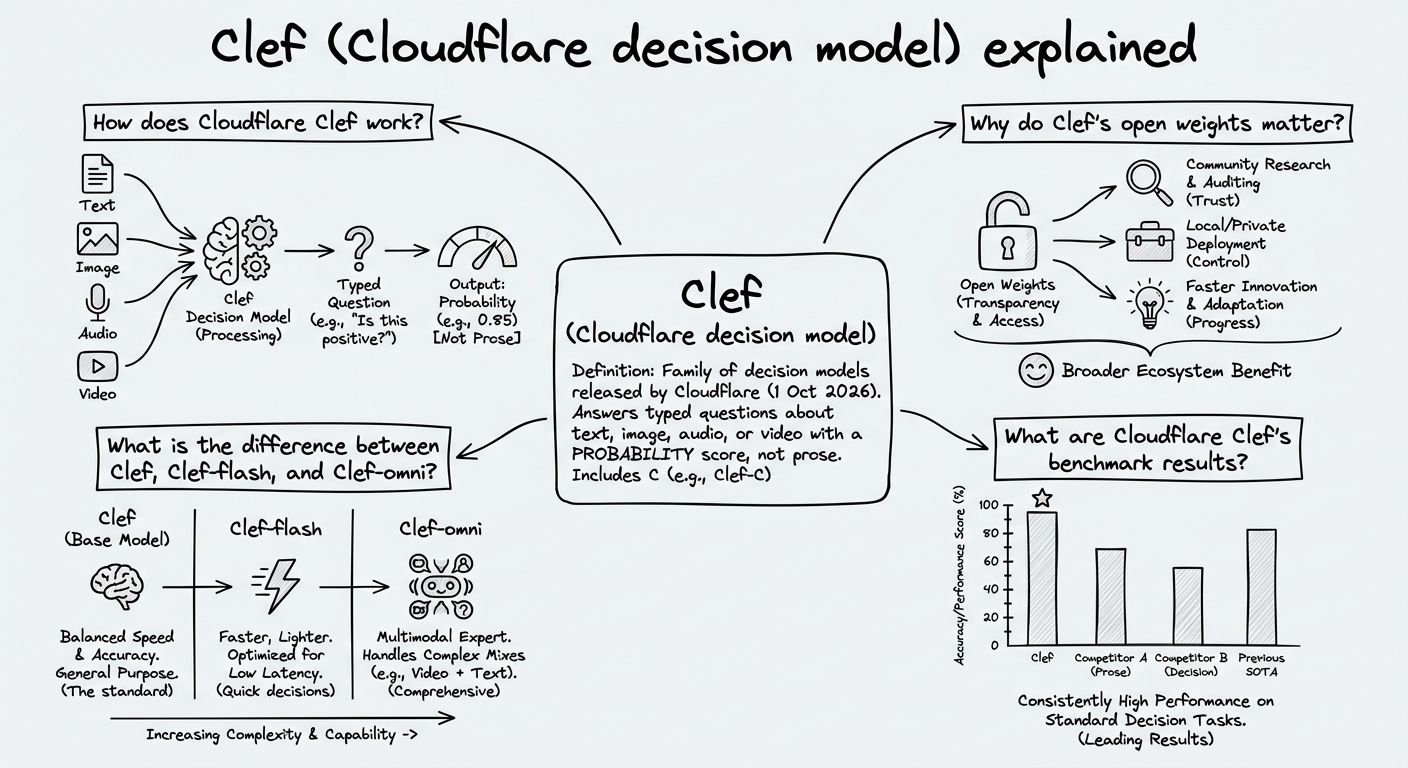
Cloudflare Clef works by scoring a fixed set of valid answers rather than generating text one token at a time. As Cloudflare describes the architecture on the Cloudflare blog, a Qwen backbone runs a prefill-only pass over the input, reading the whole state once, and then the permitted answer options are scored in parallel. Nothing is written word by word, which is where the speed comes from.
That design is also what Cloudflare and the other makers in this category mean when they say the model "can't hallucinate." The output is always a value of the type you asked for: a probability on a yes/no question, a distribution over a fixed option list, a point on an ordered scale. It is a guarantee about format, not about correctness. Every maker in this space, Cloudflare included, says the models still get answers wrong, and Clef is calibrated to express that uncertainty as a number you can threshold on.
Clef, Clef-flash, and Clef-omni are three members of the same Cloudflare decision model family, separated by capability, cost, and input type. Clef is the larger and more capable model, the one to reach for when the question is subtle, the state is long, or a wrong answer is expensive. Clef-flash is the low-latency, low-cost member, suited to high-volume classification where you are running the same question across thousands of items and latency per call compounds.
On 9 October 2026 Cloudflare shipped three changes at once: it cut Clef-flash's price, which it says brought it below Jev's, it made Clef faster, and it added Clef-omni. Clef-omni accepts audio (wav, mp3) and video (mp4, webm) alongside text and images, and Cloudflare says it is built on a Qwen3-Omni-30B-A3B mixture-of-experts model, an architecture that activates only part of the network per request. Pick Clef-omni when the thing you need a judgment about is a recording rather than a document, for example asking whether a support call contains a cancellation request.
A practical selection rule: start with Clef-flash, measure how often its confidence lands near the middle of the range, and escalate those cases to Clef. Use Clef-omni only when the input format requires it.
Clef's open weights matter because they let you run the model somewhere other than the vendor's API. Cloudflare open-sourced Clef and Clef-flash on Hugging Face under the Apache 2.0 license on 1 October 2026, alongside hosting them on Workers AI. That gives you three things a closed API does not: you can self-host on your own hardware or in your own cloud region, you can inspect and evaluate the weights directly, and you are not exposed to a single provider's pricing or availability decisions.
That is the clearest contrast with Jev, the TypeSafe AI model that opened this category and is available only as a closed API. Cloudflare also says Clef is fully Jev-API compatible, so an application written against Jev can switch by changing the model name, which makes the two straightforward to evaluate side by side on your own data.
On privacy, Cloudflare says it does not read, store, or train on requests unless you opt into its fine-tuning service, and it offers fine-tuning first through its forward-deployed engineers.
Cloudflare reported Clef leading the Jev Decision Index at its launch on 1 October 2026. Treat that as the maker's claim rather than an established fact. Every accuracy, latency, and benchmark figure published in the decision model category so far is self-reported by the model's own maker, and the benchmarks themselves are young and inconsistent between vendors. JevBench, the Jev Decision Index, Decision Bench, and ClaimBench measure different things, so a leaderboard position on one says little about performance on another.
The only benchmark that settles the question for your use case is one you build. Because Clef is Jev-API compatible and openly licensed, running Clef, Clef-flash, and a competitor against a few hundred of your own labeled examples is a short exercise, and it tells you what a published index cannot: how the model behaves on your states, with your questions, at the confidence threshold you intend to ship.
Structured content improves a Cloudflare Clef answer by narrowing what the model has to read. Clef answers a typed question about a state you supply, so the state is the whole input: everything the model knows about the case is whatever you put in that field. Hand it a rendered web page and you hand it navigation, cookie notices, related article teasers, and footer text, all of which compete with the sentence the question is actually about.
Sanity is the AI Content Operating System, and the practical consequence for decision models is that content lives in the Content Lake as separate, queryable fields rather than as a blob of markup. A GROQ query can return the product description, the returns policy, and the two locale variants a question concerns, and nothing else. The question Clef is asked and the state it is asked about then line up precisely, which is the difference between a confident probability and a noisy one.
The same structure helps on the way back. A Clef response is a typed value with a confidence attached, which is a shape you can write back onto the document as a field, review in an editorial workflow, and query later, rather than a paragraph of prose someone has to interpret.
Explore Sanity Today
Understanding Clef (Cloudflare decision model) is just the beginning. Take the next step and discover how Sanity can enhance your content management and delivery.
Last updated: