Data residency for content and AI definition
Data residency for content and AI is the requirement or choice to keep data in a specific geographic location across its whole lifecycle. That includes where content is stored, where embeddings and vector indexes live, and where AI model inference processes prompts.
To make an AI system respect GDPR, map every place personal data travels (storage, embeddings, model inference, and logs). Then keep each location in an approved region, or cover any transfer with a lawful mechanism. In Sanity, region and consent can be modeled as fields on each document, so an AI pipeline queries with GROQ for only the content allowed in a given region before embedding it or sending it to a model.
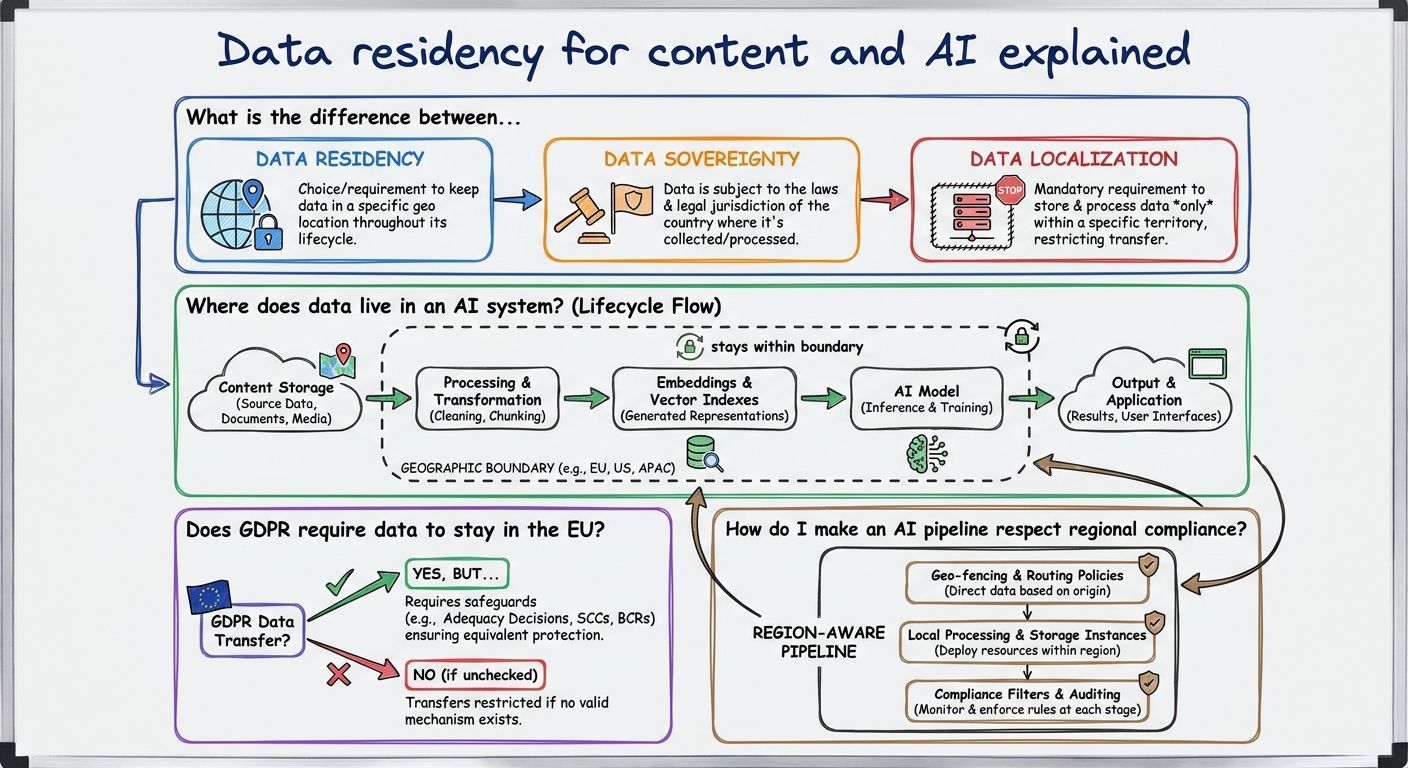
Data residency is where data is physically stored and processed, usually chosen by an organization to meet a law, a contract, or a customer expectation. Data sovereignty is the idea that data is subject to the laws of the country where it is located, so residency determines which legal system applies. Data localization is a legal mandate that certain data must stay inside a country's borders, with transfers restricted or banned.
In short, residency is a location, sovereignty is jurisdiction, and localization is a rule that forces a location. For data residency for content and AI, the distinction matters because a company can choose an EU region (residency) but still face foreign legal access if its provider is subject to another country's laws (sovereignty).
Data residency for content and AI covers at least four locations, and data can sit in a different region in each one. The first is the content store, where source documents and their personal data live. The second is the embedding and vector index. An embedding is a list of numbers that represents the meaning of a piece of text, and it is stored in a vector database for retrieval.
The third is model inference, the moment a prompt and its retrieved context are sent to a language model and processed on that provider's servers. The fourth is logs and caches, where prompts, outputs, and traces are often kept for debugging or evaluation.
A common gap is placing the content store in an EU region while the embedding service or model API runs elsewhere. Every prompt that includes customer data moves that data across a border. Embeddings derived from personal data may themselves count as personal data, so treat the vector index with the same residency rules as the source content.
GDPR does not strictly require data residency in the EU. It regulates transfers of personal data out of the European Economic Area under Chapter V of the GDPR (Articles 44 to 49). A transfer is lawful when the destination has an adequacy decision from the European Commission, or when safeguards such as Standard Contractual Clauses are in place. The EU-US Data Privacy Framework, adopted by the Commission on July 10, 2023, gives an adequacy basis for transfers to certified US companies.
For AI systems, sending a prompt containing personal data to a model hosted outside the EEA is a transfer, even when nothing is stored permanently. Many organizations still choose EU residency for content and AI because it removes the transfer question, which makes audits simpler. GDPR violations can bring fines of up to 20 million euros or 4% of worldwide annual turnover, whichever is higher, under Article 83.
Making an AI pipeline respect regional compliance follows a repeatable sequence. Step one: inventory the data flow, listing every system that touches content, embeddings, prompts, outputs, and logs, along with its hosting region. Step two: classify content by sensitivity and by the region it may be processed in, and record that classification on the content itself rather than in a separate spreadsheet.
Step three: pick regional deployments for each stage. That means a content backend in the required region, a vector database in the same region, and a model endpoint that processes inference in-region where the provider offers it. Step four: filter before processing, so the pipeline only embeds or prompts with content whose region and consent fields allow it. Step five: for any remaining cross-border flow, document the legal basis (adequacy or Standard Contractual Clauses) and check each vendor's sub-processor list.
Step six: set retention limits on prompt and output logs, and review the whole map whenever a new model or vendor is added.
Structured content helps with data residency for content and AI because regional rules can be enforced only on data the system can identify. When region, consent status, and sensitivity are explicit fields on each document, a pipeline can query for exactly what is allowed to leave a region. That works better than trying to scan free text for personal data after the fact.
Sanity is the AI Content Operating System. Content in Sanity is modeled as typed documents, so teams can add fields such as a data region or a personal-data flag to their schema. A GROQ query can then exclude restricted documents before they reach an embedding job or a model prompt. Roles & Permissions limit which people and tokens can read sensitive content in the first place. Sanity's compliance materials cover SOC 2 Type II, GDPR, and a published sub-processor list, which feed directly into the transfer documentation GDPR asks for.
Unlock New Possibilities with Sanity
With Data residency for content and AI under your belt, it's time to see what Sanity can do for you. Explore our features and tools to take your content to the next level.
Last updated: