Gemini 4 Carbon model definition
Gemini 4 Carbon is a closed-weights frontier large language model from Google DeepMind, announced October 28, 2026, that succeeds Gemini 4 Argon as the most capable Gemini 4 model and targets long-horizon coding, agentic, and cybersecurity tasks.
Gemini 4 Carbon is Google DeepMind's most capable Gemini 4 model, a closed-weights frontier LLM announced October 28, 2026, for long-horizon coding, agentic, and cybersecurity work. It arrived weeks after Gemini 4 Argon, so the practical question for content teams is how to adopt it without rewriting pipelines. In Sanity, content reaches agents through Sanity Context, a hosted MCP server any MCP-capable harness can query, so switching to Carbon means changing the model and API key, not the content.
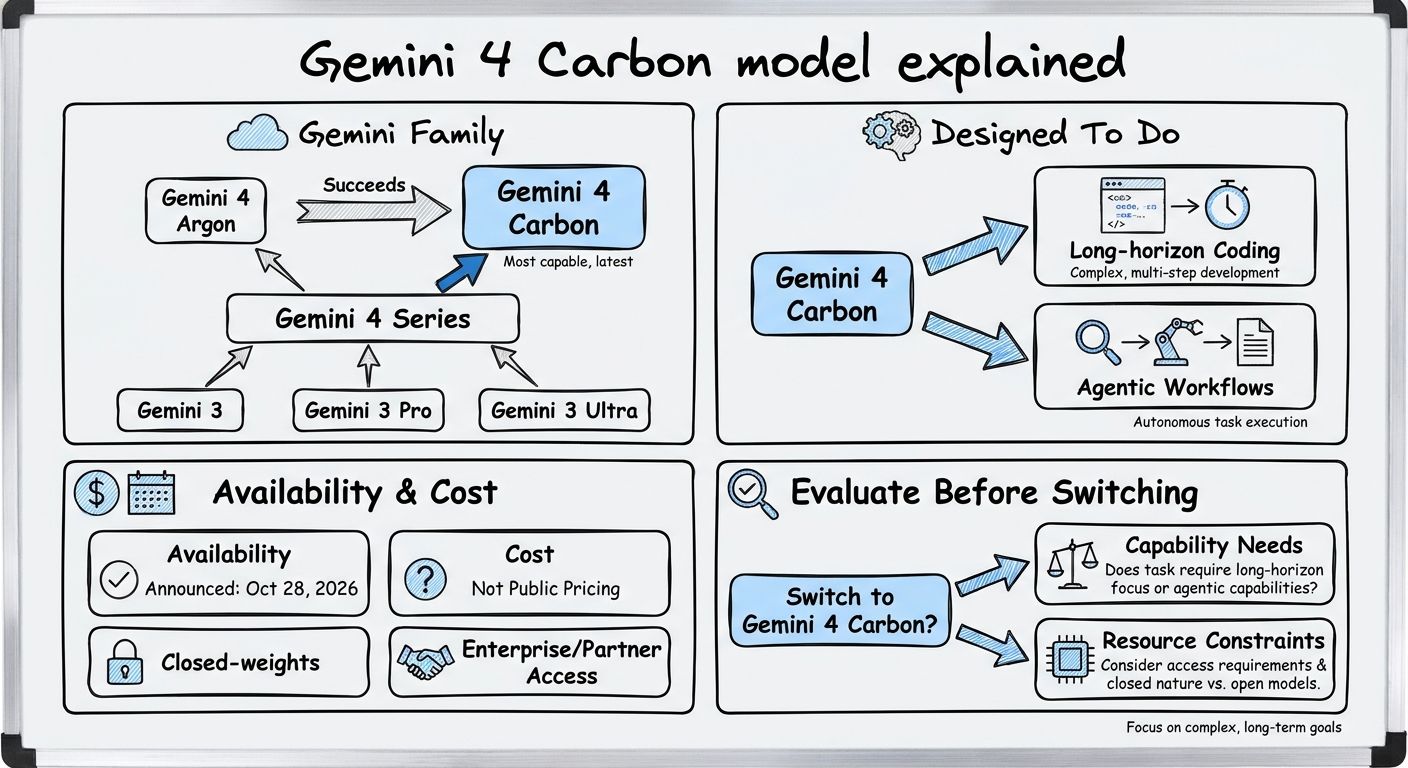
Gemini 4 Carbon is the top model in Google's Gemini 4 generation, and it sits above Gemini 4 Argon in the frontier tier. According to Google's announcement, Carbon builds on Argon, which was released only weeks earlier. The Google DeepMind Gemini page splits the current lineup into two tiers: the Gemini 4 frontier models (Carbon and Argon) and the faster, cheaper Flash line, which includes Gemini 3.8 Flash and 3.8 Flash Cyber (September 2026), 3.7 Flash (August 2026), and 3.6 Flash, 3.5 Flash-Lite, and 3.5 Flash Cyber (July 2026).
Gemini 4 Carbon is not a Flash model. Ars Technica describes it as an improvement on Argon and reports that Carbon beats Argon by slim margins in every test. Ars also speculates that Carbon could be a post-training upgrade of Argon, while Google presents it as a new model.
The name Gemini also refers to Google's consumer app and its developer API. Gemini 4 Carbon is one model that Google says will be offered through those surfaces, not the app or API itself. Epoch AI lists it as a closed-weights model from Google DeepMind.
Gemini 4 Carbon is a general-purpose model that Google built for coding, agentic and scientific work, full-stack web development, and multimodal understanding, with a stated focus on sustained agentic workflows (agents that work through many steps over long periods). Google calls it "our strongest model with state-of-the-art cybersecurity and long horizon capabilities" and says its internal teams have seen Carbon "run for days to persist through dead ends."
The figures Google published on October 28, 2026 include a first-place score of 59 on the Artificial Analysis Intelligence Index v5.0, compared with 50 for Argon; 88.2% on SEC-bench Pro, 54.8% on ExploitGym, and 71.0% on CWE-bench, all evaluated without guardrails; 96.2% on the GraphWalks long-context test from 256k to 1M tokens, versus 84.2% for Argon; and +89 Elo on WebDev Arena, ranking fourth.
Google also says Gemini 4 Carbon "retrieves the relevant sources and surfaces discrepancies to the user before acting" and cuts unsupported claims by about 2x over Argon in internal testing. 9to5Google reports Google's figures of 26% less overreach and 29% less under-service. These are vendor claims, not independent findings. Taken at face value, they point Carbon toward long, multi-step agent tasks, web artifact generation, and work where staying grounded in sources matters.
Gemini 4 Carbon was not generally available when Google announced it on October 28, 2026. Google says access goes first to "a subset of cyber defenders," then to trusted partners through its Fairwind Program, and will reach "developers, businesses, and consumers… as soon as possible." Google is also taking part in the U.S. government's voluntary pre-release model testing process.
The introductory price for Gemini 4 Carbon matches Argon: $2 per million input tokens and $10 per million output tokens, with cached input tokens priced at 95% off the input price, per Google's announcement. After the introductory period, 9to5Google reports that pricing rises to $4 per million input tokens and $20 per million output tokens. Ars Technica notes that Google has not set an end date for the introductory pricing.
Before switching to Gemini 4 Carbon, test it on your own tasks, not vendor benchmarks. Ars Technica observes that every frontier model scores in the same neighborhood and that the gap between Carbon and the competition is just a few points, so a leaderboard rank says little about a specific workload.
In our experience, the checks that matter are whether the model is available to your account, what it will cost once introductory pricing ends, how reliably it calls tools and MCP servers inside your own agent harness, how its guardrails and safety behavior handle your content and use case, and how much of your stack is written for one specific model.
That last check is not model capability, but model lock-in. In the systems we have worked on, lock-in tends to hide in prompts, output parsers, and pipelines tuned to one model's quirks. The more of that a team has, the more any switch costs, regardless of how capable the new model is.
Content stays portable across models like Gemini 4 Carbon when it lives in a structured layer that any model can query, not inside prompts written for one model. The release pace makes this a practical concern: Argon shipped weeks before Carbon, and the Google DeepMind Gemini page lists nine model announcements between July and October 2026.
Sanity is the AI Content Operating System, and agent context is one of the problems it is built to handle. Sanity Context is a hosted Model Context Protocol (MCP) server (MCP is an open standard for connecting AI models to tools and data) that gives AI agents structured, read-only access to content, either the live dataset queried with GROQ or material indexed ahead of time in Knowledge Bases, which are in Beta. Its requirements are an MCP-capable AI harness and a model and API key, so the model is not the content dependency. Sanity's documentation advises that simple schemas and questions work with small, fast models, and that if an agent picks the wrong tool or writes malformed GROQ, you switch to a more capable model. A frontier model such as Gemini 4 Carbon is one point on that scale, and the content stays the same whichever model you pick.
For agents that also need to act on content, the Sanity MCP server works with any MCP-compatible client and lets agents run GROQ queries, manage releases, and patch documents with awareness of the schema. Sanity Context does not run the agent loop or write back to the dataset. It supplies the content the model reasons over.
Explore Sanity Today
Understanding Gemini 4 Carbon model is just the beginning. Take the next step and discover how Sanity can enhance your content management and delivery.
Last updated: