Hallucination definition
A hallucination in AI is an output from a generative model that is fluent and plausible but factually wrong or unsupported by any real source. The model predicts likely-sounding text rather than retrieving verified facts, so it can invent citations, product details, dates, or quotes with full confidence.
A hallucination in AI is a confidently stated answer that is not true, an invented statistic, a citation that does not exist, or a product detail the model filled in because it sounded right. The usual mitigation is grounding, which means forcing the model to answer from retrieved source content instead of memory. In Sanity, that source content is structured and queryable in the Content Lake, so a generated answer can be tied back to the specific fields it came from rather than to a model's recollection.
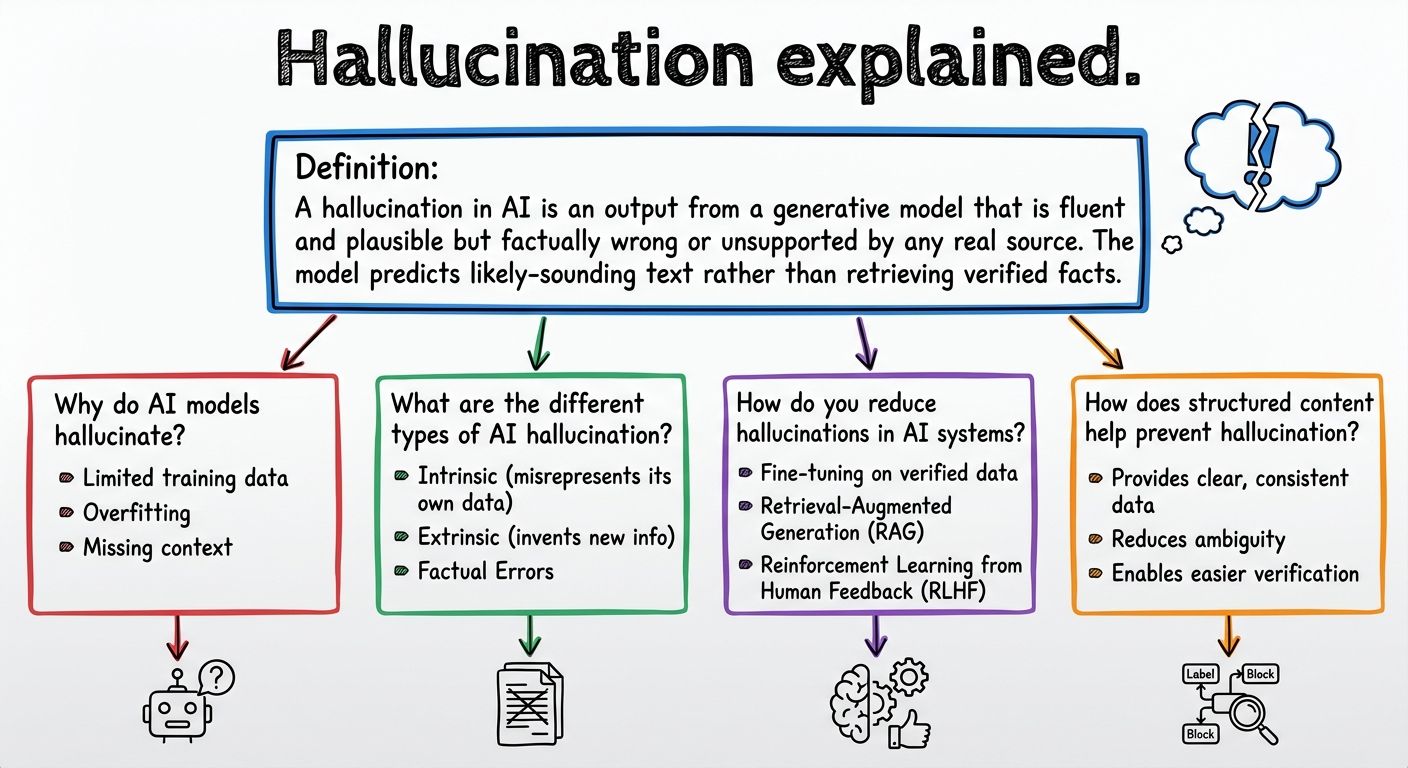
AI models hallucinate because a large language model is trained to predict the next most likely token, not to check whether a statement is true. A large language model learns statistical patterns from text, so when it is asked something it has no reliable pattern for, it still produces the most fluent continuation available. There is no internal flag that separates "I know this" from "this is the shape an answer usually takes."
Three conditions make hallucination more likely. The model is asked about something outside or newer than its training data. The question is specific enough to require a precise fact, like a version number, a price, or a legal clause. Or the prompt contains a false premise that the model accepts and builds on rather than correcting.
Fluency is the trap. Hallucinated text reads like correct text because it is produced by the same mechanism, which is why a reader cannot spot it by tone or confidence.
AI hallucinations are usually split into two kinds: intrinsic hallucination, where the output contradicts the source material the model was given, and extrinsic hallucination, where the output adds claims the source material never contained and cannot verify. The distinction comes from natural language generation research, including the widely cited Survey of Hallucination in Natural Language Generation.
An intrinsic hallucination looks like a summary that says a support policy covers 30 days when the document it was given says 14. An extrinsic hallucination looks like a summary that adds a phone number, a compatibility claim, or a founding date that appears nowhere in the document.
The practical difference matters for review. Intrinsic hallucinations can be caught by comparing the output against the source. Extrinsic hallucinations require someone to notice that a claim was added at all, which is harder, because nothing in the text signals that it came from outside the source.
Reducing hallucinations in AI systems is mostly a retrieval and review problem, not a prompting problem. A workable sequence looks like this.
First, ground the model. Retrieval-augmented generation puts relevant source documents into the prompt so the model answers from text in front of it instead of from memory. Second, keep the retrieved source correct and current, because a grounded model repeats a stale document. Third, ask for citations at the field or passage level so a reviewer can check each claim against its origin. Fourth, constrain the output shape, since a model asked to fill defined fields has less room to improvise than one asked for free prose. Fifth, keep a human approval step on anything customer-facing, and log what the model produced so an error can be traced later.
None of these eliminates hallucination. Grounding narrows what the model can say, and review catches what slips through. Treating generated text as a draft that needs approval, not as an answer, is the part that holds up in production.
Structured content helps prevent hallucination by giving a model a specific, addressable field to answer from, not a page of prose it has to interpret. When a price lives in a `price` field rather than buried in a paragraph, the retrieval step can hand the model exactly that value, and the generated sentence can be traced back to it.
This is the pillar Sanity calls integrated augmentation with AI, and it is why the Content Operating System for the AI era treats content as data, not as documents. Content in the Content Lake is queryable with GROQ, so a retrieval layer can pull the four fields an answer needs, not an entire article, and a reviewer can see which document and which field produced each claim.
Structure also fixes the freshness half of the problem. When an editor corrects a fact and publishes, the source the model retrieves changes with it, so the grounded answer stops repeating a value that was true last quarter.
A hallucination is not a bug in the usual sense, because nothing in the system malfunctioned. The model did what it was built to do, which is generate probable text, and the output happened to be false. A bug can be fixed at the source. Hallucination is a property of how generative models work, so it is managed, not patched.
That difference shapes how teams should plan for it. You cannot ship a generative feature and wait for a fix that removes hallucination, but you can decide where a wrong answer is cheap and where it is expensive. Internal search suggestions and first-draft copy tolerate error because a person reads them next. Published pricing, medical guidance, legal terms, and support instructions do not, which is why grounding, citations, and human approval belong on those paths specifically.
The useful question is not whether a model will hallucinate. It is what happens in your system when it does.
Explore Sanity Today
Understanding hallucination is just the beginning. Take the next step and discover how Sanity can enhance your content management and delivery.
Last updated: