Knowledge base definition
A knowledge base is an organized, retrievable body of information about a domain, held separately from the systems and people that consume it, so an answer can be looked up rather than remembered or rederived. It covers both the repositories teams search (support articles, policies, specifications) and the indexed corpora AI systems retrieve from to ground a response in a source.
A knowledge base is a curated, searchable store of what an organization knows, structured so a person or a program can retrieve an answer instead of reconstructing it. Increasingly that reader is software rather than a person. In Sanity, a Knowledge Base (currently in beta) is built ahead of time rather than assembled per question: a build reads the sources you attach, reconciles contradictions between them into issues you resolve once, and writes entries an agent retrieves through Context MCP.
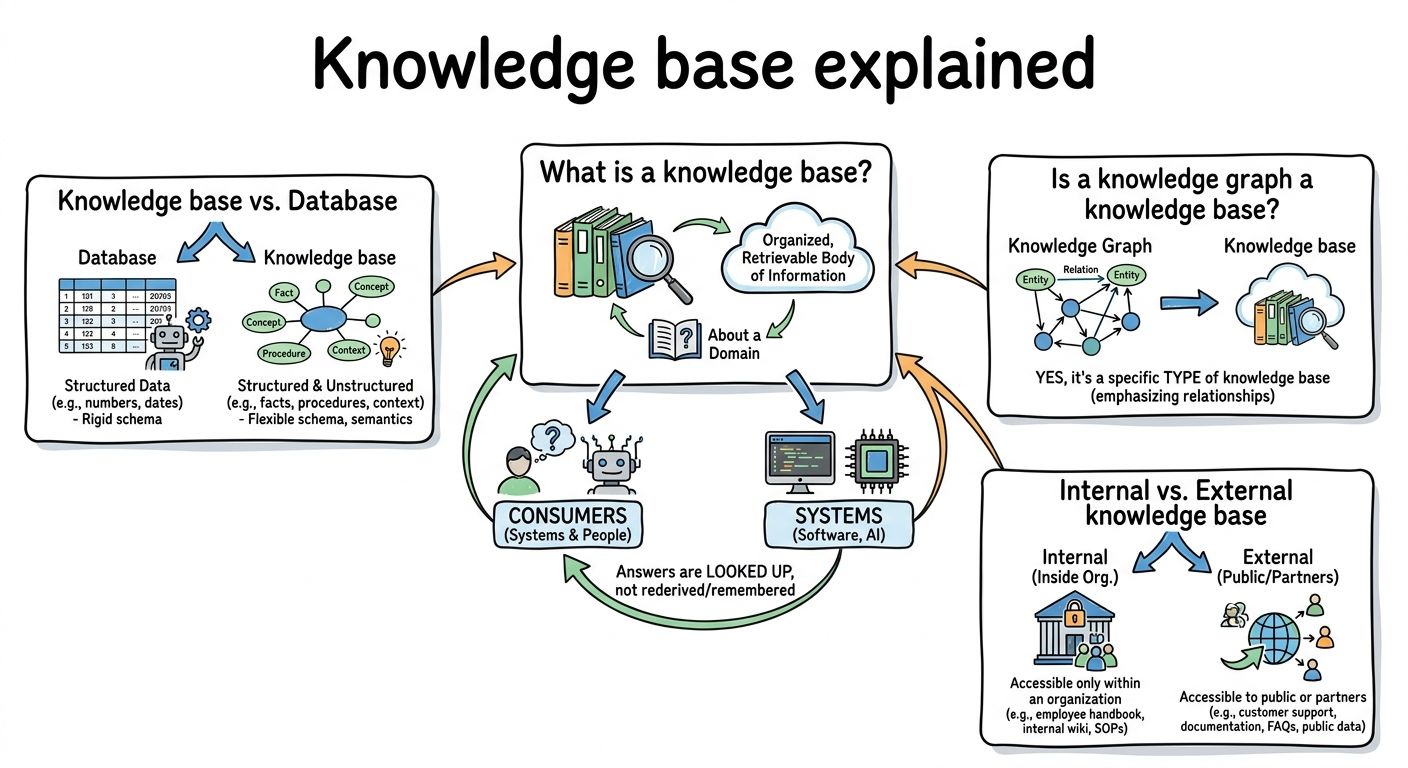
A knowledge base is a body of information about a domain, organized and indexed so that it can be retrieved on demand by whoever or whatever needs an answer. In its oldest sense, from artificial intelligence research, a knowledge base is a set of statements held in a knowledge representation language with interfaces to add new statements and to ask questions about what is known. It began life as one of the two halves of an expert system, paired with an inference engine that reasoned over it, as described in the Wikipedia entry on knowledge bases.
In everyday business use, a knowledge base is something plainer: the help center articles, troubleshooting guides, runbooks, policies, and product specifications a company writes down so the same question does not have to be answered twice. Both senses share the same shape. The knowledge lives outside the head of the person who first learned it, it is organized well enough to be found again, and retrieval is the point.
The third sense, and the reason the term is being searched again, comes from AI. When a language model is paired with a retrieval system, the corpus it retrieves from is called the knowledge base. The same words now describe a shelf of documentation and an index a machine reads at answer time.
A database stores instances as rows and is optimized for transactions, concurrency, and integrity, while a knowledge base stores facts, relationships, and general statements and is optimized for being read or reasoned over to produce an answer. The classic illustration is that a database records that a particular person exists, whereas a knowledge base can hold the general statement that all humans are mortal and let a system infer the rest.
That line was sharp when the term was coined in the 1970s and has blurred since. Modern databases added class and subclass relations and rule engines, and most knowledge bases today sit on top of perfectly ordinary databases. The useful distinction now is intent rather than technology. If the store exists to be transacted against, call it a database. If it exists to be consulted for an answer, call it a knowledge base. The Wikipedia entry on knowledge bases traces this convergence in more detail.
No. A knowledge graph is a kind of knowledge base, specifically one that uses a graph-structured data model: entities as nodes, relationships as typed edges, and often a formal ontology defining what kinds of entities and relationships are allowed. Every knowledge graph is a knowledge base, but most knowledge bases are not graphs. The Wikipedia entry on knowledge graphs and this Data Summit 2024 talk on enterprise knowledge graphs both define the graph as a knowledge base with a graph topology.
The practical difference is what question each shape answers well. A knowledge graph is good at "how is X connected to Y", because the connections are first-class objects you can traverse. A document-style knowledge base is good at "what do we say about X", because the unit of storage is an explanation written for a reader.
Two related terms are also not synonyms. A vector database is storage plus a similarity search mechanism, which is one possible way to index a knowledge base rather than the knowledge base itself. And retrieval-augmented generation is a pattern, not a store: the knowledge base is the thing RAG retrieves from.
An internal knowledge base serves employees and support agents with material like standard operating procedures, troubleshooting runbooks, escalation paths, and onboarding documentation, while an external knowledge base serves customers with self-service answers such as FAQs, setup guides, and policy pages. Atlassian's documentation on internal versus external knowledge bases draws the same line.
The difference is governance and trust boundary rather than technology. The same article can live in either, but the external version carries a higher editorial standard, no internal jargon, and no information the company would not want a competitor to read.
The neighboring terms follow the same logic. A help center is a knowledge base with a public audience and a presentation layer on top. A wiki is a knowledge base with open authorship and usually no curation step. An intranet is a knowledge base plus everything else an employee needs. What separates them is who may write, who may read, and whether anyone is accountable for keeping an entry true.
An AI agent uses a knowledge base by retrieving relevant passages from it at answer time and passing them to the model as context, so the response is grounded in a source rather than in whatever the model absorbed during training. The NIST glossary describes retrieval-augmented generation as a system "in which a model is paired with a separate information retrieval system (or 'knowledge base')", and notes that this arrangement "allow[s] the internal knowledge of a GenAI model to be modified without the need for retraining."
Scale decides whether you need retrieval at all. Anthropic's Contextual Retrieval post, published on September 19, 2024, puts the threshold plainly: "If your knowledge base is smaller than 200,000 tokens (about 500 pages of material), you can just include the entire knowledge base in the prompt that you give the model, with no need for RAG or similar methods." Above that, you chunk and retrieve, and chunks are usually no more than a few hundred tokens each.
Chunking introduces its own failure. As Anthropic puts it, "traditional RAG solutions remove context when encoding information, which often results in the system failing to retrieve the relevant information from the knowledge base." Their contextual embeddings and contextual BM25 approach reduced failed retrievals by 49%, and by 67% when combined with reranking.
A knowledge base works for an AI agent when it contains one answer per question, because a model cannot notice a contradiction the way a reader can. A person who finds a help center page saying returns are accepted within 30 days and a product page saying 45 will spot the mismatch and go ask someone. An agent will retrieve one of them and state it with confidence. Duplication and drift that humans quietly absorb become wrong answers delivered to customers.
This is the problem Sanity, the Content Operating System for the AI era, addresses in the Power anything pillar through agentic context storage and MCP delivery. A Sanity Knowledge Base, currently an opt-in beta, is a pre-built index over sources you choose: a dataset selected with a GROQ query, a website crawl that respects robots.txt, or uploaded files. Instead of reading and reconciling those sources at query time, a build reads them ahead of time, detects conflicts, and raises an issue showing the competing claims side by side with their sources so an editor picks which one is ground truth.
The result is a set of Markdown entries with citations back to the original source, organized under slash-delimited paths such as support/returns, plus an outline that marks entries as core or peripheral. A Knowledge Base belongs to an organization and can draw on sources from more than one project, and agents read it through Context MCP rather than querying the underlying content directly. Features and limits may change before general availability.
Discover More with Sanity
Now that you've learned about knowledge base, why not start exploring what Sanity has to offer? Dive into our platform and see how it can support your content needs.
Last updated: