System One model definition
A System One model is a class of AI model that returns typed, probabilistic decisions from a fixed answer space instead of generating text. Given a piece of state and a set of questions defined in code, it answers each one with a schema-valid value such as a chosen option, a score, or a probability, and then stops.
A System One model answers typed questions about a piece of content with structured values rather than prose: pick one of these options, place this on this scale, or give the probability that this is true. The name comes from Daniel Kahneman's fast, intuitive "System 1" thinking. Because the model judges whatever state you hand it, structured content matters: in Sanity, content is stored as discrete fields and blocks, so you can pass the exact block a question concerns instead of a whole rendered page.
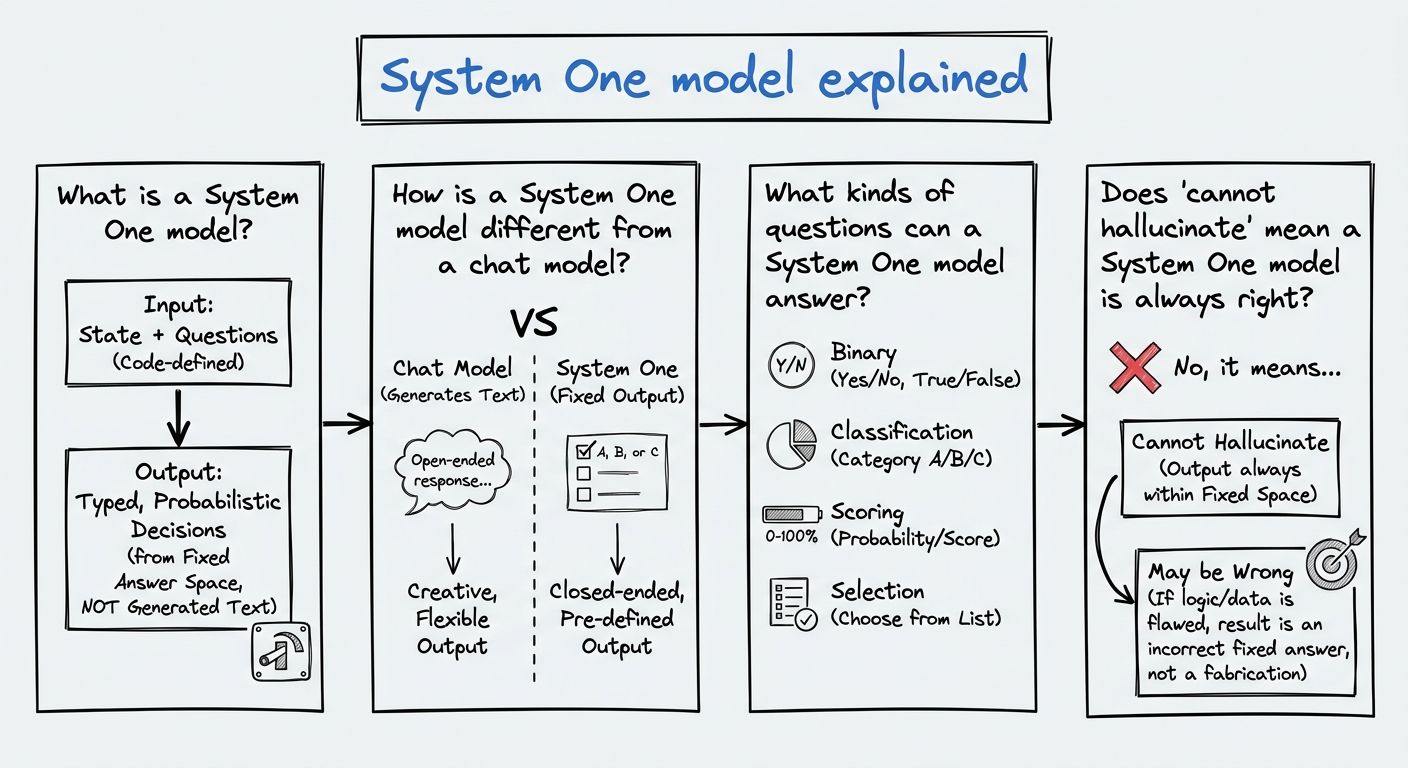
A System One model makes fast, structured decisions about a piece of text instead of writing text back. You give it state, meaning the text or JSON to be judged, plus a set of typed questions defined in your code. It answers the questions and stops. The response contains no prose, no rationale, and no code, only values that fit the types you declared.
The category name follows Daniel Kahneman's Thinking, Fast and Slow, which splits cognition into System 1, the fast and intuitive mode, and System 2, the slow and deliberate one. A System One model is deliberately the first of those: it is built for judgment calls a system makes thousands of times a day, not for reasoning tasks where you want an explanation.
The first model released in this class is Jev, published by TypeSafe AI on 15 September 2026 and built by Diogo Almeida, previously at OpenAI and a co-author of the InstructGPT paper. The name is a nod to William Stanley Jevons, whose paradox holds that efficiency gains increase total demand rather than reducing it. Jev is the first example of the class, not a synonym for it.
A System One model differs from a chat model in what it produces and how it computes it. A chat model is autoregressive: it generates one token at a time, each conditioned on the tokens before it, so a longer answer takes proportionally longer and the shape of the answer is whatever the text happens to be. Getting
A System One model skips generation entirely. TypeSafe describes Jev's architecture as a parallel sampler that computes all outputs in a single pass rather than emitting tokens in sequence, with each question in a call evaluated independently against one shared read of the state. The practical consequence TypeSafe reports is that a tenth question in the same call costs input tokens, but almost no extra time. Training also differs: TypeSafe says Jev is trained with RLCD, Reinforcement Learning for Calibrated Decisions, rather than the RLHF approach used to tune conversational models.
The tradeoff is that a System One model cannot tell you anything. It emits no text at all, so there is no explanation, no summary, and no draft. Every performance and architecture detail here is self-reported by TypeSafe and has not been independently reproduced.
A System One model answers questions from a bounded, known answer space, and Jev publishes three question types that show what that means in practice.
Choice picks one option from a list of up to 255 and returns a probability for each option plus a separate confidence value, which suits routing, tagging, and classification. Score places the state on an ordered scale of 2 to 10 levels, where each level is described in words, and the answer can land between two levels rather than snapping to one.
What these share is a fixed answer space you define before the call. A System One model is not the right tool when the set of valid answers is open-ended, when the answer is a piece of writing, or when you need the reasoning rather than the verdict.
No. When a System One model is described as unable to hallucinate, the claim is about format, not correctness. The output is constrained to schema-valid values, so an off-schema option, a score outside the declared range, or a type error is structurally impossible. The model can still return the wrong valid answer, like a confident but incorrect category, or a probability that does not match reality.
That distinction matters when you design around one. A guarantee of well-formed output removes a whole class of parsing and retry code. It does not remove the need for evaluation, spot checks, or a human review path on decisions that carry consequences. TypeSafe asserts a 0% structured-output error rate for Jev from schema design rather than from measurement, which is a claim about what the format permits, not a measured accuracy figure.
A probability is also a filter, not evidence about a person. Using a returned score as though it were a finding about someone, rather than a signal for ranking or triage, misreads what the number is.
For Jev, the only published System One model, every accuracy and pricing figure comes from TypeSafe itself and has not been independently reproduced. On TypeSafe's own four-workflow benchmark, TypeSafe reports Jev scoring 67.8%, level with GPT-5.6 Terra and behind GPT-5.6 Sol at 74.1% and Claude Opus 5 at 73.1%, at roughly one two-hundredth of the cost. That "accuracy" measures agreement with GPT-6 Astra and Claude Fable 5.1 used as consensus labels, not agreement with ground truth, so it says how closely Jev tracks two frontier chat models rather than how often it is correct.
On cost and latency, TypeSafe lists $0.042 per million input tokens with output unmetered and free, a 64,000-token context with a 32,000-token state budget, and end-to-end times of 70 to 500 milliseconds. Access is closed, hosted, and waitlisted, through POST to https://api.typesafe.ai/v1/systemone on the jev-latest route, with jev-1.13.0 the only published build and SDKs for Python and TypeScript. The weights are not open.
Known weaknesses are worth reading alongside the numbers. TypeSafe notes Jev is unreliable at counting, with error growing as the count grows, treats dates as text rather than as ordered quantities, and is text-only.
A System One model needs state that is small, relevant, and complete, because its answer is only as good as the slice of content it is given. Jev's state budget is 32,000 tokens, so on anything larger than a short document you choose what to send. Sending a whole rendered page wastes the budget on navigation, boilerplate, and markup, and it buries the part the question is about.
That is an argument for storing content as structured fields and blocks rather than as one blob of markup. When the product description, the legal disclaimer, and the image caption are separate addressable fields, you can hand a moderation question the caption alone and a tone question the description alone. Sanity stores content in the Content Lake as structured documents queried with GROQ, which is what makes it possible to select exactly the field or block a typed question concerns before the call is made. Sanity has not announced an integration with Jev or with any System One model, and none of this depends on one: the architectural point holds for any model that judges state you assemble yourself.
Explore Sanity Today
Understanding System One model is just the beginning. Take the next step and discover how Sanity can enhance your content management and delivery.
Last updated: