Skip to content

WinnerPath oneRules & eligibility

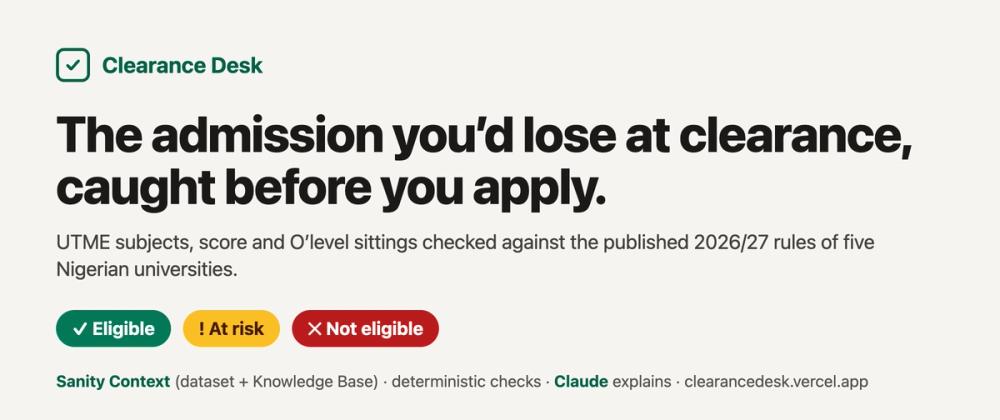
Clearance Desk

Catches the Nigerian university admission you'd lose at clearance, before you lose it.

by Idolor Godswill Eseteru

Eval cases correct, versus 6/15 for the same model with Knowledge Base search
13/15
Ineligible candidates told "Eligible", versus 4 for the keyword-search baseline
0
Source conflicts Sanity Context surfaced in the Knowledge Base
7

What it does

An applicant enters their results. Each course comes back eligible, at risk or not.

An applicant, parent or teacher enters UTME subjects, score and O'level sittings, then picks a course at UNILAG, UI, OAU, UNN or LASU, or asks which courses they qualify for. Each course gets a verdict with a plain-English reason and links to the source behind every rule.

Under the result, they can ask follow-up questions about deadlines, screening and awaited results. Answers come only from JAMB and university notices, and the agent says when the sources do not cover the question.

The problem

A strong UTME score can still fail at clearance over one subject.

Clearance is when a university checks O'level results against course rules, after admission has been offered. Small details decide it: how many sittings are allowed, a missing Further Maths credit, a subject that does not count for a given course. A single mismatch costs the applicant a year. The rules are spread across JAMB brochures and university notices, and those sources often disagree with each other.

What they built

Admission rules modelled as checkable data, one requirement per programme.

34 requirements across 5 universities for 2026/2027, built from 57 saved sources (51 official); Knowledge Base from 32 sources.

  • source

    One saved official notice, brochure or blog that rules and citations point back to.

  • subject

    One exam subject, matched by ID with aliases so naming differences do not break matches.

  • institution

    One of the five covered universities.

  • programme

    One course offered by a university.

  • requirement

    One programme's UTME and O'level rules for a session, with citations, verification status and conflict notes.

The stack

Two Context endpoints, one evaluator, one agent loop.

  • Sanity Context MCP
  • Knowledge Base
  • Content Lake
  • GROQ
  • Vercel AI SDK 6
  • Claude Sonnet 5.5
  • TypeScript
  • Next.js
  • Vercel
  • JAMB IBASS API
  • Claude Code

The hard part

The model finds and explains the rules; deterministic code decides every verdict.

Claude queries requirement documents through one Context endpoint, then hands their IDs to a local TypeScript evaluator. The evaluator holds the applicant's results server-side and checks subjects, scores and every sitting combination. A second endpoint serves the Knowledge Base for explanations.

Code drops any policy note whose source was not read in that run and still returns verdicts if the model stalls. In the builder's eval, the same model with keyword search over the same content read the right rules and still misjudged eligibility.

Full eval results ↗

More from path one

See the full showcase