Agent action selection definition
Agent action selection is the step in an AI agent's loop where it decides what to do next from the actions available to it: call a tool, ask the user a question, hand off to another agent, or stop. The decision can be made by a language model, by a fixed workflow with branch points, or by a separate classifier that picks from a closed list.
An AI agent chooses its next action by comparing its current state against a defined set of options, then picking one, usually through a model emitting a tool call, a workflow routing on a branch condition, or a fast classifier selecting from a closed list. The quality of that choice depends on how bounded the inputs and options are. Structured content helps here: in Sanity, typed fields and references to taxonomy documents give an agent a clean input and a finite answer space rather than free prose to interpret.
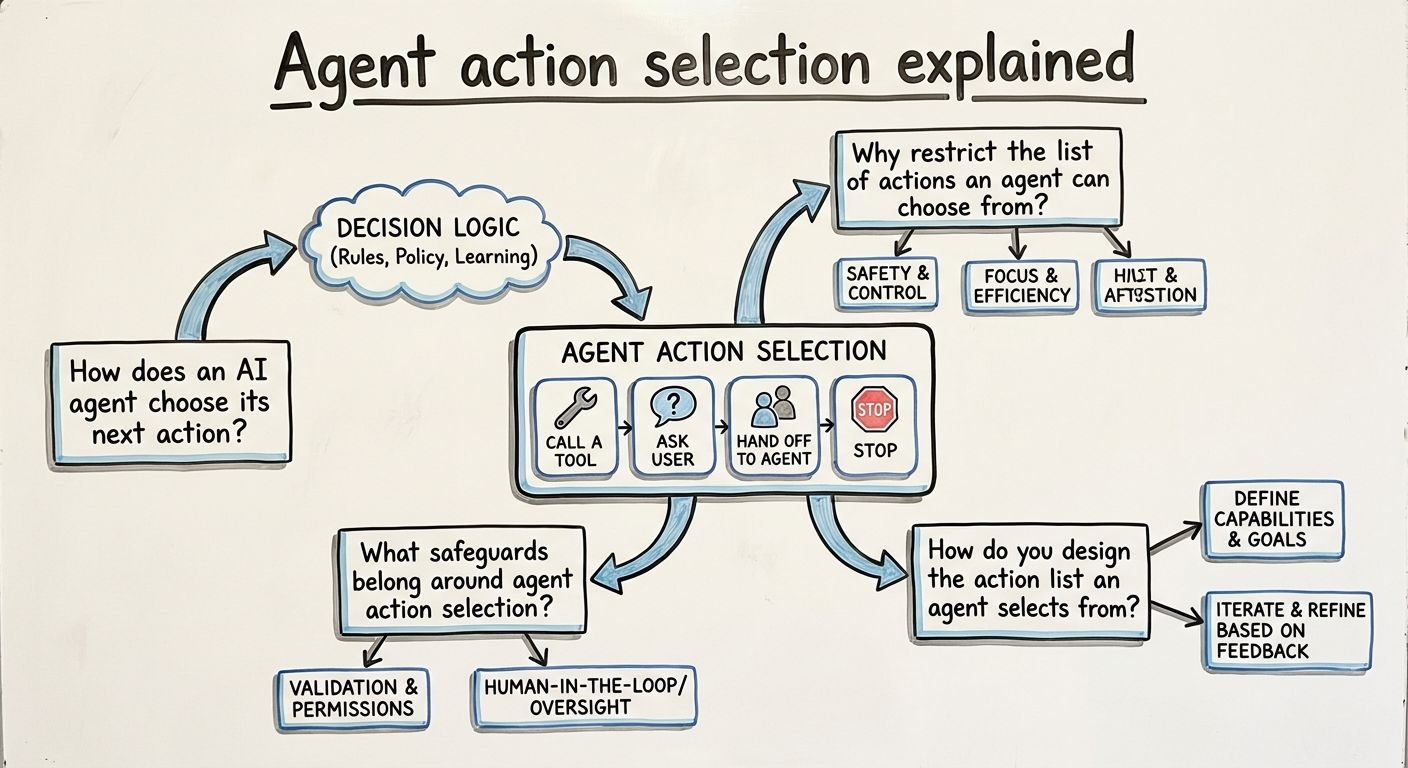
An AI agent chooses its next action by reading its current state, which includes the user's request, what it has already done, and whatever context it has retrieved, and then selecting one option from the set of actions it is allowed to take. Agent action selection is that step, and it repeats on every turn of the loop until the agent either produces a final answer or stops.
Three designs cover most of what engineers build today. In the first, a language model performs the selection directly: the available tools are described to the model, and the model responds with the name of a tool and its arguments. This is tool calling, and it is the default pattern in most agent frameworks.
In the second, the sequence is fixed in code as a state machine or workflow, and a model is consulted only at branch points. The agent always does step one, then step two, and the model decides only whether step three is the refund path or the escalation path.
In the third, a separate, smaller component handles the choice. A classifier or decision model takes the context and returns one item from a closed list of actions, with no free text generated at all. Choosing an agent's next action is one of the uses OpenAI names for its Decisions API, announced at DevDay on 29 September 2026, which focuses a model on user-defined questions with finite pre-defined answers.
Restricting the list of actions in agent action selection narrows what can go wrong. When the answer space is a closed set of named actions rather than open text, the agent cannot invent a tool that does not exist, cannot call a real tool with a malformed name, and cannot wander into a step nobody designed for. The output is one of N known values, so the code receiving it does not need to parse or repair anything.
There are three practical gains. Validity: an action outside the list is impossible by construction rather than caught after the fact. Auditability: a decision recorded as "chose refund_order out of these five options" is reviewable by a person months later, which a paragraph of model reasoning is not. Cost and latency: selecting from a short list is a smaller job than generating an explanation, so it can be routed to a cheaper, faster model, and the dominant cost drivers become how much context you send and how many turns the loop runs rather than how much text comes back.
The trade is real. A bounded action list is less flexible than an open-ended model, so a situation nobody anticipated has no correct option and the agent picks the least wrong one. The list also becomes something you maintain: every new capability, every edge case, and every retired tool means revisiting it, and an action list that drifts out of sync with the tools behind it fails in confusing ways.
The safeguards that belong around agent action selection are gating, thresholds, and logging, and they address different failure modes.
Tool gating controls which actions are even on the list for a given agent, user, or moment in the conversation. A read-only agent never sees a delete tool. A support agent sees the refund tool only after identity has been verified. Gating works at the level the model cannot argue with: if an action is not in the set presented, it cannot be selected.
Confidence thresholds decide when the agent should not act alone. If the selection component reports how certain it is, or if two independent components disagree, the system can route the case to a person instead of proceeding. This is the human-in-the-loop pattern applied at the decision point rather than at the end, and it is most useful for actions that are expensive to reverse, such as issuing money, sending external email, or publishing to a live audience.
Logging every decision creates a decision audit trail: what context the agent had, which options were available, which one it chose, and what happened next. Without that record, a wrong action is a mystery; with it, you can tell whether the retrieval was bad, the action list was wrong, or the selection itself misfired. Teams running agents in production generally find the log is what makes improvement possible at all, because it turns one-off complaints into a reviewable set of cases.
Designing the action list for agent action selection is mostly a modeling exercise, and the following sequence holds up in practice.
One: write down every outcome the agent is responsible for, in the user's language, not the API's. Two: map each outcome to exactly one action, and give the action a name that says what it does rather than which system it touches. Three: add the non-tool actions explicitly, because asking the user a clarifying question, handing off to another agent, and stopping are all real choices and an agent with no way to stop will keep acting. Four: decide which actions require gating or human approval before they run. Five: define what the agent does when none of the options fit, since a default of "escalate" is safer than a default of "guess." Six: log the decision with the options that were on the table, not just the one that was taken.
The quality of the inputs matters as much as the list. An agent selecting an action from a wall of unstructured prose has to interpret before it can decide, and interpretation is where errors enter. Sanity, the AI Content Operating System, is built for the opposite case: content stored as typed fields with references to taxonomy documents and a full history of document revisions, so an agent reading it gets values with known shapes rather than text it has to parse, and the set of valid choices can be derived from the taxonomy itself instead of hard-coded in a prompt.
Agent action selection is one step inside an
The distinction matters when something goes wrong, because it tells you where to look. If the agent chose a sensible action and the action failed, the problem is in the tool or the data it reached. If the agent chose an action no reasonable operator would have chosen, the problem is in selection: the context was incomplete, the action descriptions were ambiguous, or the list contained two options that overlap.
It also matters when you are deciding what to optimize. Making the overall workflow faster often means cutting turns or parallelizing tool calls. Making selection faster and more predictable usually means a smaller, tightly scoped component for the decision itself, which is the thinking behind decision models that return a choice from a defined answer space instead of generated text.
Explore Sanity Today
Understanding agent action selection is just the beginning. Take the next step and discover how Sanity can enhance your content management and delivery.
Last updated: