Agentic workflow definition
An agentic workflow is a multi-step process in which one or more AI agents, rather than a fixed script, decide what to do next. The system is given a goal, not an ordered list of instructions, and a model plans the steps, calls tools to carry them out, reads the results, and re-plans until an exit condition is met.
An agentic workflow hands control of a process to an AI agent: you give it a goal, and it plans the steps, calls tools, reads what came back, and re-plans until it is done. Every run needs somewhere the stages, the tool results, and the approvals are recorded, or nobody can audit it afterward. In Sanity, Workflows (currently in beta) define those stages in TypeScript beside the content, so an agent that advances or rejects a draft leaves its decision in the content repository.
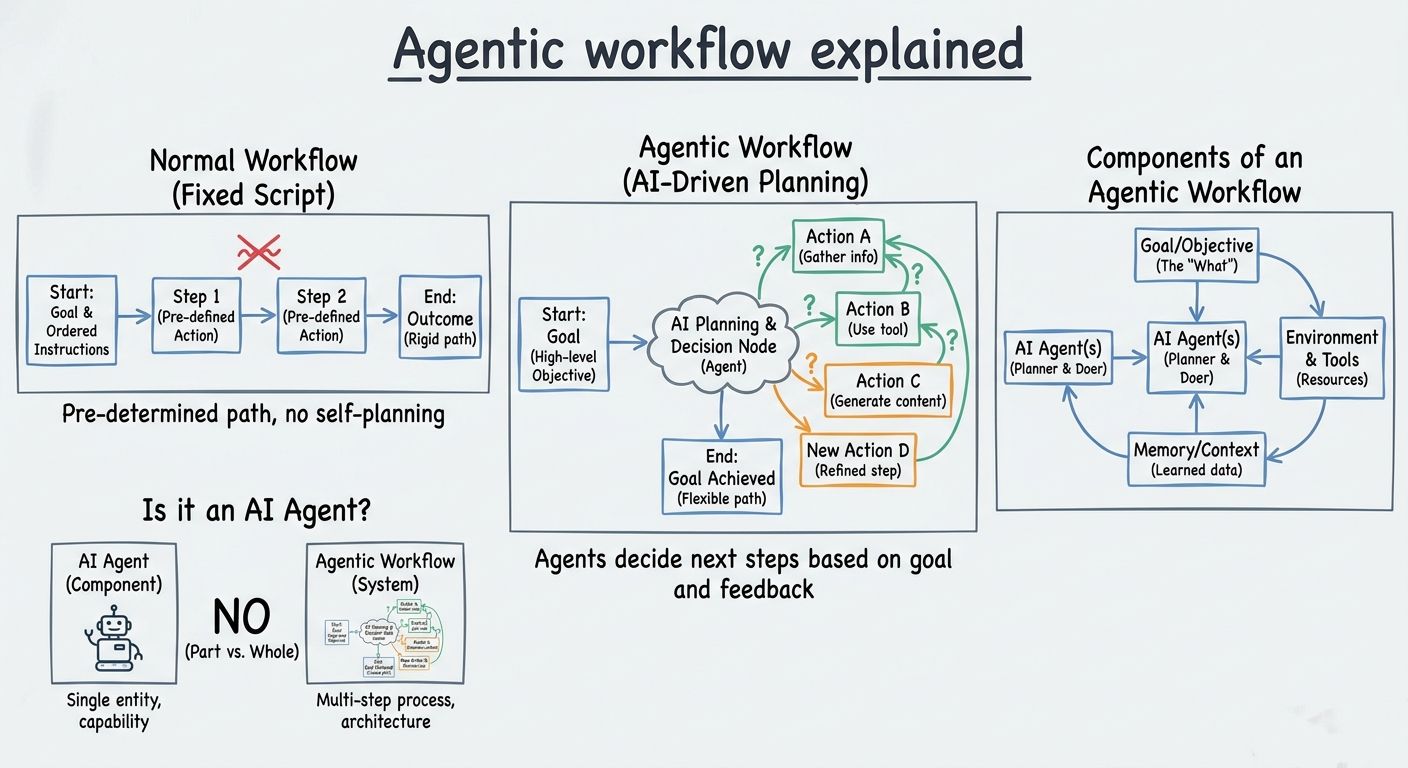
The difference is who decides the control flow: in a normal workflow, the code decides, and in an agentic workflow, the model decides. Anthropic's "Building effective agents" (published December 19, 2024) draws the line this way: "Workflows are systems where LLMs and tools are orchestrated through predefined code paths. Agents, on the other hand, are systems where LLMs dynamically direct their own processes and tool usage, maintaining control over how they accomplish tasks."
Anthropic groups both under the heading agentic systems, which is why the phrase "agentic workflow" gets used in the wild for both halves of the split. Its taxonomy of seven patterns is a useful ladder: the augmented LLM, prompt chaining, routing, parallelization, orchestrator-workers, evaluator-optimizer, and the autonomous agent loop. The first six are predefined code paths with model calls inside them. Only the last one hands control flow to the model.
A practical test for any system you are looking at is this: if you can draw the sequence of steps before the run starts, it is a workflow with AI inside it. If the sequence is only knowable after the run, it is agentic.
An agentic workflow runs as a loop, and the loop is an ordinary program, not something mysterious. The program sends the model three things: a system prompt, the conversation history so far, and a menu of tools it is allowed to call. If the model replies with tool calls, the program runs them, appends both the model's turn and the tool results to the history, and calls the model again. If the model replies with text and no tool calls, that text is the answer and the loop stops. The wrapper program that does all this is usually called the harness.
Google Cloud describes the same mechanism as "continuous perception, reasoning, and action loops," with the agent decomposing a high-level goal into sub-tasks (page last updated August 11, 2026).
There are two ways out. That cap is usually set somewhere between 20 and 50 iterations in the loops Sanity runs, or an equivalent ceiling on total tokens or wall-clock time, so a confused agent stops instead of spinning.
An agentic workflow is built from six recurring parts, per IBM's and Google Cloud's component lists. First, an AI agent, the actor that takes the goal. Second, a large language model as the reasoning engine that does the planning. Third, tools: APIs, search, datasets, and anything else the agent can invoke to change or observe the world. Fourth, memory, which Google Cloud splits into short-term memory inside the context window and long-term memory that persists across sessions. Fifth, feedback mechanisms, including
Retrieval is where many of these workflows get decided, because an agent reasoning over stale or vague content will plan confidently and wrongly. When Sanity is the source, an agent's retrieval tool is a GROQ query, so hard filters compose with keyword and semantic ranking in one request, and the result reflects what is published now rather than a nightly snapshot.
Multi-agent setups, where several agents split the work, are one way to build an agentic workflow, not a requirement of one. Google Cloud frames multi-agent frameworks as a scaling choice for enterprise workloads.
No. An AI agent is the actor, and the agentic workflow is the process that actor runs. The workflow includes the tools the agent may call, the order it discovers at runtime, the checkpoints where a human or another agent approves, and the conditions under which it stops. IBM states the containment relation plainly: a workflow is not agentic if it does not consist of an AI agent.
Two other confusions are worth clearing up. An agentic workflow is not a single AI call, even a good one. Anthropic's advice is that for many applications, optimizing single LLM calls with retrieval and in-context examples is usually enough, because agentic systems trade latency and cost for better task performance. A single retrieval-augmented answer is not an agentic workflow.
And "agentic" does not mean no human is involved. Human-in-the-loop review is listed as a core component by IBM, and Google Cloud's worked example stages a fix for mandatory human review before production. Autonomy here is about who chooses the next step, not about whether a person ever signs off.
IBM's IT helpdesk example is the clearest contrast available. A rule-based chatbot walks a static decision tree and escalates to a human when the tree runs out. The agentic version asks clarifying questions, picks which diagnostic to run based on the answers, calls a monitoring API if it suspects a server-side fault, and tries a different approach when the first one fails. Both handle password resets. Only one handles the ticket nobody anticipated.
The pattern in content operations looks similar. A person submits a draft, an agent checks it against the style guide, and the agent either moves the work forward or sends it back with a reason. What makes that governable, not alarming, is that the stages are written down and the agent's decision is recorded. Sanity is the Content Operating System for the AI era, and Workflows (in beta) model those stages in TypeScript, versioned and deployed alongside the rest of your code, so the process cannot drift from what is written down. Because the trail lands in the content repository rather than a separate audit system, a question like "what published without legal review" is one GROQ query.
Governance is not a nice-to-have here. Gartner predicted on June 25, 2025 that over 40% of agentic AI projects will be canceled by the end of 2027, citing escalating costs, unclear business value, and inadequate risk controls.
Not a precise one, and it is more useful to say so than to pretend otherwise. Anthropic notes that "agent" can be defined in several ways, with some teams meaning fully autonomous systems that run over long horizons and others meaning prescriptive, predefined workflows with model calls inside them. IDC's framing is the shortest one that most vendors would accept: an agentic workflow executes a task end to end rather than only answering a question.
Where the references do agree is the contrast with older automation. IBM describes traditional automation such as robotic process automation as following predefined rules, sufficient for repetitive tasks with a standard structure, while agentic workflows are dynamic and adapt to real-time data and unexpected conditions in a multistep, iterative way. Google Cloud makes the same point about scripts that follow rigid, pre-defined pathways.
So when someone tells you a system is an agentic workflow, the question worth asking is not whether the label fits. It is which decisions the model gets to make, which tools it can reach, and where a human still has to say yes.
Unlock New Possibilities with Sanity
With agentic workflow under your belt, it's time to see what Sanity can do for you. Explore our features and tools to take your content to the next level.
Last updated: