Agentic marketing definition
Agentic marketing is marketing in which AI agents plan and carry out multi-step work such as briefing, drafting, localizing, and publishing under human oversight. The term also covers marketing aimed at AI agents that research, compare, and buy on behalf of people.
The best AI content generation workflows for marketing teams give agents structured content and written brand rules to work from, and they put a human approval step between brief, variants, localization, and publishing. In Sanity, content is stored as schema-defined fields instead of finished pages, so Content Agent or a workflow built on the Agent API edits named fields under that schema, and the same approved record serves the website and the AI agents that read it.
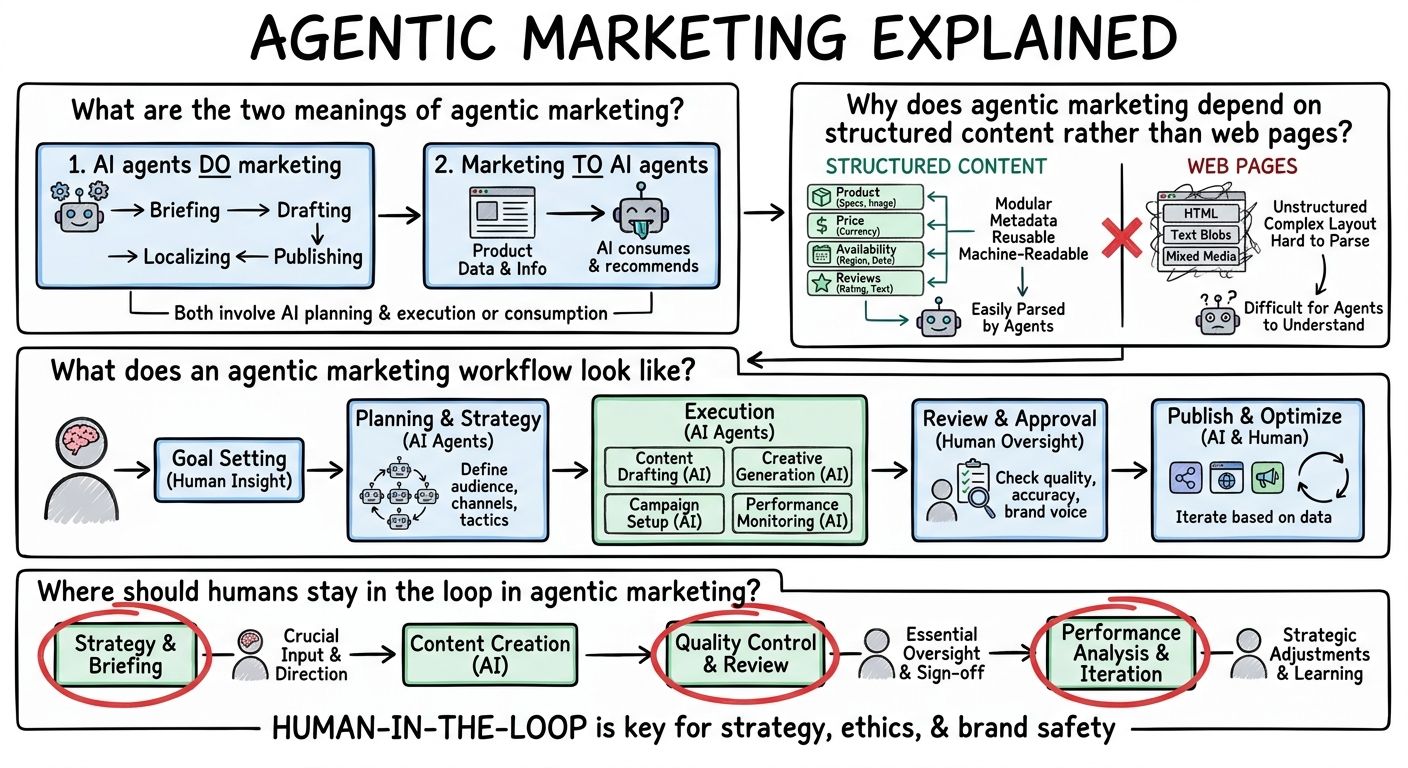
Agentic marketing has two meanings, and both matter to a marketing team. The first is marketing work carried out by AI agents, meaning software that can take a goal, break it into steps, use tools, and act on the results, not just answer a single prompt. In this sense, an agent might turn a campaign brief into channel copy, adapt it for several markets, and queue it for review.
The second meaning is marketing aimed at AI agents that act for buyers. When a person asks an assistant to compare products, summarize options, or complete a purchase, the assistant reads your content before any human does. Agentic marketing in this sense is about making product facts, pricing, and claims accurate and easy for a machine to parse, so the agent represents your offer correctly.
The two meanings share one requirement. Whether an agent is writing your content or reading it, agentic marketing works only when the underlying content is accurate, current, and machine-readable.
Agentic marketing depends on structured content because agents work reliably with labeled fields, and they work poorly with finished prose pages. Structured content stores information as typed fields, such as a product name, a price, a benefit statement, and a legal disclaimer, before it is rendered into any page. An agent can then change one field, check another, and leave the rest untouched.
A prose page mixes all of that into paragraphs and layout. An agent generating a variant from a page has to guess which sentence is the regulated claim and which is flexible copy, and an agent reading the page for a buyer has to guess which number is the current price. In our experience, those guesses are where off-brand copy and wrong answers come from.
Agentic marketing also depends on governed brand rules: tone guidance, approved terminology, banned claims, and required disclaimers written down where an agent can read them. Rules that live only in people's heads cannot constrain an agent.
An agentic marketing workflow moves content through a fixed sequence of stages, with an agent doing the repetitive work and a person approving each handoff. A practical version has five steps.
Step 1 is briefing: a marketer writes a structured brief naming the audience, the offer, the key message, the channels, and the markets. Step 2 is variant generation: an agent drafts copy for each channel and audience into the matching fields, following the written brand rules. Step 3 is review: an editor accepts, edits, or rejects each variant and records why, so the rules can be improved. Step 4 is localization: an agent translates and adapts approved copy per market, and a regional reviewer checks meaning, tone, and local regulations. Step 5 is publishing: approved content goes live to the website, apps, and any channel where AI agents read it, from the same source.
The value of this agentic marketing workflow comes from the order. Generation happens only from an approved brief, and localization happens only from approved source copy, so errors are caught before they multiply across variants and languages.
In agentic marketing, humans should approve anything that changes what the brand promises: the brief, the source copy, regulated or legal claims, and the final publish decision. Agents handle volume, such as drafting variants, resizing copy for channels, and producing first-pass translations. People handle judgment.
A useful test is reversibility. If a mistake would be cheap to fix and visible only internally, an agent can act and a person can spot-check. If a mistake would reach customers, regulators, or AI agents answering buyers, a person signs off first. Keeping a record of what each agent changed, and who approved it, lets the team audit agentic marketing output and tighten the brand rules over time.
Sanity supports agentic marketing by holding marketing content as schema-structured documents that people and agents edit in the same place. Sanity is the AI Content Operating System, and in practice that means the content model, the brand rules, and the approval steps live in one back end, not split across a CMS, a spreadsheet, and a translation tool.
For marketing work done by agents, Content Agent and the Agent API let teams run agentic automation such as drafting, transforming, and translating content against the fields defined in the schema, with editors reviewing the results in Sanity Studio before anything is published.
For marketing aimed at agents, the same structured records that render the website can be delivered as clean, field-level data to AI agents and other channels. One approved source means a buyer reading the product page and an assistant answering a buyer's question get the same facts.
Explore Sanity Today
Understanding agentic marketing is just the beginning. Take the next step and discover how Sanity can enhance your content management and delivery.
Last updated: