AI governance definition
AI governance is the set of policies, controls, accountability structures, and oversight that determine how AI systems and agents are used, what data and systems they can access and change, and who is answerable for what they produce.
AI governance is the set of policies, controls, and accountability that decides what AI systems and agents may access and change, and who answers for their output. For agents editing content, it comes down to permissions, review, and traceable history, which Sanity implements directly: the Content Agent works only within the user's existing role permissions, proposes edits that an editor approves into a draft or Content Release, and approved changes land in each document's revision history.
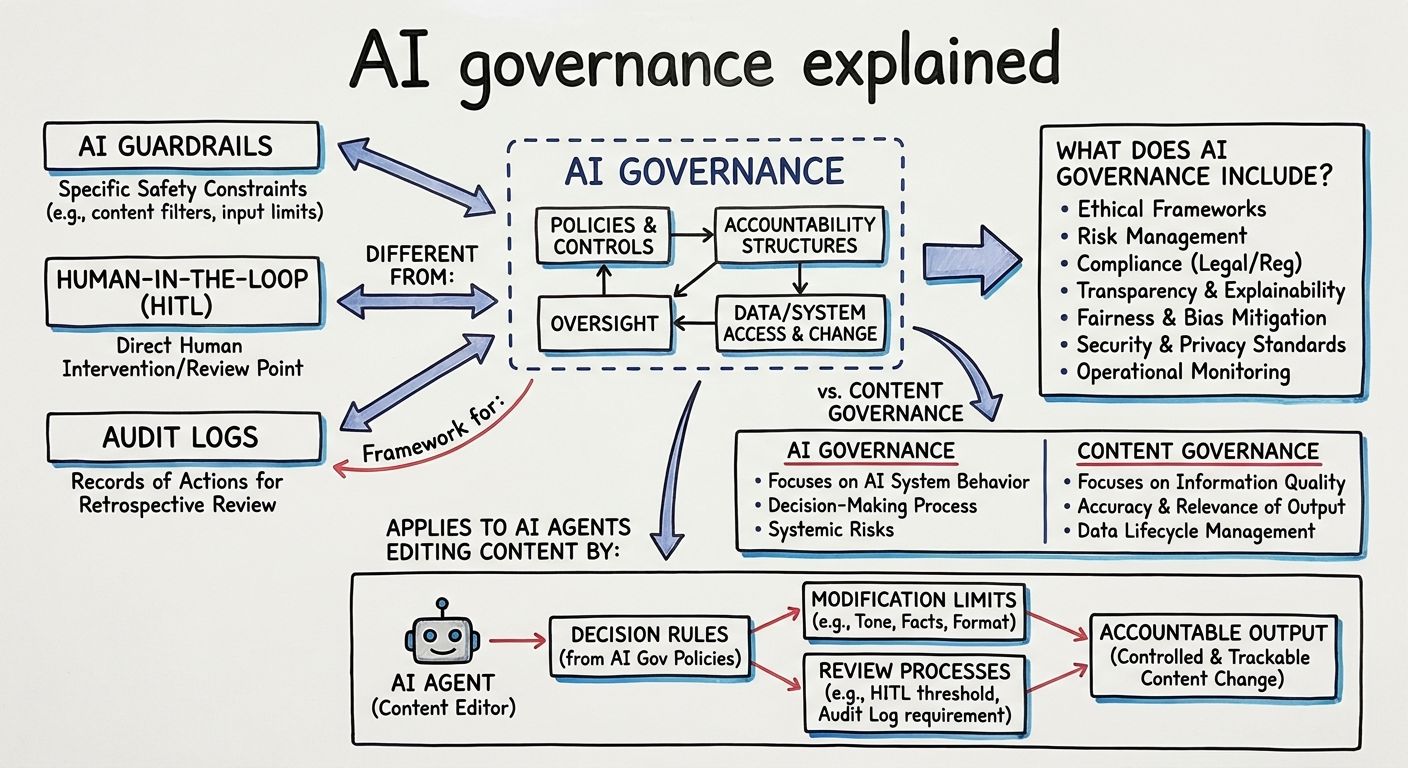
AI governance includes four things: rules for how AI may be used, technical controls that enforce those rules, named people who are accountable for outcomes, and ongoing oversight of risk across the AI lifecycle. IBM describes it as "a set of policies, processes and tools designed to ensure that AI systems behave ethically, reliably and in compliance with regulations."
Major frameworks treat accountability as part of the definition, not an add-on. The NIST AI Risk Management Framework 1.0, released January 26, 2023, makes GOVERN one of its four core functions alongside MAP, MEASURE, and MANAGE, and it covers roles, responsibilities, training, and executive accountability. The OECD AI Principles include an Accountability principle that asks AI actors to apply systematic risk management according to their roles.
For organizations that want a certifiable structure, ISO/IEC 42001:2023, published in December 2023, is the first standard for an AI management system, meaning the organizational framework that sets up and maintains AI governance.
AI governance is the organizational system that sets the rules and assigns accountability, while guardrails, human-in-the-loop review, and audit logs are mechanisms that AI governance may require.
AI guardrails are runtime technical checks on what goes into and comes out of a model, such as filters, validators, and blocked topics. McKinsey and Telnyx both describe guardrails as controls of this kind. Guardrails enforce rules. AI governance decides what the rules are.
Human-in-the-loop (HITL) is a design pattern in which a person reviews or approves an AI action before it takes effect. The EU AI Act writes a version of it into law in Article 14, which covers human oversight of high-risk systems. AI governance decides where HITL is required and where it is not, for example, on read-only actions.
An audit log is evidence: a record of who or what did what, and when. AI governance sets what must be logged, who reviews it, and how long it is kept. Logs make AI governance checkable after the fact, but they do not replace it.
AI governance covers AI systems wherever they are used, while content governance covers how content is created, reviewed, approved, and published, whether a person or a machine does the work. The two overlap when AI agents create or edit content.
At that overlap, a sensible rule is that an agent's edits should pass through the same permission, review, and history controls as a human editor's. An agent that can publish when its user cannot, or whose changes leave no record, sits outside content governance even if the organization has a written AI governance policy.
AI governance is also distinct from data governance. IBM treats the two as complementary: data governance controls the data itself, while AI governance controls the models and agents and how they are used.
For AI agents that edit content, AI governance becomes four concrete questions an organization should be able to answer for every change.
First, permissions: what can the agent read, and what can it write? Second, review: does a person approve a change before it goes live? Third, provenance: can you tell what was changed, and when? Fourth, audit trail: can you reconstruct and query that record afterward?
These questions matter more as agents move from pilots into daily work. In McKinsey's The state of AI in 2025 survey of 1,993 respondents, conducted in June and July 2025, 23% said their organizations were scaling at least one agentic AI system and 39% said they were experimenting with AI agents. An agent that writes to a website or product catalog acts on behalf of the business, so AI governance for agents is not just guardrails, but the discipline of giving those agents no more reach than a person in the same role would have.
Sanity supports AI governance for content agents by running AI actions through the same roles, review steps, and document history that govern human editors. Sanity is the AI Content Operating System, the intelligent back end for companies building AI content operations at scale, and its approach to agentic automation is to give agents context with full governance and control.
Roles in Sanity are named bundles of permissions, and the Content Agent can only see documents the user can see and edit where the user has write access. The built-in Contributor role, for example, can write drafts but cannot publish. Custom roles are available on Enterprise plans.
Review is built into the Content Agent, which never applies changes without approval. An editor decides whether to create drafts, add the changes to a Content Release, or discard them. Content Releases, available on certain Enterprise plans, group changes across many documents so they can be previewed and validated before publishing together.
Provenance comes from document history, where each edit is stored as a transaction in the revision history. Retention is 3 days on Free, 90 days on Growth, and 365 days or custom on Enterprise. Because content is structured to a Schema, AI edits land in specific fields, which makes them easier to review than changes to a blob of text.
The main laws and standards that shape AI governance today are the EU AI Act, the NIST AI Risk Management Framework, ISO/IEC 42001, and the OECD AI Principles.
The EU AI Act (Regulation (EU) 2024/1689) entered into force on August 1, 2024, with obligations phasing in over several years. Its Article 14 requires human oversight of high-risk AI systems. The NIST AI RMF 1.0 is a voluntary US framework built around the GOVERN, MAP, MEASURE, and MANAGE functions. ISO/IEC 42001:2023 defines a certifiable AI management system. The OECD AI Principles set out values, including accountability, that many national policies draw on.
None of these frameworks prescribes a specific tool. They describe outcomes, such as clear accountability, documented oversight, and managed risk, and leave each organization to choose the controls that deliver them.
Discover More with Sanity
Now that you've learned about AI governance, why not start exploring what Sanity has to offer? Dive into our platform and see how it can support your content needs.
Last updated: