Content layer definition
A content layer is the tier in an application architecture that stores, models, and serves content as structured, queryable data, independent of the interfaces that display it. It sits between raw storage and the surfaces that consume content, and it exposes that content over APIs rather than as pre-rendered pages.
A content layer is the architectural tier that holds content as
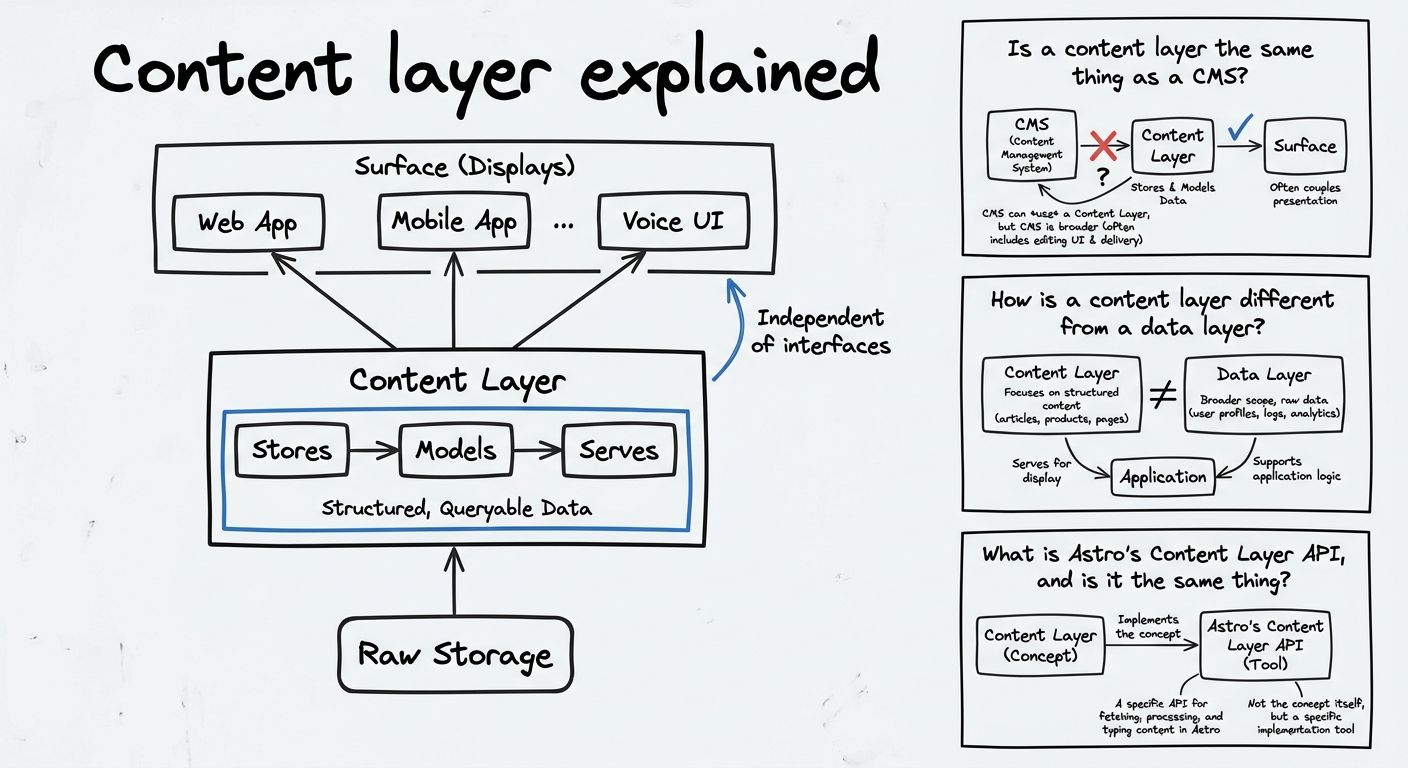
A content layer sits between storage and presentation. It models content into types, fields, and relationships, then serves it over query APIs to whatever asks for it. Websites, mobile apps, in-product help, kiosks, and AI agents all read from the same place, and none of them own the content.
The defining property is content as data. Instead of storing a page of markup that mixes meaning with layout, a content layer stores discrete pieces with known shapes: a price is a number, an author is a reference to a person document, and a body is structured text. Everything people associate with a content layer (multi-channel delivery, reuse, translation, and machine readability) follows from that separation.
It is also worth being clear about what a content layer is not. It is not the transactional data layer that runs the application itself, holding orders, inventory rows, sessions, and user records. In the five-layer agentic stack described by Topic Intelligence in March 2026, the content layer is Layer 3, sitting above the data and storage layer (Layer 2) and below agent orchestration (Layer 4), with infrastructure at Layer 1 and the user or agent interface at Layer 5. That is one vendor's model, not a standard, but it maps well to how these systems get built in practice.
No. A content layer is an architectural position, not a product category, and a CMS (content management system) is a product category, not an architectural position. A CMS often implements the content layer, but the content layer also includes the schema, the query interface, and the delivery contract, and it can aggregate sources that no single CMS owns.
The test is separation from presentation. A CMS that only emits rendered HTML pages is not functioning as a content layer, because the content never exists independently of its layout. A set of JSON files behind a small service, or a bespoke API over Postgres, can be a content layer if it models content as data and serves it to multiple consumers.
A related confusion is with headless, which names a delivery pattern: content served over an API with no bundled frontend. Gatsby's glossary and dotCMS both define headless as decoupling the content layer from the presentation layer, which is exactly the relationship between the two ideas. Headless is one way to build a content layer, not a synonym for it.
One more point from the Topic Intelligence piece: an organization without a deliberately designed content layer still has one. It is implicit, scattered across page templates and spreadsheets, and inconsistent between surfaces.
A content layer holds editorial and descriptive material meant for publication and reuse, while a data layer holds the records an application needs to operate: users, orders, sessions, and inventory. The content layer usually adds drafts, versioning, review, and localization, which a transactional data layer has no reason to carry. In layered stacks, the content layer sits above the data layer and often reads from it.
There is also a true homonym worth ruling out. In tag management, "the data layer" is a client-side JavaScript array (`window.dataLayer`) that temporarily holds values so analytics tags, triggers, and variables can use them, as defined in Google's Tag Manager documentation. It has nothing to do with a content layer in the architectural sense.
A third distinction matters in AI stacks. A vector store holds embeddings optimized for similarity search, and a
Astro's Content Layer API is a build-time content abstraction inside a frontend framework, not a content layer in the architectural sense. Collections are populated by pluggable loaders that pull from local Markdown or MDX, a remote API, or elsewhere on the filesystem. Astro caches the result in a local data store between builds and exposes it through type-safe `getCollection()` and `getEntry()` functions, with TypeScript types generated from a Zod schema.
The key distinction is that Astro's Content Layer API is a consumer-side aggregation and caching layer, not a source of truth. Pages query an immutable snapshot compiled at build time. It consumes a content layer, and it does not replace one. Astro shipped it experimentally in 4.14 and stabilized it for Astro 5, and Astro's own write-up cites the motivating problem that earlier Content Collections "struggled to scale into the tens of thousands of pages, with slower builds and excessive memory usage."
A second naming collision is Contentlayer, an npm package described by its own docs as "a content SDK that validates and transforms your content into type-safe JSON data" for frameworks like Next.js. Its scope is much narrower: local files, a build step, no storage, no editing, and no multi-consumer delivery. Community threads report it as unmaintained, with a `contentlayer2` fork circulating, though there is no authoritative deprecation notice.
Sanity occupies the content layer position through the Content Lake, the hosted store that, per Sanity's documentation, "stores your content as structured data, making it queryable, referenceable, and ready for delivery to any channel." Content lives there as JSON documents. GROQ (Graph-Relational Object Queries) is the query language used to describe the shape of content an application needs, with GraphQL also available, and delivery happens through the cached API CDN or the Live Content API for fast-moving content like news, sports, and commerce.
The structural point is that Content Lake decouples structure from storage. Schema lives in code and content lives in the cloud, so one can change without breaking the other. A content layer becomes a contract, not just a database: the same document resolves into a website, a native app, an in-product panel, or a tool call from an agent, with no duplication between them.
This is where the institutional framing belongs. Sanity is the Content Operating System for the AI era, and it is described that way because one structured content layer connects teams, systems, surfaces, and agents instead of leaving each one with its own copy.
Be honest about the boundary. Sanity is the content layer, not the transactional data layer: orders, inventory, and user records belong elsewhere, and Sanity is not itself a vector store. It is the authoritative upstream source those systems read from and index against.
Unlock New Possibilities with Sanity
With content layer under your belt, it's time to see what Sanity can do for you. Explore our features and tools to take your content to the next level.
Last updated: