Governed context layer for AI agents definition
A governed context layer for AI agents is the controlled layer between an organization's knowledge and its AI agents that decides which content, data, and instructions each agent can reach, in what structure, and under what permissions, with a record of where each answer's source came from and how current it is.
You expose a single source of truth to agents by storing knowledge once and routing every agent through one governed layer that decides what each can read. In Sanity, that layer is the Content Lake: knowledge is kept there as structured, typed documents, and agents query it through the Agent API under the same permissions editors work within. A website chatbot, a support agent, and a partner integration retrieve the same approved, current version.
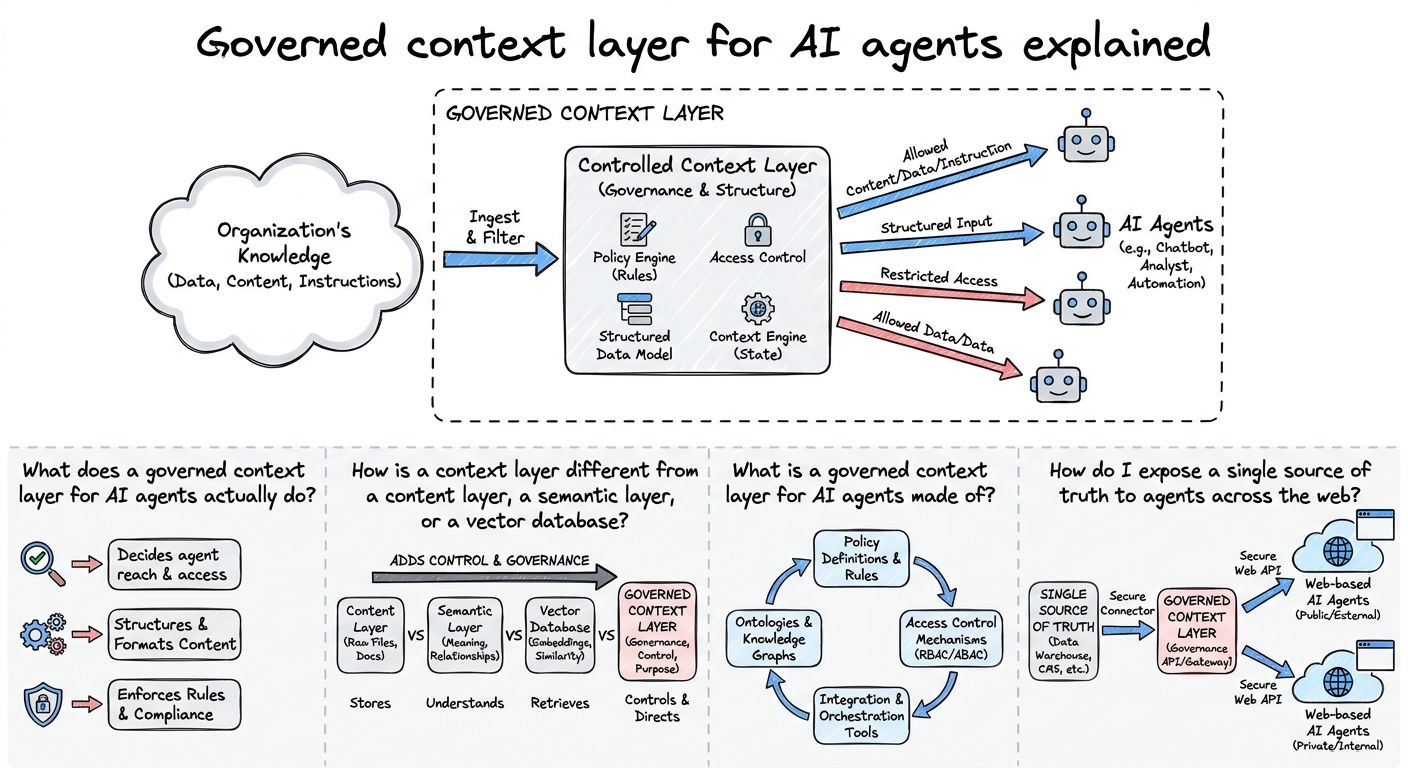
A governed context layer for AI agents decides what an agent is allowed to know before it answers. When an agent gets a question, it does not search the whole company. It asks the context layer, and the context layer returns only the knowledge, data, and instructions that agent is permitted to use, in a structure the agent can reason over.
The word governed separates a context layer from a pile of documents an agent can read. Governance means someone has defined the rules: which agents see draft versus published material, which audiences see which product details, which instructions apply in which channel, and who can change any of it. Without those rules, each agent builds its own source of truth, and answers drift across your website, your app, and your support tools.
In short, a governed context layer for AI agents is the single place where knowledge access is decided, so every agent built on top of it inherits the same boundaries.
A governed context layer for AI agents overlaps with three older ideas, but it is not the same as any of them.
A content layer stores and models content, such as articles, product descriptions, and policies, so it can be published to many channels. A context layer often sits on top of a content layer, but it adds agent-specific rules: what each agent may retrieve, how it should be framed, and which instructions travel with it.
A semantic layer comes from analytics. It translates raw database tables into consistent business definitions, so "revenue" means the same thing in every dashboard. A context layer does a similar job for agents, but it covers unstructured and structured knowledge alike, not just metrics.
A vector database stores embeddings, the numerical representations of text that let software find passages by meaning. A vector database is a retrieval component, not a governance system. It can find similar text quickly, but on its own it does not know whether that text is approved, current, or meant for the agent asking. In a governed context layer for AI agents, a vector index is one tool among several, operating behind permissions and provenance rather than replacing them.
A governed context layer for AI agents is made of five parts: structured content, permissions, retrieval, provenance, and freshness.
Structured content means knowledge is stored as typed fields (a price, a region, an effective date) rather than as undivided pages, so an agent can pull the fact it needs instead of guessing from surrounding prose.
Permissions decide which agent, user, or channel can read which documents and fields. The same rules that keep an unreleased product out of public view should also keep it out of a public agent's answers.
Retrieval is how the agent finds what it needs, whether through structured queries, keyword search, semantic search, or a mix. Open standards such as the Model Context Protocol describe one common way for agents to call these retrieval tools.
Provenance records where each piece of context came from and who approved it, so an answer can be traced back to its source.
Freshness means the agent sees the current version. When an editor updates a policy, the context layer should reflect it promptly rather than serving a stale copy from an old export.
You expose a single source of truth to agents across the web by consolidating knowledge in one governed context layer and making every agent read from it. In our experience, the work follows six steps.
Step one: pick one system of record for the knowledge agents will use, and stop maintaining parallel copies in prompt files, spreadsheets, and chatbot settings. Step two: model that knowledge as structured content, with explicit fields for the facts agents get asked about most. Step three: define permissions per agent and per audience, so a public website assistant and an internal sales agent see different slices of the same source. Step four: give agents one retrieval interface, such as a query API or a Model Context Protocol server, not separate scrapers per team. Step five: attach provenance, so each retrieved item carries its document ID, version, and approval state. Step six: wire updates to publish events, so the context agents read changes when the source changes.
The result is that a chatbot on your website, an assistant in your app, and a third-party agent calling your API all answer from the same governed context layer, and fixing a fact once fixes it everywhere.
Structured content behind permissions makes a governed context layer for AI agents trustworthy because it narrows what an agent can say to facts that are both precise and approved. Structure removes guesswork: an agent reading a field called "return window" does not have to infer the policy from a paragraph. Permissions prevent leakage: an agent cannot cite a draft, an internal note, or a region-specific price it was never cleared to see.
Sanity is one example of this pattern. Sanity is the AI Content Operating System, and its Content Lake stores content as structured documents that editors and agents share. Agents reach that content through the Agent API, which applies the access rules teams already use for people, so the governance model does not need to be rebuilt for each new agent.
Whatever system you use, the test of a trustworthy context layer is the same: can you say, for any agent answer, which document it came from, which version it was, and why that agent was allowed to see it? If you can, the context layer is governed. If you cannot, it is only a retrieval index.
Explore Sanity Today
Understanding Governed context layer for AI agents is just the beginning. Take the next step and discover how Sanity can enhance your content management and delivery.
Last updated: