Multimodal content definition
Multimodal content is content that combines more than one mode of communication, such as text, images, audio, video, and interactive or 3D elements, within a single piece or experience. In AI contexts, the term also describes content that multimodal models can read and generate across those formats rather than text.
Multimodal content is content made of more than one format at once, such as an article with images, an audio narration, and a short video, or a product page that pairs copy with photography and a 3D viewer. Whether it holds together depends on how those formats are modeled and related, not how they happen to be laid out. In Sanity, each asset and text block is a typed, queryable field with its own metadata, so the same set of formats can be recombined per channel instead of re-authored.
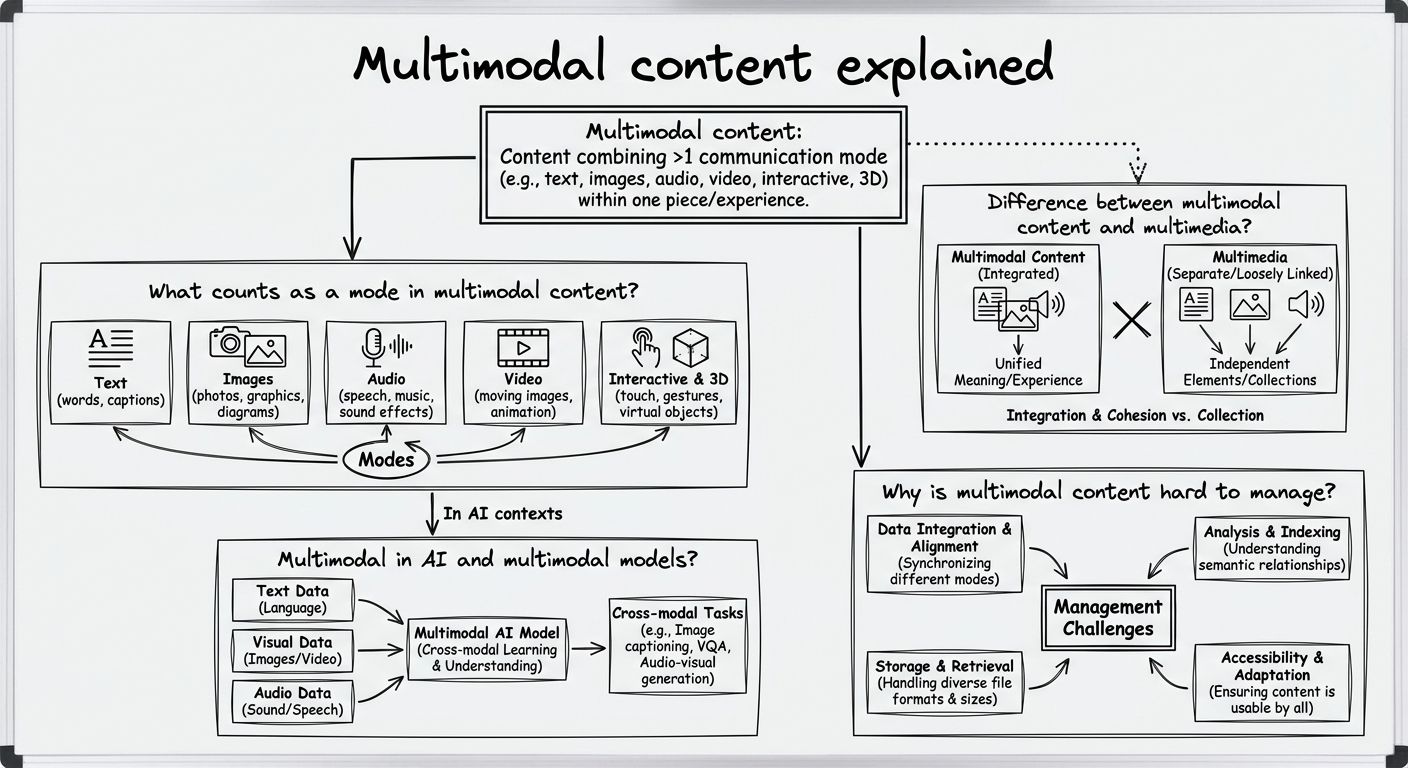
A mode is a distinct channel of meaning: written language, still image, moving image, sound, speech, gesture, layout, and increasingly interactive formats like 3D models or configurators. Multimodal content uses two or more of these together so each one carries part of the message.
The idea comes from multimodality in communication studies, associated with the work of Gunther Kress and Theo van Leeuwen, who argued that meaning is made across modes rather than in text with decorative extras attached. A diagram in a technical explainer is not illustration, it is the argument. A voiceover in a how-to video carries the instruction, and the footage carries the evidence.
This matters practically because it tells you what to keep together. If the image and the caption make sense only as a pair, they belong in one structure with a defined relationship, not in two systems that a layout template happens to place near each other.
Multimodal content and multimedia overlap, but they answer different questions. Multimedia describes the media types present: this page has video, so it is multimedia. Multimodal content describes how the modes work together to make meaning, which is a question about relationships, not inventory.
A second difference is intent. A page with an autoplaying background video and a wall of text is multimedia. A page where the video demonstrates the step the text describes, with a transcript that makes the same content searchable and accessible, is multimodal in the useful sense.
A third difference is where the term shows up. Multimedia is mostly a delivery and production word. Multimodal is now also a machine learning word, used for models that accept and produce several formats. That second usage is why the term keeps appearing in content operations conversations that have nothing to do with video production.
In AI, multimodal describes a model that can take in or produce more than one type of data. A multimodal model can be shown an image and asked a question about it in text, transcribe and summarize audio, or generate a caption, an alt text, or a video description from a source file.
Major model families now ship with this built in. OpenAI's GPT-4o, announced in May 2024, accepts text, audio, image, and video input and generates text, audio, and image output. Google's Gemini was described as multimodal from its first release in December 2023. Anthropic's Claude accepts image input alongside text.
For content teams, the consequence is concrete. Formats that used to be opaque to software are now readable. An image can be described, a video can be transcribed and chaptered, and a PDF can be parsed into fields. That turns media from something you store into something you can search, check, and repurpose, provided the output is written back somewhere structured rather than pasted into a document.
Multimodal content is hard to manage because the formats are often produced by different people, in different tools, on different schedules, and then assembled late. The text lives in a content system, the photography in a digital asset manager, the video with an agency or a video platform, and the 3D model with a product team. Nothing in that arrangement records that these pieces belong to the same story.
The symptoms are familiar. A product is renamed and the copy updates while the video still says the old name. A photo is replaced and its alt text, which described the old photo, stays. A campaign runs in six markets and the localized captions drift out of sync with the images they describe.
The fix is not a bigger asset library, but relationships: an explicit model that says this video belongs to this step, this transcript belongs to this video, and this alt text belongs to this image in this language. Once those links exist in the data rather than in a layout, you can validate them, query them, and change one side without silently breaking the other.
Modeling multimodal content means defining each mode as its own typed structure and then defining how the modes reference each other. A workable sequence looks like this.
First, list the modes the experience actually needs and what each one is responsible for. Second, give every asset its own record with metadata that travels with it: alt text, caption, credit, transcript, duration, focal point, and usage rights. Third, model the relationship rather than the placement, so a step in a tutorial references a video and a transcript instead of a template placing them side by side. Fourth, make required fields required, so an image cannot publish without alt text. Fifth, keep delivery separate from structure, so a phone, a voice assistant, and a large screen can each request the modes they can present.
In a structured setup like Sanity, assets and text blocks are queryable fields with their own metadata rather than files pasted into a page, so a generated transcript or alt text can be written back into the same document it describes and then reused by any channel that queries it. Sanity is built as the Content Operating System for the AI era, which in this context means the multimodal pieces are governed together as data instead of being reconciled by hand at publish time.
Examples of multimodal content include a recipe that combines ingredient text, step photography, a technique video, and a printable card. A support article that pairs written instructions with an annotated screenshot and a two minute screencast. An ecommerce product page with copy, a photo set, a size chart, a 360 degree spin, and a demo video.
Less obvious examples are worth noting because they carry the same modeling requirements. A podcast episode is audio plus a transcript plus show notes plus chapter markers. A data story is prose plus charts plus the underlying dataset. A voice assistant answer is spoken audio generated from text that may also have a visual card on a screen device.
What the examples share is that no single format is complete on its own, and that the same underlying pieces get recombined per surface. That is the practical test for whether you are dealing with multimodal content: if removing one format leaves a gap in the meaning rather than a gap in the decoration, it is multimodal.
Explore Sanity Today
Understanding multimodal content is just the beginning. Take the next step and discover how Sanity can enhance your content management and delivery.
Last updated: