OpenAI Decisions API definition
The OpenAI Decisions API is an interface, announced at OpenAI DevDay on 29 September 2026, that answers a set of user-defined questions with finite pre-defined answers instead of returning free text. Developers supply context as text or images and get back a chosen answer for each question, usable to classify content, route requests, or pick an agent's next action.
The OpenAI Decisions API is a decision interface announced at DevDay on 29 September 2026 that constrains a model to answer questions you define with answers you define, so the result drops straight into code. Its quality depends on the answer space you hand it, which is where content modeling does the work: in Sanity, typed fields and references to taxonomy documents give a decision call a maintained label set rather than an option list pasted into a prompt.
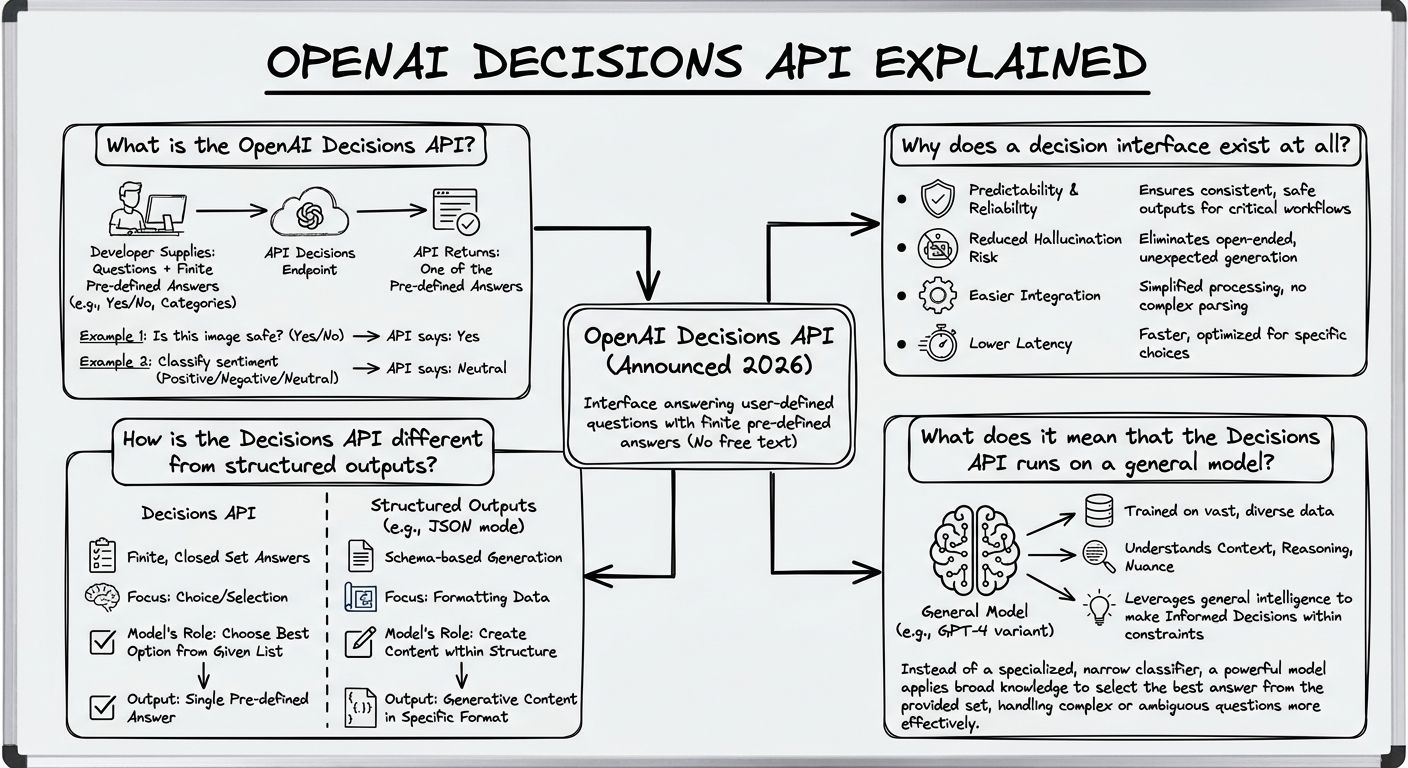
The OpenAI Decisions API is an interface that focuses a model on a specific set of questions you define, each with a finite set of answers you define, and returns a chosen answer for each. OpenAI announced it at DevDay on 29 September 2026, describing it as enabling real-time decision-making: developers supply context using text or images, and get back answers they can use to classify content, route requests, or choose an agent's next action.
It is powered by GPT-6 Luna, OpenAI's general text model released on 22 September 2026. That is the important architectural detail. The Decisions API is a way of calling a general model, not a separate model trained only to make decisions.
The three named uses map onto three familiar jobs. Classification means attaching a label from a fixed set to a piece of content, such as tagging a support ticket as billing, bug report, or feature request. Routing means picking which downstream handler, index, or model a request should go to. Action selection means letting an agent choose its next step from the tools it is allowed to use.
A decision interface exists because a general model asked to pick an option can answer in a way code cannot use. Ask a chat model "is this ticket about billing, a bug, or a feature request?" and it may reply "This looks like a billing issue, though it could also be read as a bug," or invent a fourth category, or wrap the answer in an explanation. Every one of those outputs needs parsing, and parsing prose is where brittle glue code accumulates.
There is also a cost to generation itself. A model producing free text works through the answer token by token, and a long preamble before the useful word is work that does nothing for the caller. Constraining the model to a defined answer space removes both problems at once: the output is one of the options you listed, and the model is not spending effort producing sentences around it.
The OpenAI Decisions API sits in the broader category of decision models, meaning models and interfaces that return a choice from a bounded answer space rather than generated text. TypeSafe AI's Jev, released on 15 September 2026, was the first model sold specifically as a "System One model" in that category. The Decisions API approaches the same job from the other direction, by putting a decision-shaped interface on top of a general model.
The OpenAI Decisions API and structured outputs both make a model's answer machine-readable, but they constrain different things. Structured outputs make a general model return JSON that conforms to a schema you supply, so you control the shape of the response and can include an enum field that limits a value to a fixed list. The model is still generating text; the schema is a contract on what that text must look like.
The Decisions API is framed around the decision rather than the document. You give context and a set of questions with finite answers, and you get an answer per question back. There is no response object to design, no field naming to agree on, and nothing in the response that you did not ask for.
In practice the choice is about what else you need. If the model's job is to produce a record with several populated fields, some of them free text, structured outputs on a general model is the natural fit. If the job is purely "which of these options," a decision interface expresses that directly. Both are better than parsing prose, which is the failure mode they were built to retire.
Because the OpenAI Decisions API is a decision interface over GPT-6 Luna rather than a separately trained decision model, its behavior follows the underlying model. The reasoning that produces the choice, the biases it carries, and the way it handles ambiguous context all come from Luna. Changing the model under the interface would change the decisions, in the same way that swapping models changes any other output.
That distinction matters when you compare it to models released specifically as decision models, which are built and evaluated around picking from a bounded answer space. An interface-first approach inherits a general model's breadth of world knowledge. A model-first approach is shaped around the narrow task from the start. Neither is automatically the better choice, and which one fits depends on whether your decisions lean on general knowledge or on a tight, repetitive, high-volume judgment.
It also shapes how you should read any confidence signal a decision system gives you. A number attached to a choice is only meaningful if it is calibrated, meaning that across many decisions the cases marked 80 percent confident are correct roughly 80 percent of the time. Uncalibrated scores are relative rankings at best, and treating them as probabilities is how automated routing quietly sends the wrong things to the wrong place.
As of 4 October 2026, the OpenAI Decisions API is in limited preview for selected API customers, with OpenAI saying a broad release is planned in the coming days. As of that date, OpenAI's recap of DevDay 2026 is the authoritative description of what the interface does, and anything beyond it should be checked against OpenAI's own documentation before you build on it. Treat request and response examples circulating from third parties as third-party material, not as OpenAI's contract.
On naming: OpenRouter offers a separate product also called a Decisions API, and the two are different things from different companies, so confirm which one a tutorial, benchmark, or forum thread is talking about before you follow it.
A decision is only as good as the answer space it chooses from, so the label set behind a decision call deserves as much care as the prompt. If the options are a list of category names typed into a prompt string, they drift the moment the business adds a product line, and nobody notices until the routing starts looking strange. If the options come from a maintained source, the decision moves with the business.
This is the architectural reason structured content matters for decision interfaces like the OpenAI Decisions API. Sanity is the AI Content Operating System, and content in it is modeled rather than stored as pages: typed fields constrain what a value can be, references point at taxonomy documents that hold the canonical list of categories or routes, and document revisions record how a piece of content looked when a decision was made about it. A model calling a decision interface can be given a clean, bounded input and an answer space derived from the same taxonomy that editors maintain, instead of a snapshot someone copied months ago.
The auditing side benefits too. When both the input content and the label set are addressable documents with history, a decision that looks wrong later can be traced to what the content actually said and which options were available at the time, rather than reconstructed from logs.
Discover More with Sanity
Now that you've learned about OpenAI Decisions API, why not start exploring what Sanity has to offer? Dive into our platform and see how it can support your content needs.
Last updated: