pplx-decider (Perplexity decision model) definition
pplx-decider is Perplexity's family of decision models, served through its Decisions API, which answer typed questions about a piece of state (text, JSON, or images) with probabilities rather than generated prose. A request supplies the state and a question of type noul, choice, or score, and the response is always a value of that type.
pplx-decider is Perplexity's decision model, launched with the company's Decisions API on 1 October 2026. Instead of writing an answer, it returns a probability for a yes/no question, a probability for every option in a list, or a probability for every level on a scale. The quality of that answer depends on the state you hand it, and structured content in Sanity lets you pass exactly the fields a question concerns rather than a rendered page full of navigation and boilerplate.
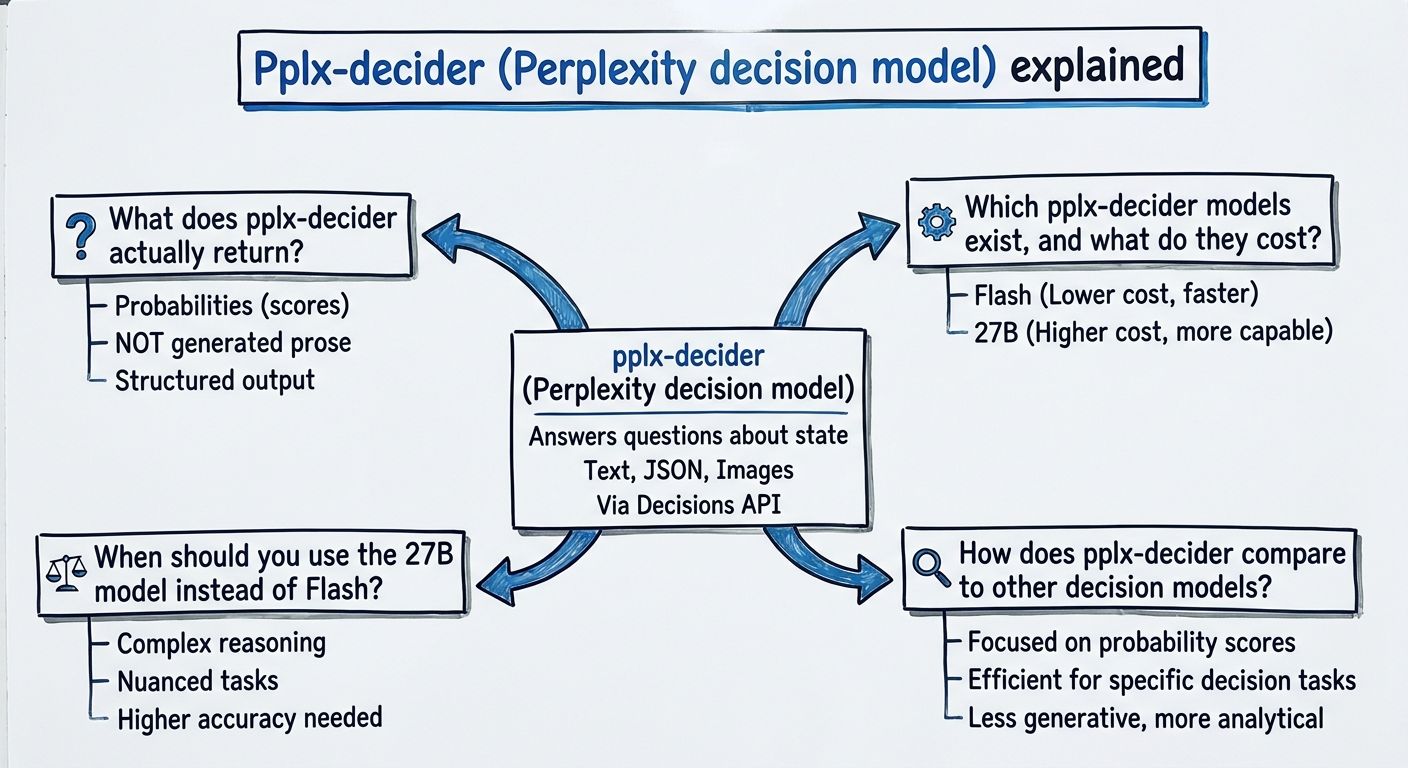
pplx-decider returns a typed answer with probabilities attached, never a paragraph of text. You send a piece of state, which Perplexity's API accepts as text, JSON, or images, plus a question of one of three types.
A
Because the response is constrained to the requested type, pplx-decider cannot return something unparseable. That is a guarantee about format, not about correctness. The model can still be wrong about the answer, and Perplexity's own guidance is to check its behavior on your own labelled data before you trust a threshold in production.
There are two current pplx-decider models, both released under open weights. pplx-decider-v1.2 is the 27-billion-parameter model at $0.02 per million input tokens, and pplx-decider-flash-v1.2 is a 4-billion-parameter model at $0.01 per million input tokens. Output tokens are free in both cases, which follows from the fact that the output is a small set of probabilities rather than generated text.
The aliases pplx-decider-latest and pplx-decider-flash-latest always point at the current version. The original launch model, pplx-decider-v1-27b, was fine-tuned from Qwen3.8-27B and shipped on 1 October 2026; older model names still resolve to v1.2, so existing calls keep working.
Requests go to POST https://api.perplexity.ai/v1/decisions. Perplexity's API supports a 256K-token context, up to 255 options per choice question, and up to 10 levels per score question. Because the weights are published on Hugging Face, both models can also be self-hosted, and the 4B Flash model is small enough to run on compatible local devices.
Perplexity's published guidance is to start with the 27B pplx-decider model, particularly for nuanced rubrics or for decisions where a wrong answer is expensive, and to consider pplx-decider-flash for high-volume decisions with clear, simple criteria.
The practical procedure Perplexity recommends is straightforward. First, write the question and the state exactly as your application will send them. Second, run both models over a set of examples you have already labelled by hand. Third, compare them at the probability thresholds you actually plan to act on, not just on overall accuracy, since a model that is right most of the time can still be badly calibrated at the cutoff you care about. Perplexity also advises sending one question per request rather than bundling several questions into a single call.
Perplexity reports pplx-decider leading several benchmarks, including Decision Bench, ClaimBench, and the Hugging Face Decision Index. Those are the maker's own figures, and the benchmarks in this category are young and differ between vendors, so treat them as a starting point rather than a ranking.
pplx-decider is one of several decision models that appeared in late 2026, after TypeSafe AI launched Jev on 15 September 2026 as the first model of this kind. On 1 October 2026, the same day Perplexity launched its Decisions API, Cloudflare released Clef and Clef-flash and AWS's Strands Labs released Strands Decider 2B. OpenAI put its own Decisions API into public beta on 6 October 2026.
The family resemblance is strong: all of them answer typed questions about a state and return probabilities. The differences worth checking are vocabulary, question types, context limits, pricing, and whether weights are published. pplx-decider sits on the open-weights side, which means it can be self-hosted rather than only called as a service.
The one comparison worth resisting is accuracy. Every published accuracy and latency number in this category is self-reported by the model's maker, and the benchmarks themselves (JevBench, the Jev Decision Index, Decision Bench, ClaimBench) are new and not directly comparable. Run your own evaluation on your own data.
A good state for pplx-decider contains the facts the question depends on and little else, because a typed answer is only as good as the state it is given. Sending an entire rendered webpage means sending navigation, cookie notices, related-article modules, and footers, all of which the model has to read past before reaching the one field that decides the answer.
This is where the shape of your content system matters. Sanity is the AI Content Operating System, and because content is stored as structured documents in the Content Lake rather than as pages of markup, a query can return just the fields a given question concerns: the price and currency for a pricing question, the body and locale for a tone question, the publish date and status for a freshness question. The state you send is then a small, precise JSON object you can read and reason about when a decision looks wrong.
It also makes decisions reproducible. When a question's state is assembled from named fields rather than scraped from a page, you can log exactly what the model saw, re-run it after an edit, and explain the difference.
Discover More with Sanity
Now that you've learned about pplx-decider (Perplexity decision model), why not start exploring what Sanity has to offer? Dive into our platform and see how it can support your content needs.
Last updated: