Strands Decider definition
Strands Decider 2B is an open-source decision model released by Strands Labs on 1 October 2026 that answers typed questions about a supplied state by scoring a fixed set of options instead of generating text. It has about 2 billion parameters, runs locally on a CPU or GPU, and returns a calibrated confidence with every answer.
Strands Decider 2B is a small open-weights model that picks between options, rates things on a scale, or answers yes or no, and reports how confident it is. Released under Apache 2.0 by Strands Labs, the experimental arm of the AWS-backed Strands Agents project, it runs on a laptop. Every answer depends on the state it is handed, and in Sanity a GROQ projection returns only the fields you name, so the state can hold the two or three fields the question concerns rather than a whole rendered page.
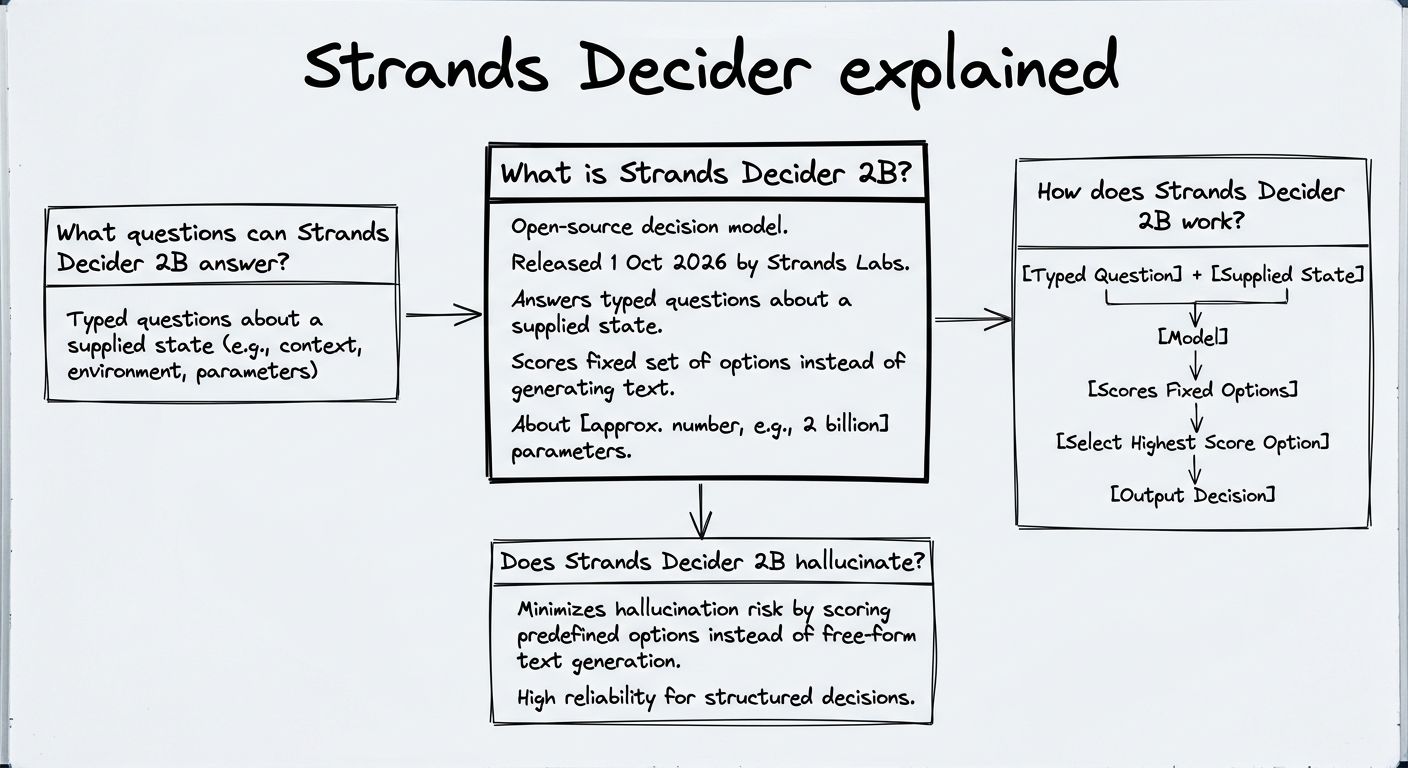
Strands Decider 2B is a decision model: a model that answers typed questions about a piece of supplied text or JSON (its state) by scoring a fixed set of options, rather than writing a free-text reply. Its makers describe it on the Hugging Face model card as "a small, fast decision model for agentic AI. Unlike an LLM, which can generate arbitrary text, a decision model picks between sets of options and rates things on a scale, and every answer carries a calibrated confidence."
It was released on 1 October 2026 by Strands Labs, the experimental arm of Strands Agents, the open-source agent SDK from AWS. The code, training recipe, data inventory, and evaluations live in the strands-labs/strands-decider repository under Apache 2.0, with weights published on Hugging Face. You install it with pip install strands-decider.
The repository README places the model in its category more sharply than any paraphrase: it "works best for problems that fall between LLMs and traditional classification models," because it "responds faster than an LLM and does not take the time and expertise to train that a traditional classifier does." It arrived during a cluster of similar launches in September and October 2026, after TypeSafe AI's Jev named the category.
Strands Decider 2B answers three kinds of typed question, named on its model card as
A noul question is a yes/no question and returns a single probability, such as whether a support ticket is urgent. A choice question offers up to a fixed list of options and returns the selected one plus a probability for each, such as which team should handle a message: billing, sales, or retail. A score question asks for a level on an ordered scale and returns an expected value plus a probability for each ordered label, such as how frustrated a writer sounds on a calm-to-distressed scale.
The option set travels with the request, inside the question itself, which is the practical difference from a traditional fine-tuned classifier. One checkpoint of Strands Decider 2B can route a ticket to three teams in the morning and rate tone on a five-point scale in the afternoon with no retraining in between. The command line reflects that shape directly: a choice is written as a question, an equals sign, and a comma-separated option list.
The uses its makers name are "model routing, tool selection, argument checking, triage, guardrails, evaluations, and the rote decisions of a hybrid agent that leaves the hard ones to an LLM."
Strands Decider 2B is built from a pre-trained language model with its text-generating part surgically removed. According to the launch post, the torso is a Qwen3.5-2B model whose language-model head has been taken off, "taking away its ability to generate text." In its place sits a pointer head of just over a million parameters that scores the hidden state at each option position against the hidden state at the answer position. The torso itself is fine-tuned with a rank-16 LoRA adapter, a small set of extra weights layered onto a frozen base model.
That architecture is why the output is always a value of the requested type. There is no token stream to go off the rails, so the model cannot return prose where you asked for a probability.
On speed, Strands Labs reports a median of around 115 ms per local decision on an Nvidia RTX 3090, with latency rising roughly linearly with task size, and a median of about 153 ms for small tasks on an M3 MacBook. Those figures are self-reported by the makers and measured on their own hardware, as is every performance number published in this young category.
The repository also records that the first architecture used a different "slot head" that "performed significantly worse," and that the launch checkpoint was the nineteenth iteration.
Strands Decider 2B cannot produce an answer outside the type you asked for, but it can still be wrong. The guarantee offered by decision models is about format, not correctness: a noul question always comes back as a probability, and a choice question always comes back as one of the options you supplied. Whether that option is the right one is a separate question, and the makers of these models say so plainly.
The v19 model card lists the weak spots. "Long, multi-step documents are the weak spot: JevBench's hard tier scores far below its easy tier." Questions are "read less than documents," so with the state and options fixed, a changed question often gets the same answer. Score and noul "transfer poorly to rubrics and yes/no tasks unlike the training mix." Calibration uses one temperature per question type, fitted on held-out short classification tasks, so the card tells you to "measure on your own traffic before you trust a threshold." And because it was trained on public datasets, it inherits their domains and their label noise.
The calibrated confidence is what makes that manageable. The repository README reports that on short classification tasks it has never seen, answers at a confidence of 0.9 or more are right about 95 percent of the time, and advises confirming anything below that or asking a person. There is also a scope point worth stating: the model judges whether conditions are met. Deciding whether to act on that judgment stays in your application.
Strands Decider 2B publishes not just its weights but its training data, its training scripts, and the record of every architecture iteration, which makes it unusually open to inspection for a model in this category. The repository ships code, recipe, data inventory, and evaluations under the same Apache 2.0 license as the weights, and the launch post notes that "everything we changed in each version is covered in the repo, and you can follow along with the work we did."
Training is reproducible with stated hardware and wall clock: the makers report retraining takes about 11 hours on one RTX 3090, or about 1 hour 10 minutes on eight H100s. A data/sources.md file "lists every source with its revision, role, license and attribution." A provenance.json file records the base model and revision alongside sha256 hashes of the config, adapter, and head, and a verify command checks them.
The accuracy numbers come with the same candor. On JevBench's 231 public tasks at a 4,096-token window, the makers record 167 correct for the v19 checkpoint at a
A decision model like Strands Decider 2B is given a state, not a database, so something upstream has to decide which content goes into that state. The quality of a typed answer depends on whether the state contains the fields the question is actually about. Hand the model a whole rendered page and the relevant sentence competes with navigation, boilerplate, and related links. Hand it two fields and the question has somewhere clean to land, which matters more as documents get longer, given that the makers of Strands Decider name long multi-step documents as the model's weak spot.
That is an argument for storing content as structured data rather than as finished pages. Sanity is the AI Content Operating System, and in Sanity the Content Lake stores content as structured data while GROQ, the query language, is "designed to help you describe exactly what information your application needs." A GROQ projection returns only the fields you name, in the shape you name them, which is the same shape as the state string a decision model takes. Selecting a product's price, availability, and region for a choice question is a query, not a scraping job.
The same logic applies to picking which documents become the state in the first place. Semantic ranking is good at ordering candidates by meaning, but a structured filter is what narrows the set to the documents a question could sensibly concern.
Unlock New Possibilities with Sanity
With Strands Decider under your belt, it's time to see what Sanity can do for you. Explore our features and tools to take your content to the next level.
Last updated: