Speculative retrieval definition
Speculative retrieval is the practice of fetching the context an answer is likely to need before the request is complete, for example while a user is still typing, so retrieval is already finished when the request arrives. A cheap model or heuristic predicts the likely source from partial input, the fetch runs in parallel, and a wrong guess is discarded.
Speculative retrieval in AI applications means starting the document fetch before the user has finished asking, on a guess about what they will ask, so the context is already in memory at the moment they hit enter. What makes a guess affordable is how small a wrong one is: in Sanity, content sits in the Content Lake as typed fields with stable document IDs, so a speculative fetch can name one field on one document and a miss throws away a small read.
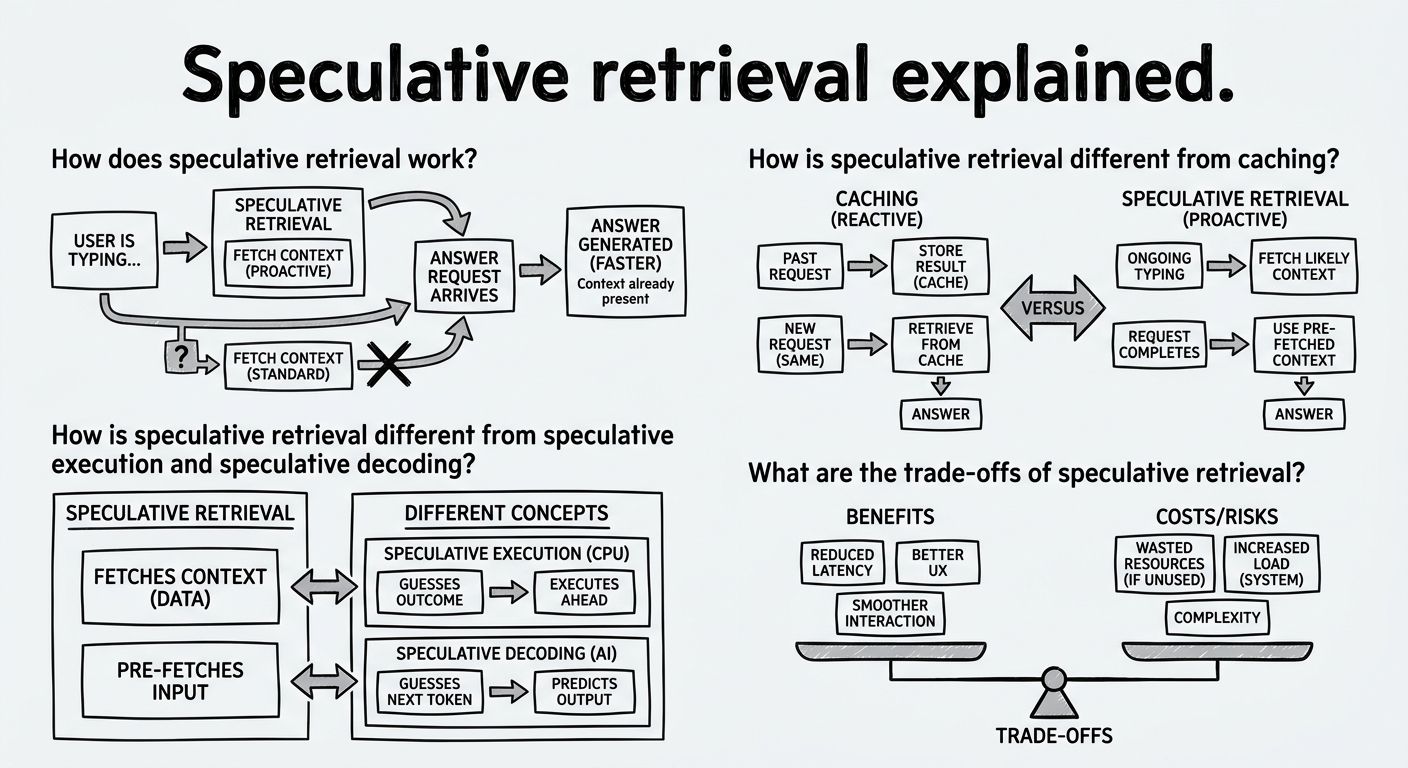
Speculative retrieval works in four beats: trigger, guess, parallel fetch, and resolve.
The trigger is a signal that a request is forming but has not arrived: keystrokes in a search box, a mouse hover over a product, the previous turn of a conversation, or an intermediate step in an agent's reasoning loop.
The guess is the part that gives the technique its name. A cheap, fast model or a plain heuristic predicts which source or document the request will need. Note what it predicts: the location of the answer, not the answer itself. Guessing a document identifier is a bounded choice over a known set. Guessing the answer is open-ended generation, and far more expensive to get wrong.
The parallel fetch starts immediately, overlapping with whatever the user is still doing or with upstream processing that has to happen anyway.
The resolve step compares the prediction to the real request. If they match, the context is already resident and the model can start reasoning at once. If they diverge, the in-flight request is cancelled or its result discarded, and ordinary retrieval runs as it always would. Two controls keep the cost in check: a confidence threshold, so only high-probability guesses are allowed to spend input and output operations, and abort logic, so a speculative request is cancelled the moment the final input diverges from the prediction. The Inferensys glossary describes the same pattern as a latency-hiding technique driven by "a lightweight heuristic or a small classifier."
The important thing to understand is that speculative retrieval does not make retrieval faster. It moves retrieval off the critical path. The latency is hidden, not removed, and every trade-off below follows from that one fact.
Speculative retrieval borrows its name from speculative execution in CPUs and shares a shape with speculative decoding in language model inference, but it operates on different material and carries a different cost when wrong.
Speculative execution is the ancestor. A processor performs work before it is known whether the work will be needed, and if it turns out not to be needed, most changes are reverted and the results ignored. A branch predictor guesses the outcome of a conditional, instructions on the predicted path run anyway, and a misprediction flushes the pipeline. The difference that matters: CPU speculation is microarchitectural and designed to be invisible when wrong. Speculative retrieval happens at the application layer, where a wrong guess spends real network calls, real index queries, and real money, and where the discarded work can be observable from outside the system.
Speculative decoding is the sibling. A small draft model proposes several future tokens and the large target model verifies them in parallel, accepting or rejecting. Speculative decoding generates tokens; speculative retrieval fetches documents. Speculative decoding is also verified by construction, so the output distribution is preserved, which is why vLLM's speculators documentation calls it lossless. Speculative retrieval only preserves outputs if you add a verification step yourself. The RaLMSpec paper (arXiv, January 2024) names speculative retrieval as a formal component and pairs it with batched verification and asynchronous verification precisely so the served output matches what non-speculative retrieval would have produced.
The two compose. A system can speculatively retrieve documents while a draft model speculatively decodes tokens.
Speculative retrieval and caching both make a result available before it is formally requested, but a cache serves something the system has already seen, while speculative retrieval fetches something nobody has asked for yet. A cache answers "have we done this before?" A speculator answers "are we about to?"
They work well together. A speculative fetch that guessed wrong still warms the cache, so if a later request does need that document, the earlier mistake has partly paid for itself. Semantic caching, which matches on meaning rather than exact query text, widens that overlap further.
Speculative retrieval is also distinct from connection pool warming, which keeps idle connections open to a vector database or search index so a query does not pay handshake overhead. Warming predicts nothing about content. It is infrastructure readiness, and it sits underneath speculation rather than replacing it.
The closest mainstream analog is in the browser. The Speculation Rules API lets a page declare which navigations it thinks are coming and have the browser prefetch or prerender them, with an eagerness setting that tunes how aggressively the browser acts. MDN's guide to speculative loading warns in the same place about wasted bandwidth when the predictions are poor. Same shape, different payload: pages instead of passages.
Speculative retrieval trades wasted work for perceived speed, and there are three distinct costs to weigh.
The first is wasted fetches. Every guess that misses spends an index query, network bandwidth, and in most hosted setups a billable read. The economics depend on hit rate and on how expensive a single fetch is, which is why systems gate speculation behind a confidence threshold and cancel in-flight requests on divergence. A speculator that fires on every keystroke with no threshold multiplies your retrieval bill by the length of the average query.
The second is freshness. Content fetched early is content fetched at an earlier moment. If the underlying document changes between the speculative fetch and the final request, the answer is built on a snapshot rather than the current state. For slow-moving reference content, that gap is harmless. For inventory, pricing, or anything with an approval workflow behind it, it is not, and the system needs a revalidation step or a short time-to-live on speculative results.
The third is privacy, and it is the one most easily overlooked. Speculative retrieval acts on input the user has not sent. Search-suggest boxes that transmit data on each keypress have drawn exactly this criticism for years. If your system queries an index, calls an external API, or writes a log line based on half-typed text the user then deletes, you have processed something the user never submitted. That is a decision to make deliberately, document in your privacy policy, and keep out of regulated or sensitive surfaces.
Speculative retrieval needs a prediction that lands well under typing speed, because the entire latency budget for the guess is the gap between one keystroke and the next.
The largest public keystroke study to date, Dhakal and colleagues at CHI 2018, recorded 136,857,600 keystrokes from 168,000 participants and found a mean typing speed of 51.56 words per minute, with individual participant means ranging from 4 to 158 WPM. At the average, that leaves roughly a quarter of a second between keystrokes. A predictor that takes a second to decide has already been overtaken by the user, and the speculative fetch it eventually launches arrives too late to hide anything.
That budget rules out a conversational language model generating a sentence about which document to pick. What fits is a classifier, a heuristic over recent behavior, or one of the newer fast decision models, sometimes called System One models, which take a state plus a typed question and return probabilities over a fixed answer space instead of prose. The shape matches the job: speculative retrieval needs a ranked choice over a known set of candidate sources, returned quickly, not an explanation of the choice.
It also explains why speculation and retrieval gating are cousins. Gating decides whether to retrieve at all and from which source. Speculation makes a version of the same source decision earlier, on less information, and accepts being wrong more often in exchange for being ready sooner.
Speculative retrieval is affordable when a wrong guess is small and a right guess is addressable, which is a property of how the content is stored rather than of the model doing the guessing.
Two things do most of the work. The first is granularity. If a fetch returns a whole rendered page, every miss throws away a page. If the content model exposes discrete fields, a fetch can be scoped to the one field a question concerns, and a miss throws away a small read. The second is addressability. If the only way to find a document is to run a search, the speculator has to guess a query and then pay for a search. If every document has a stable identifier, the speculator's output can be "fetch this ID," which is a bounded choice over a known set, exactly the shape a fast decision model handles well.
Sanity is the AI Content Operating System, and this is the pillar it maps to: power anything. Content in the Content Lake is stored as typed fields and Portable Text blocks rather than one blob of rendered markup, every document carries an immutable `_id` that is unique within its dataset, and a GROQ projection returns only the fields you name. A speculative fetch against that store can be a named ID with a named projection, so the cost of guessing wrong is a small, bounded read rather than a full page retrieval. References between documents and taxonomy terms give the guesser a fixed answer space to choose from instead of an open field.
The same structure helps on the freshness side. Because documents carry revisions, a system that speculated early can check whether the document it fetched is still the current one before building an answer on it.
Discover More with Sanity
Now that you've learned about speculative retrieval, why not start exploring what Sanity has to offer? Dive into our platform and see how it can support your content needs.
Last updated: