
Skip to content

ShowcasedPath oneDeveloper & ops tooling

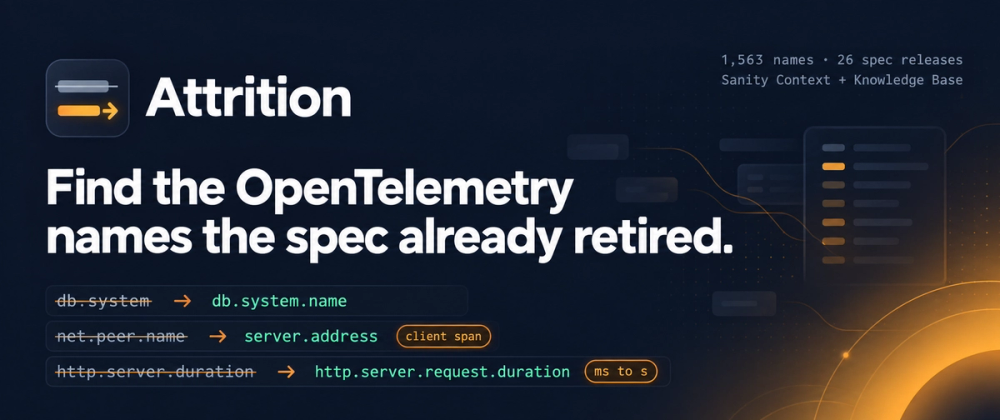
Attrition

Finds retired OpenTelemetry attribute, metric and event names in instrumentation code and gives developers the correct replacement.

by vigneshwarOpenTelemetry contributor

Names from 26 specification releases checked on every scan
1,563
Retired names found in jaegertracing/jaeger, across 13 files
67
Names that left the registry with no deprecation entry, recovered from release history
50

What it does

A developer pastes a file and sees which telemetry names are retired.

A developer pastes instrumentation code into the web app, or runs the scanner across a repository or in CI. Each retired name gets a verdict, its replacement for the span kind in use, the release that retired it and any unit change.

Results link to the specification line and add context from the official migration guides. A chat agent answers follow-up questions from the same sources and lists the calls behind every answer. Safe renames can be patched automatically.

The problem

Retired telemetry names fail silently, and dashboards quietly stop matching.

OpenTelemetry renames attributes and metrics between releases, while old tutorials and copied snippets keep the retired names in use. Nothing errors, so teams learn weeks later that alerts stopped firing. A keyword search misses the context: some names have two replacements depending on span kind, some renames also change units, some names vanished without a deprecation entry, and the registry and migration guides sometimes disagree.

What they built

The semantic conventions imported release by release as structured documents.

1,654 documents from 26 releases (v1.21.0 to v1.44.0): 940 attributes, 571 metrics, 36 events; Knowledge Base from 144 sources.

  • attribute

    One attribute key with status, history, deprecation verdict, conditional replacements and deprecated enum values.

  • metric

    One metric name with unit, status, deprecation verdict and any unit change on replacement.

  • event

    One event name with status, history and deprecation verdict.

  • specRelease

    One tagged specification release and its statistics.

The stack

Two Context endpoints serving four clients.

  • Sanity Context MCP
  • Knowledge Base
  • Content Lake
  • Sanity Studio
  • Sanity CLI
  • Next.js
  • TypeScript
  • Go
  • Rust
  • Python MCP SDK
  • GitHub Actions
  • Vercel

The hard part

Structured data decides each verdict; the model never chooses what replaced what.

An importer computes every verdict in code from the specification's own fields, and the builder reviewed each by hand. A scan extracts names, sends one GROQ query through the dataset endpoint, and uses code to pick the replacement for the span kind.

A second endpoint serves a Knowledge Base built from the migration guides, covering what the registry omits, such as dropped names and unit changes. Patches cover only unconditional renames, so unit changes and source conflicts always go to a person.

Benchmark results on five repositories ↗

More from path one

See the full showcase