
Skip to content

ShowcasedPath oneResearch, science & evidence

Default Flag

Answers exoplanet density and habitability questions from one published parameter set per planet, never mixing papers.

by Saifullah

Mixed-provenance rate for the structured agent (0/29), versus 3% for search baselines
0%
Correct refusals on questions the data cannot support
5/5
Accuracy on 40 frozen questions (39/40), same model across all arms
98%

What it does

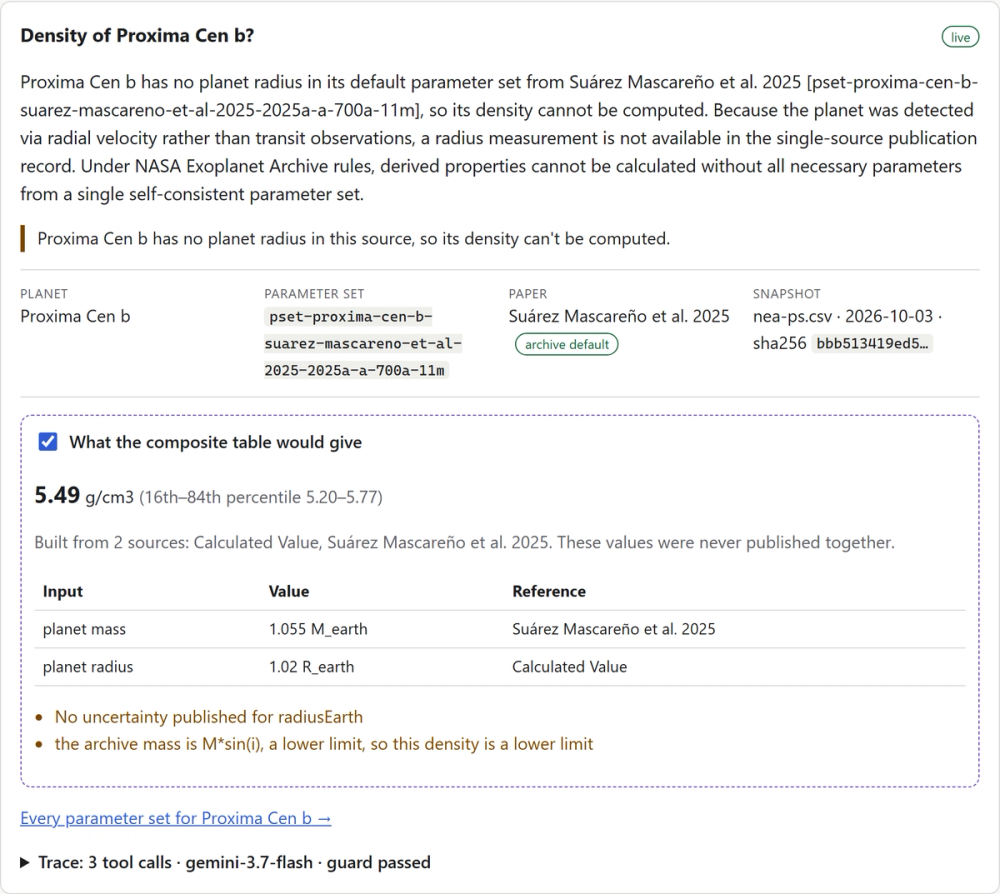
Someone asks a planet's density. The agent answers from one paper only.

A user asks a derived question such as density, insolation, equilibrium temperature, or habitable-zone status. The agent finds the planet, picks the archive's default parameter set, and runs deterministic code on that single set.

The answer shows a provenance strip naming the paper and snapshot. A toggle reveals what the archive's mixed composite table would give instead, and when the data cannot support an answer, the agent refuses and names the missing field.

The problem

Combining one paper's mass with another's radius gives a number nobody published.

The NASA Exoplanet Archive's composite table fills each parameter from whichever paper its rules choose, sometimes using values the archive calculated. Derived answers built on it can blend incompatible sources. For Kepler-139 d the composite density is less than half the default paper's figure. Researchers and tools relying on these rows can cite results that no single study supports.

What they built

Each archive row becomes one self-contained parameter set document.

31 planets and 129 parameter sets from an archive snapshot; 68 Knowledge Base documents against a 150 budget.

  • planet

    References to all parameter sets, the default set, and a composite snapshot with value sources.

  • parameterSet

    One archive row: values with asymmetric errors, limit flags, mass kind, and its own stellar solution.

  • stellarSolution

    Stellar values published together with a specific parameter set.

  • publication

    The paper a parameter set comes from, with its citation.

  • star

    The host star a planet orbits.

  • snapshot

    A raw archive file with its SHA-256, row count, and retrieval time.

  • constant

    A physical constant with its source and location in that source.

  • derivedAnswer

    A computed result whose every input references a single parameter set.

The stack

Two Context endpoints: one for data, one for explanation.

  • Content Lake
  • Sanity Studio
  • Sanity Context MCP
  • Knowledge Base
  • Next.js
  • Gemini 3.7 Flash
  • Vercel
  • NASA Exoplanet Archive
  • Playwright
  • axe-core
  • Claude Code

The hard part

Code computes every number; a code guard rejects anything the model invents.

The compute tool takes one parameter set id and can read only that set. An output guard, written in code, rejects any answer containing a number not returned by the dataset or compute that turn, a citation not read that turn, or an inexact quote. It retries once, then withholds.

The Knowledge Base explains the rules but is never accepted as a source of values. Studio validation and CI GROQ checks enforce one default per planet.

Four-arm evaluation ↗

More from path one

See the full showcase