
Skip to content

ShowcasedPath oneTechnical specs & compatibility

Racksmith

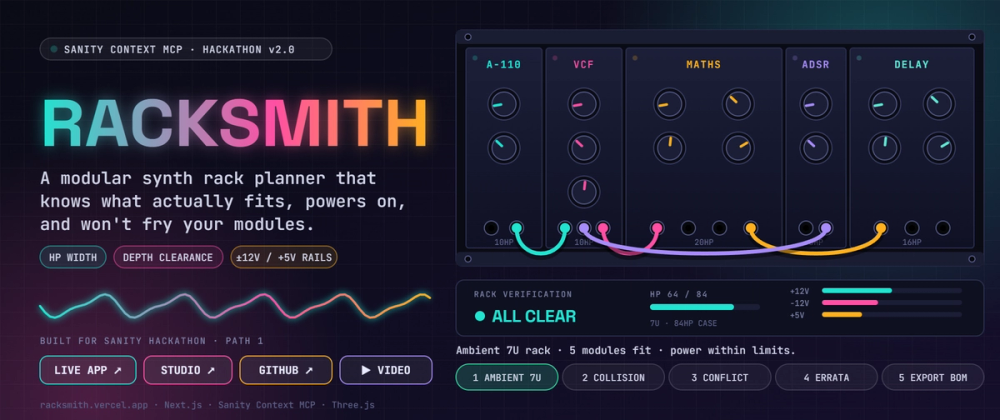
Helps synth builders plan Eurorack racks that fit the case's depth, width and power limits.

by Shreyansh Agrahari

+12V draw of the agent's four-module ambient rack, against a 960 mA safety ceiling
360 mA
Case width used by the same build
60 of 62 HP
Depth collisions after the agent chose the shallower module revision
0

What it does

A builder asks for an ambient rack. The agent picks modules that fit.

A user describes the rack they want in plain language, such as an ambient setup with modulation and reverb. The agent looks up candidate modules, checks known spec conflicts, and runs the build through a validation step.

Modules that pass are mounted on a 3D model of the case, alongside the agent's reasoning and the documents it retrieved. When sources disagree on a spec, the user picks a resolution and it is saved for later runs.

The problem

A module that fits on paper can short against the power bus.

Eurorack cases have bus boards and supplies inside, so a deep module can hit hardware in a shallow skiff. Startup surges can push power rails past safe limits. Manuals and errata often list different current draws or depths for the same module across revisions, and similarity search over forum posts blends those figures without knowing which revision each describes.

What they built

Specs stored as sourced claims, and conflicts as their own documents.

33 modules, 4 cases, 8 manufacturers, 6 sourced claims and 3 contradictions in Content Lake.

  • module

    One module: width in HP, depth, current on each of three rails, category and manufacturer.

  • case

    One case: total HP, rows, depth clearance and power supply rating per rail.

  • manufacturer

    One maker profile with website and support links.

  • claim

    One spec assertion with field, value, unit, source URL, revision and confidence.

  • contradiction

    Two conflicting claims linked, with explanation, conflict type and impact analysis.

  • userDecision

    A user's resolution of a conflict, honored by later agent runs.

The stack

A custom MCP server over Sanity, plus a math check.

  • Content Lake
  • GROQ
  • Sanity Studio
  • Model Context Protocol
  • Next.js 16
  • React 19
  • Vercel AI SDK
  • Gemini 3.8 Flash
  • React Three Fiber
  • Three.js
  • Drei
  • Zustand
  • Vercel

The hard part

Fit and power are checked by plain code, not by the model.

The agent proposes modules but never does the arithmetic. A validation tool sums width and +12V current, compares each module's depth with the case clearance, and rejects any build above 80 percent of rated rail capacity.

Spec conflicts are stored as documents linking two sourced claims, so the agent can see that an older through-hole revision of a module is deeper than the newer one and choose the version that fits.

More from path one

See the full showcase