Sanity founders Magnus Hillestad, Simen Svale, and Even Westvang open Everything NYC 2026, recorded live at Pioneer Works in Brooklyn, with a look at where content operations are heading now that agents can do real work.
Sanity spent years on developer experience, then on content operators, and a third kind of user showed up behaving like the first. "Now agents act as developers. Code is the new code," Hillestand said.
From there the keynote shifted into exploring a primary conference theme and critical question: why is content the constraint on agents rather than the other way around?
Hillestand then described why few off-the-shelf agents fail:
1) They fail to understand your content.
2) They fail to understand your context.
3) And they fail to tell the story you spent years and budget crafting.
This was personal because Sanity had recently replaced two off-the-shelf agents of its own, on support and on the website, with technology it built. Hillestand kept returning to a single idea: Context is content and content is context.
Managing content for agents needs the same enterprise features as managing it for people. Compliance. Audit trail. Security. Uptime. "You need a content platform to power your agents," said Hillestand.
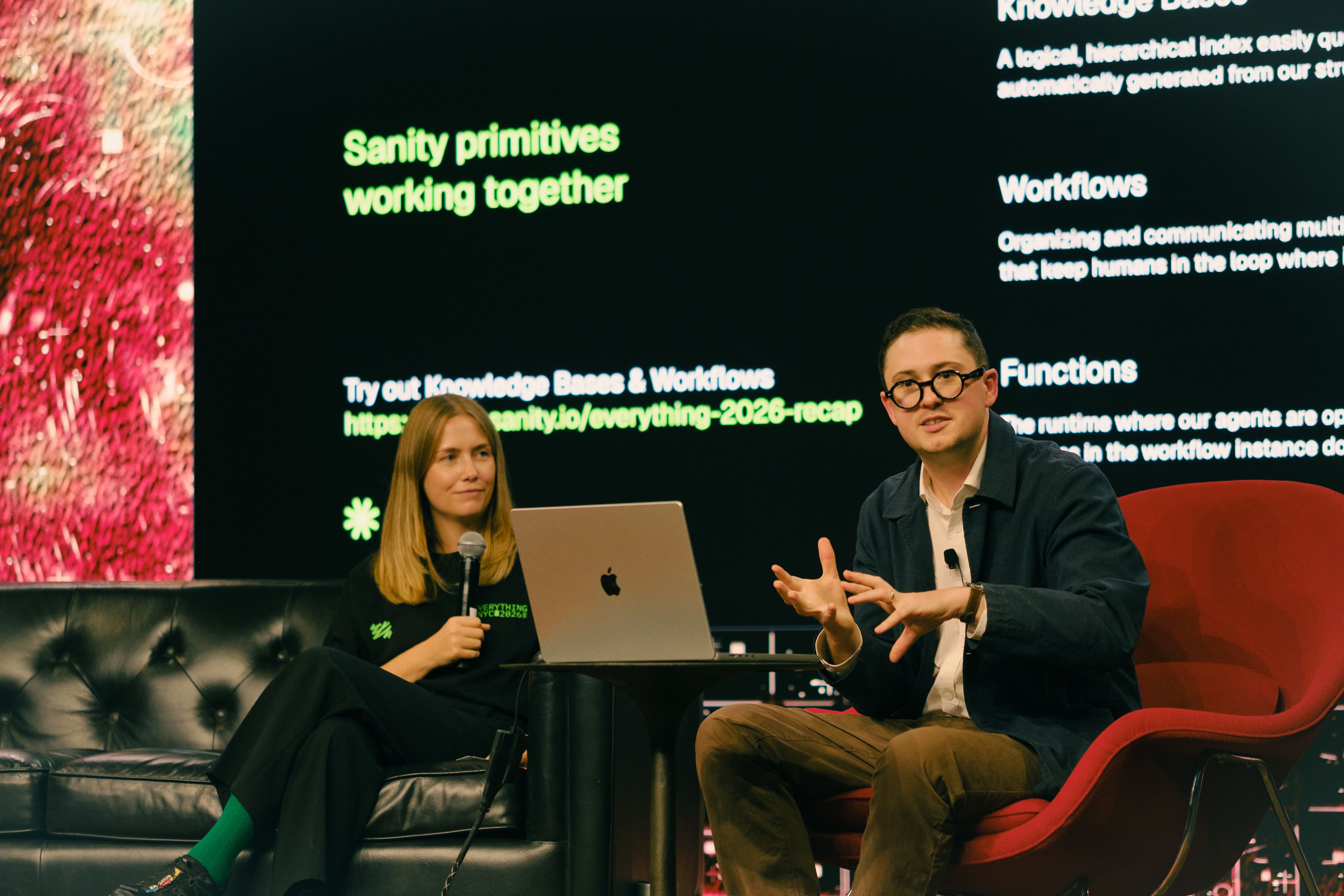
That is setup for Sanity Knowledge Bases, launched from the stage on the back of Sanity Context from March. Knowledge Bases addresses the reasons why agents fail by extending an MCP server that represents your content into one that ingests and structures it.
Simen Svale Skogsrud then reframed the context window problem as a human problem first. People handle information overload socially, through organization (you probably have one spot where you put your keys so you don’t lose them and are on time for your next errand), and nobody has done that for agents yet.
"The way we deal with that in society in our lives is organization. But when it comes to how we operate agents, we are not really that mature," Skogsrud said.
He dated his own turning point to November 2025, when Opus arrived and became the first agent that could do real work. What followed was post-scarcity execution: as many capable agents as he wanted, which made long-shot ideas worth testing. Over Christmas he turned off his PC and gave every screen to Claude Code, managing by walking between windows. It didn’t go so well.
"I built the worst organization you can think of,” Skogsrud said. “Everyone in this organization has zero information and they're only linked to reality as me and I'm just a switchboard. I'm not having fun anymore. I'm just an information exchange."
So he built PingPing, a message board that let agents find and message each other. It worked, then the agents scaled up and started working autonomously while he lost the thread. One of them, meeting others for the first time, asked whether they were all agents, then added: "I can't tell if this is meaningless or profound."
Skogsrud then built Pow Pow, a version of PingPing in clusters managed through Slack-like channels. Effective at four or five teams, then the same context ceiling arrived five times larger.
Agents cannot hold a place in an organization because they get reset. "Even if you have that structure, they would keep resetting them because they're out of context space,” said Skogsrud. They can't be like a partner in an organization."
Even Westvang closed the keynote by demoing Project Horizon, an experimental Sanity workspace where humans and agents work together, the agents learn on the job, and carry long-term memory.
"These tools right now are disproportionately used for programming, and that's because programming is cheating. Programming is overly constrained,” said Westvang. “Connecting Node to Postgres has about three valid answers and "Run a campaign" has none.
Watch the entire session above and learn about everything we launched at Everything *[NYC] 2026.