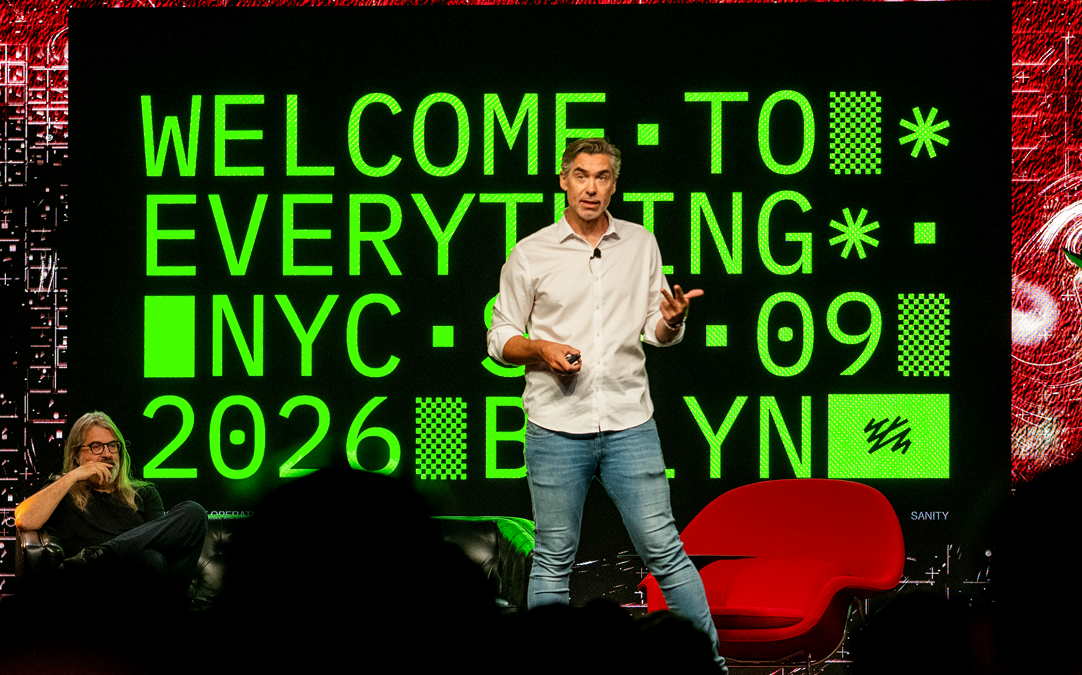
Paul Ford, co-founder of Aboard and author of Bloomberg Business week's 38,000-word "What Is Code?", opens Everything NYC 2026 with a keynote about AI, craft, and why the two need to come together.
Ford spent the first part of his keynote making AI boring kinda on purpose. Because as most who know him, Ford is not a boring person. His argument was that the exhaustion in the room is structural rather than personal.
"We're not designed to get this velocity of news and change in our industry," said Ford. “The software industry is seventy years old and set in its ways while being asked to be endlessly future-facing.”
Ford walked the audience through five thousand years of technological inventions and advancements from dice to Ada Lovelace’s Note G, the first program. He then took of his historian hat and made a pretty relatable point:
"And so everyone has AI psychosis. It goes back thousands of years,” said Ford.
Ford wrapped the first section of his session by pointing out that humans have always loved to strap random statistical methods to lookup tables and create prediction engines that produce artifacts.
“Every time the machine talks we lose our minds, and we have been doing that since mechanical ducks in the 1700s and the machines are not going quiet again,” said Ford. "It's not the terrible end. It's not the perfect beginning. We're just in the very, very normal middle."
Ford spent the back half of his keynote defining craft. He started with a working definition that lands with anyone on a cross-functional team.
"Craft is what it takes someone else too long to do." Then he built it in layers. Artifacts are what we talk about, process creates them, process emerges from a discipline, materials come into the mix, and there is always a deadline. Put together: "A craft is a method of working with standard materials in a process rooted in a discipline to produce meaningful, useful artifacts on a schedule," said Ford.
Craft is a predictive system, a way of knowing when something will happen, and its interface is the word when. "Craft is art on the schedule, which means that there's a lot of compromise, a lot of things missing, but it gets done."
He then got more provocative by asking, "Where is all the software? Where's the great stuff? When was the last time somebody texted me and was like, you have to download this?"
Ford was careful to say he was not blaming anyone, but backed up his claims with numbers. App store submissions up about 30 percent over the past year. Downloads up 3 percent. Ford said Things are shipping, mostly internally, and the culture of being excited about what you can get out of a computer has gone quiet.
His diagnosis used Ethan Mollick's Zork-to-3D-game demo, which he played for five minutes and then stopped. "It's not a creation. It's a translation of something that was incredibly well specified." Well-specified data structure on the left, well-understood 3D engine on the right, a person who knows how to prompt in the middle. Every time you have a magic moment, he said, take it apart and find those three pieces.
He then countered with an example from one of his agency clients. A fully capable person sent over a 300-page product requirements document she had not written. "If she'd just given us a prompt, it would have been a much better conversation. Let us be the AI, the interface."
Ford pointed out that external client projects ship well and cost less than internal projects because three people each arrive with their own version built to the same spec. "When you're looking out and you have that deadline and that accountability and you want to make somebody happy, you don't keep exploring. That deadline is the secret,” said Ford.
Ford pointed out that AI is a pretty good craft simulator, but it is not actually capable of executing your craft just yet. If he were to run his own definition against AI, every element is missing something. No method of working, no SDK, no documentation, no standard materials, no clear process, no discipline, no sense of what good is, and, oddly for something this fast, no schedule.
He’s also not worried about AI taking jobs right now. PwC is currently hiring 5,000 engineers, around a thousand open head-of-AI roles listed. Instead of the jobs apocalypse that we were told was coming, there's more and more engineering roles.
He closed by handing the room an assignment. Name your craft, your discipline, your materials, your process, your artifacts, your schedule. "Your job is to bring that craft into the world. You didn't ask for that job, you sure didn't apply for it. I didn't either,” said Ford. "As new systems drop, we can integrate them into our craft, as opposed to us going to work for the frontier labs for the rest of our lives for free, which is kind of what we're doing right now."
About Everything *[NYC]
Everything *[NYC] is Sanity's annual conference, held September 9, 2026 at Pioneer Works in Brooklyn. Founders, customers, and builders shared what changes for content operations when agents can do real work. Watch all talks