AI agent harness definition
An AI agent harness is the software that wraps a language model and makes it act as an agent. It runs the loop of model calls and tool calls, assembles the context for each turn, manages memory and state, enforces permissions and stopping rules, and records what happened so the agent can be evaluated.
An AI agent harness is everything in an agent except the model: the loop that calls the model, runs the tool calls it requests, and decides when to stop. Its hardest job is context assembly, which means choosing what the model sees on each turn. With Sanity Context, a hosted MCP server, the harness opens a session with a compressed schema overview of the content, then queries typed fields through GROQ inside a server-side filter the conversation cannot widen.
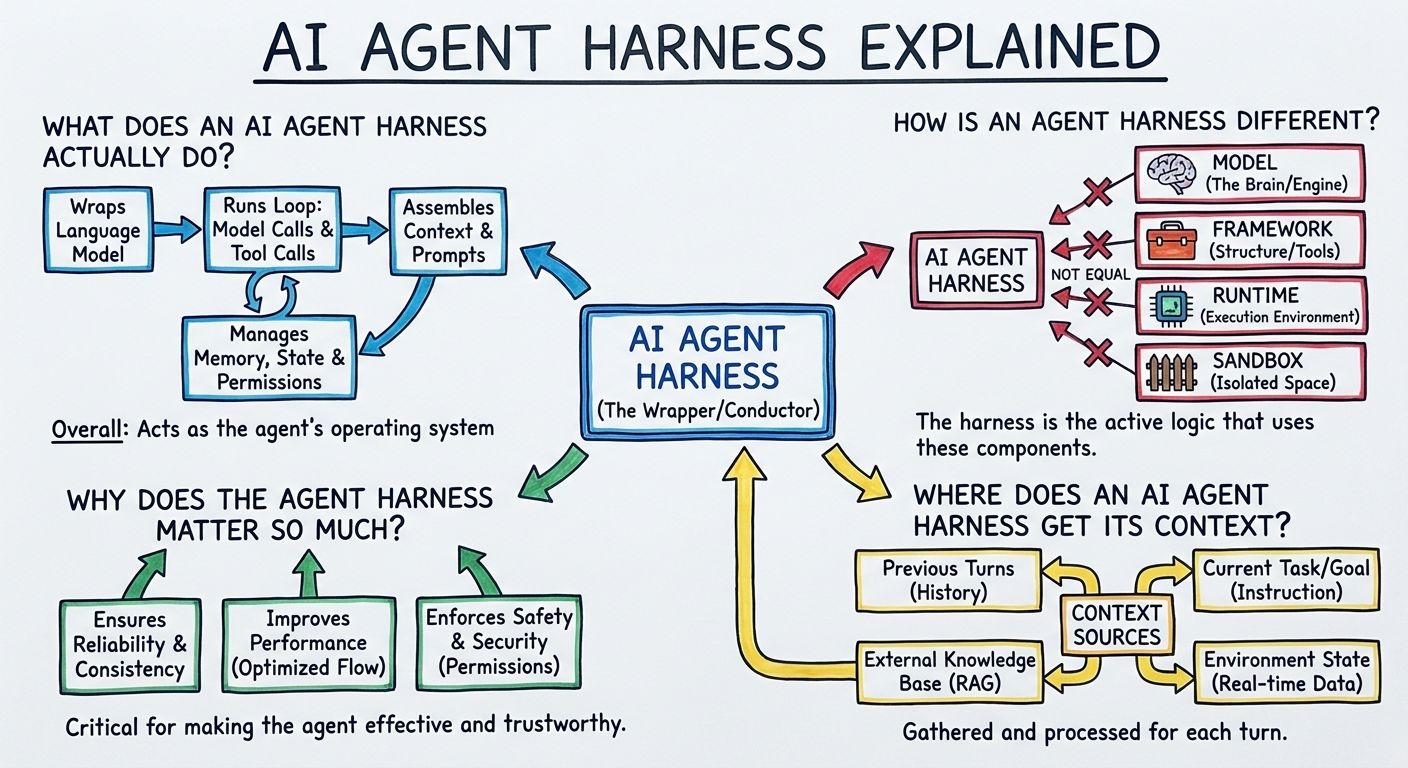
An AI agent harness does every job in an agent except generating the next token. A model on its own takes text in and returns text out. The harness turns that into an agent by running a loop: it sends the model a prompt, carries out any tool call the model asks for (searching, reading a file, running code), feeds the result back, and repeats until a stopping rule fires.
Around that loop, an agent harness assembles the context for each turn, keeps memory and state across turns, enforces permissions and guardrails, and exposes hooks for tracing and evaluation. LangChain lists the parts as "system prompts, tools, hooks/middleware, skills, sub-agent delegation, memory systems, and more." Anthropic describes its Claude Agent SDK as "a general-purpose agent harness" with context management features such as compaction, which summarizes older turns so a long task fits in the model's context window. A common shorthand is "agent = model + harness."
The term "agent harness" is new and still settling. Harrison Chase of LangChain wrote in October 2025 that it was a term he was "starting to see used more" and that there was not "yet a super clear definition" (source). The description here reflects the emerging consensus, not a formal standard.
An agent harness is the control layer between a model and the outside world, and each neighboring layer does a different job. The model produces the next token or tool call. The harness decides what the model sees, which tools exist, what happens after each call, and when to stop.
A framework mainly provides abstractions for building agents; LangChain names examples such as LangChain, Vercel AI SDK, CrewAI, OpenAI Agents SDK, Google ADK, and LlamaIndex. In Harrison Chase's taxonomy, an agent harness sits higher: it "comes with batteries included," with default prompts, opinionated tool handling, planning tools, and filesystem access. Deep Agents, the Claude Agent SDK, and arguably the coding CLIs fit here. A runtime, such as LangGraph, Temporal, or Inngest, sits lower and handles infrastructure like durable execution, streaming, and persistence. Chase calls these lines "blurry," so treat the three layers as a useful mental model rather than strict categories.
A sandbox is where generated code runs and files get edited. In Anthropic's Managed Agents design, the harness calls the sandbox like any other tool, and credentials stay outside it as a security boundary. Anthropic separates session, harness, and sandbox so each can "be swapped without disturbing the others."
The agent harness matters because it controls what the model sees and how its actions are checked, and changing it alone can move results substantially. On February 17, 2026, LangChain reported raising its coding agent from 52.8 to 66.5 on Terminal Bench 2.0, an 89-task benchmark, a gain of 13.7 points, while keeping the model fixed at gpt-5.2-codex. The changes were to the system prompt, tools, and middleware. That is a single vendor-reported result, but it shows that harness design is not a minor detail.
Anthropic found something similar on long-running agents. Compaction alone was not enough for Claude Opus 4.5 to build a production-quality app. The team added harness patterns: an initializer agent that wrote a JSON list of over 200 features (each marked failing until verified), a progress file, and git history. They chose JSON because the model was "less likely to inappropriately change or overwrite JSON files compared to Markdown files."
An agent harness is built around what current models cannot yet do, so parts of it expire. Anthropic added context resets to stop Claude Sonnet 4.5 from wrapping up early near its context limit. On Claude Opus 4.5 that behavior was gone, and Anthropic wrote that "the resets had become dead weight."
An AI agent harness pulls context through three paths: retrieval, which searches documents by keyword or embeddings; structured queries, which filter typed fields so a schema tells the agent where to look; and governed tools, which are scoped by token, filter, or permission. LangChain puts it this way: "Part of harness engineering is building a good delivery mechanism for context engineering." Context engineering decides what belongs in the context, and the harness is the machinery that puts it there.
Sanity, the AI Content Operating System, supplies that context as the content system a harness reads from and writes to. Sanity Context is a hosted MCP (Model Context Protocol) server that gives any MCP-capable harness read-only access to content. In GROQ mode it serves the live dataset and exposes tools such as `schema_explorer` and `groq_query`. In Knowledge Base mode, currently in beta, it serves a pre-built index of chosen material. The harness owns the loop, and Sanity Context governs what it can read: access is decided once when the agent connects, and a `groqFilter` applies server-side, so nothing said in the conversation can widen it.
For writes, a harness uses the separate Sanity MCP server, which lets agents run GROQ queries, manage releases, and patch documents with awareness of the schema. Alternatively, the harness's own server-side code can write changes to the Content Lake once the agent decides what to do.
Discover More with Sanity
Now that you've learned about AI agent harness, why not start exploring what Sanity has to offer? Dive into our platform and see how it can support your content needs.
Last updated: