Content supply chain definition
A content supply chain is the end-to-end system an organization uses to plan, produce, review, store, distribute, and measure content across every channel it publishes to. It is not a single tool but the connected arrangement of people, processes, and technology that carries content from a brief through to a published asset and the performance data that comes back.
A content supply chain is the whole production system that moves content from request to published asset to performance data, borrowing supply chain vocabulary (intake, handoffs, throughput, bottlenecks, reuse) to make content production measurable. Chains break at the handoffs, so the practical question is where the process lives. In Sanity, content sits in the Content Lake as
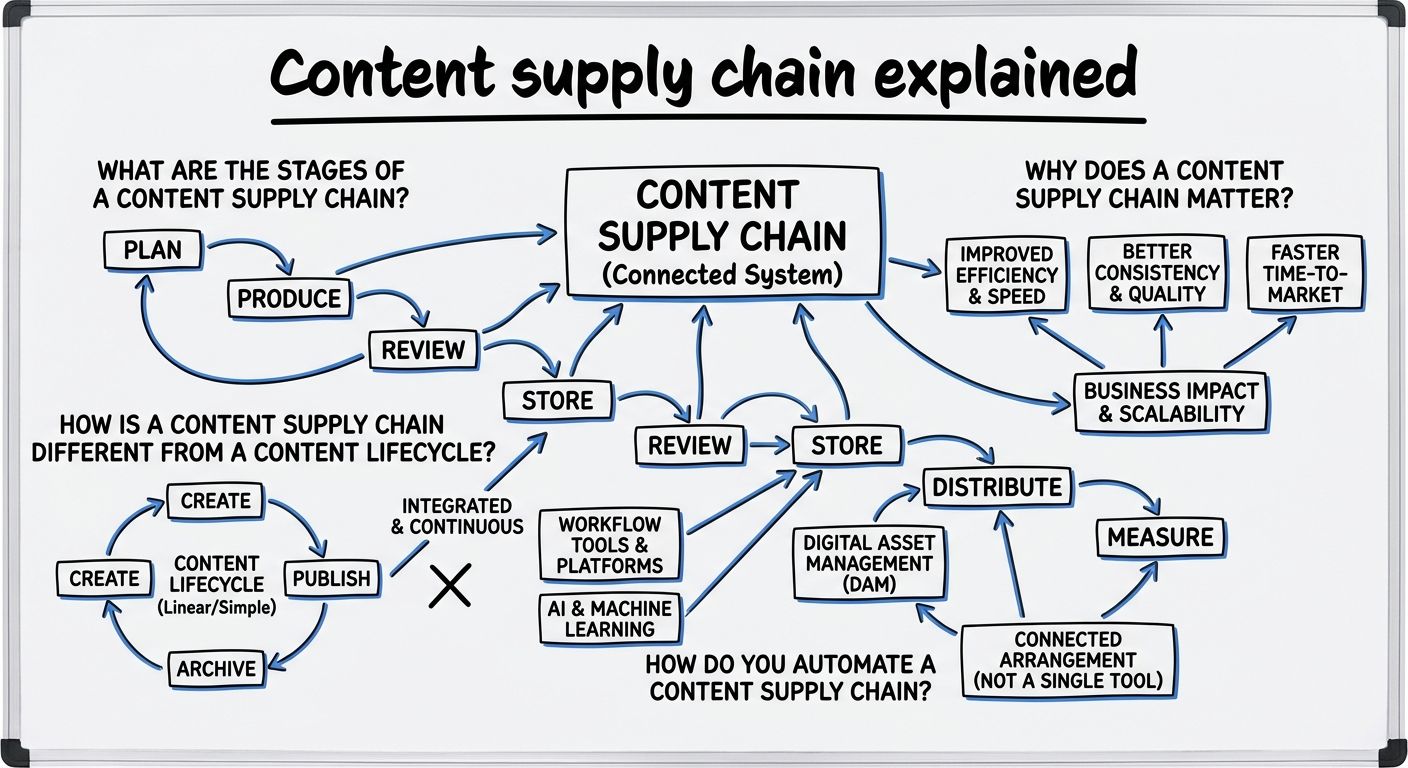
The stages of a content supply chain are usually described as planning, creation, storage, activation, and measurement, though the exact labels differ by source. Deloitte defines the content supply chain as "the end-to-end system that governs how content is planned, created, stored, activated, and measured across the enterprise," and adds that it is "not a single tool or platform, but an integrated ecosystem of technology, people, processes, and operating model." Adobe uses a shorter four-step version: plan, create, deliver, and analyze.
The stage names matter less than the joins between them. Deloitte organizes the content supply chain into four pillars (content planning, creation and storage, activation, and measurement and optimization) underpinned by automation, governance, and new ways of working, and argues that what separates mature organizations is not whether they own the tools but how well the stages connect. Its diagnosis of the common failure state is worth repeating: content is planned in one place, created in another, stored somewhere else, activated manually, and measured inconsistently, which produces slow speed to market, duplicated effort, and very little reuse.
So a useful way to read any stage list is as a map of handoffs. Every arrow between two stages is a place where a file gets re-uploaded, a brief gets re-explained, or a piece of content gets rebuilt because nobody could find the original.
A content supply chain matters because content demand has grown faster than the headcount available to produce it, which turns coordination into the constraint. In research published on June 16, 2025, Adobe surveyed more than 1,600 marketers and reported that 96% had seen content demand increase at least 2x over the previous two years, 62% had seen it increase 5x or more, and 71% expected demand to grow more than 5x between then and 2027.
The same survey puts numbers on where the time goes. 47% of respondents said that creating, reviewing, approving, and activating a single piece of content involves between 51 and 200 people, and for 18% it exceeds 200. 89% said content must pass three or more approval stages, and 58% said more than 40% of their time goes to managing reviews and approvals rather than to strategy or to the content itself. That is the argument for treating content production as a supply chain: the bottleneck sits in the movement between stages, not inside any one stage.
Deloitte reports that leading marketers who automate and optimize their content supply chains have cut timelines by 50%, achieved 75% cost savings, and seen 310% ROI. Those figures are Deloitte's own stated outcomes rather than an independent industry benchmark, so read them as a vendor claim about what good looks like.
A content lifecycle describes the stages one piece of content passes through, while a content supply chain describes the production system that moves many pieces through those stages at once. The lifecycle is a property of an asset: created, published, updated, archived. The content supply chain is a property of an organization: who hands off to whom, where work queues, how long each stage takes, and what gets reused instead of remade.
The content supply chain is also broader than content operations, the internal discipline and team function that runs the work day to day. The two overlap heavily and are often used interchangeably, but the supply chain framing is the one used when scope widens to include agencies, external partners, capacity planning, budget allocation, and performance measurement, and when the goal is to optimize the whole flow as one system.
A content management system, a digital asset management system (which stores approved assets), and a product information management system (which holds product data) are stations in the content supply chain rather than the chain itself. The chain is how work moves between them and what happens in the gaps. Similarly, content velocity, meaning output per period, is one metric of a content supply chain, not the chain.
One disambiguation: the software supply chain is an unrelated concept that happens to share the phrase shape. It concerns code dependencies, build artifacts, provenance, and software bills of materials, and has nothing to do with editorial production.
You automate a content supply chain by making each stage react to an event in the previous stage instead of to a human remembering to act. That requires two things: content stored as structured, queryable data rather than as rendered pages or loose files, and automation attached to changes in that data.
Sanity is a Content Operating System for the AI era, providing the structured foundation, automation layer, and agentic context companies need to power every content experience, from websites to AI agents. In practice, that covers the produce, store, govern, and deliver span of a content supply chain. The Content Lake holds content as structured data that any channel can query, so the same modeled content feeds a website, an app, and an assistant rather than being recreated per surface, which is what makes reuse real rather than a copy-paste ritual.
Functions are serverless event handlers that run on Sanity's infrastructure and respond to content changes. Document functions trigger on create, update, and delete events, so publishing a document can kick off the downstream step automatically. Functions are authored in TypeScript or JavaScript and declared in a Blueprint file (`sanity.blueprint.ts`) kept beside application code, so the pipeline itself is version-controlled infrastructure rather than clicks in an admin panel. Agent Actions add programmatic AI operations over that content, with five actions available: Generate, Translate, Transform, Prompt, and Patch. Content Releases group updates across many documents so they can be validated, previewed, and published together, which is the closest thing to a coordinated campaign launch. Workflows, currently in early access, models the stages a document moves through as data next to the content, with a durable event history that turns an audit question such as "what published without legal review" into a query.
Improving a content supply chain starts with measuring the handoffs, not buying a tool. A workable first pass, in order: first, map every stage a typical piece of content passes through and name the person or team that owns each one. Second, record how long the content waits between stages, because wait time is usually easier to cut than work time. Third, count how many approvals a piece actually needs versus how many it currently gets. Fourth, find the assets being remade because nobody could locate or reuse the original. Fifth, decide which single handoff, once automated, removes the most waiting.
The reason to start with the map is that the expensive problems in a content supply chain are structural. Adobe's 2025 survey found that 33% of marketers named siloed collaboration across teams as a barrier and 31% named lengthy manual approvals, both of which are problems of arrangement rather than of software features.
It is also worth being honest about coverage. No single platform runs an entire content supply chain. Campaign intake, agency briefing, budget allocation, and media performance attribution typically live in different systems from the one where content is modeled and produced. A realistic target is fewer gaps and cleaner joins between stages, not one tool that swallows all five.
Explore Sanity Today
Understanding content supply chain is just the beginning. Take the next step and discover how Sanity can enhance your content management and delivery.
Last updated: