Content variant definition
A content variant is an alternative version of the same piece of content, created to suit a specific audience, channel, locale, test, or context while still referring to the same underlying subject. Variants share an identity and purpose, but differ in wording, length, media, or emphasis.
A content variant is an alternative version of one piece of content, adapted for a particular audience, channel, language, or experiment while still describing the same thing. A product description written short for a marketplace feed and long for a landing page is two variants of one product's copy. In Sanity, variants can be modeled as fields or related documents inside a single content model, so each version is queried independently while staying tied to the same source of truth.
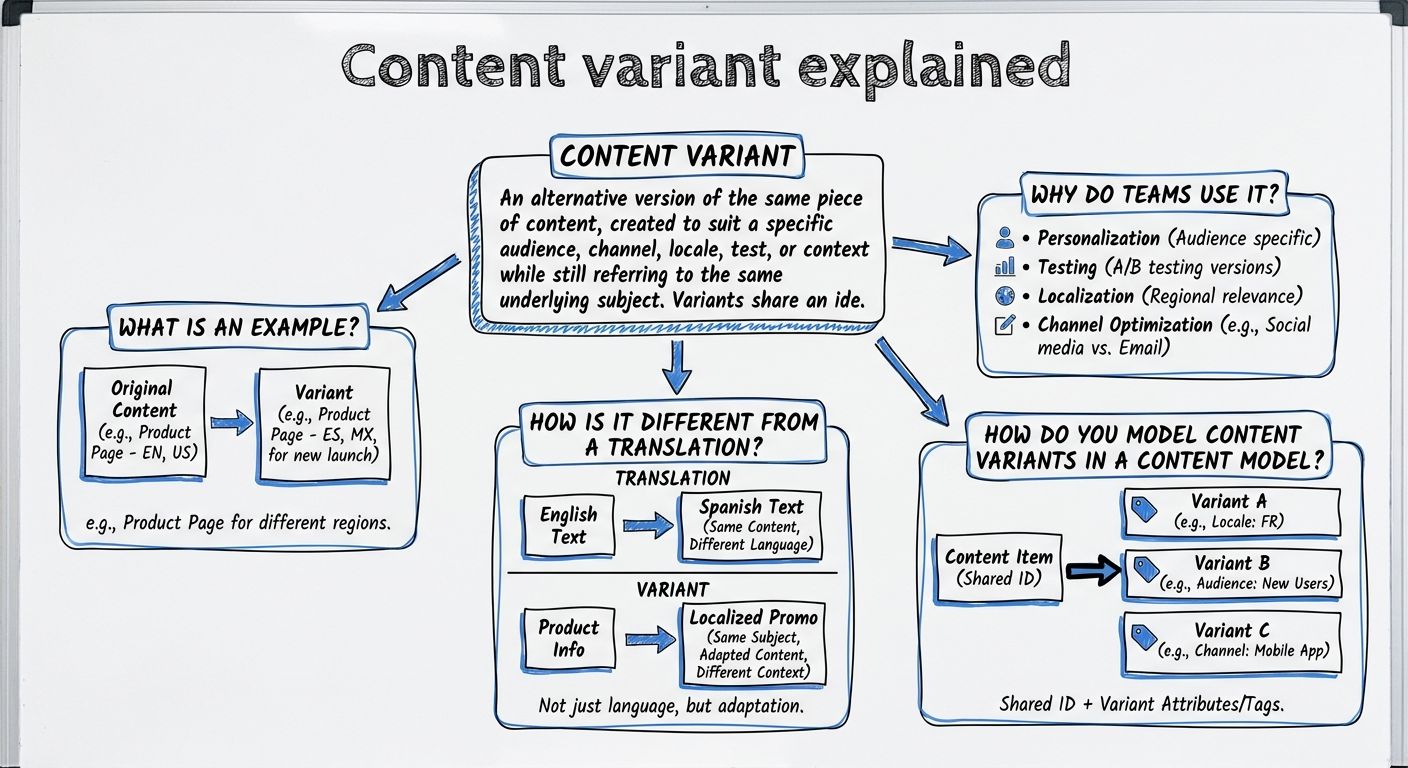
A clear example of a content variant is one product description written three ways: a 160-character version for a marketplace feed, a two-paragraph version for the product page, and a one-line version for a push notification. All three describe the same product, carry the same claims, and change together when the product changes.
Other common variants of the same content include a headline tested in two wordings to see which performs better, an article rewritten at a lower reading level for a different audience, a support answer phrased for an in-app widget versus a help center page, and a campaign message adapted for a region where a particular claim is not legally allowed.
What makes each of these a variant is shared identity, not format. If an underlying fact changes, every variant is wrong until it is updated, which is a practical test teams can apply when deciding whether something belongs in a variant set.
A translation is one kind of content variant, but a content variant is not necessarily a translation. Translation changes the language while aiming to preserve meaning as closely as possible. A variant may keep the same language and change length, tone, reading level, imagery, call to action, or the claims that are legally permitted in a given market.
The distinction matters in practice because the two are produced differently. Translations are usually derived from a source version and handed to linguists or machine translation with the expectation of fidelity. Non-translation variants are often authored fresh, because a shorter version is not a compressed translation of a longer one. It is a different editorial decision about what to keep.
A related term is localization, which sits between the two. Localization adapts a variant to a market, covering language plus currency, date format, examples, and cultural references. A single piece of content can therefore have a locale variant, and within that locale, channel variants for email, web, and app.
Teams use content variants to say the right thing in the right place without duplicating content into copies that drift apart. The alternative, copying a page and editing the copy, works until the source fact changes and nobody remembers how many copies exist.
Four reasons come up repeatedly in content operations work. First, channel fit: a feed, an email subject line, and a web page have different length and formatting constraints. Second, audience fit: an enterprise buyer and a self-serve user need different emphasis on the same product. Third, experimentation: A/B and multivariate testing require two or more variants that can be served and measured separately. Fourth, compliance and regional rules: a claim that is fine in one market needs rewording or removal in another.
The operational payoff is consistency. When variants are linked to one source rather than scattered duplicates, a price change, a feature rename, or a legal correction can be traced to every version it affects.
Modeling content variants means deciding, up front, what stays shared and what is allowed to differ. A workable approach in five steps: identify the stable entity the variants describe, such as a product or an article; list the axes along which versions differ, such as locale, channel, audience, or test arm; keep facts that must never diverge (price, SKU, publication date, legal identifiers) in shared fields; keep the fields that are allowed to differ in the variant itself; and give every variant a machine-readable label for its axis so a query can ask for the exact version it needs.
The two common shapes are field-level variants, where one document holds several versions of a field, and document-level variants, where each version is its own document linked to a shared parent. Field-level keeps everything in one editing view and suits a small, fixed set of versions. Document-level scales better when variants have their own workflow, reviewers, or publish schedules.
In Sanity, both shapes are expressed in the same typed schema and queried with GROQ, so an application can request a single variant by locale or channel rather than fetching a whole document and filtering in the client.
The most common failure with content variants is drift, where versions that were once consistent stop agreeing because an edit landed in one and not the others. Drift is a modeling problem more than a discipline problem: if a shared fact is duplicated into each variant instead of stored once, every update becomes a manual sweep.
A second failure is uncontrolled growth. Variant axes multiply, so three channels, five locales, and two test arms describe thirty possible versions. Teams that add axes without deciding which combinations need to exist end up maintaining versions nobody reads.
A third is missing fallback rules. If a variant does not exist for a requested combination, something has to be served, and the sensible default is usually a defined parent or default locale rather than an empty page. Deciding fallback behavior at model time, not at incident time, avoids blank slots in production.
A fourth is unclear ownership. When nobody is named as the owner of a given axis, such as regional compliance wording, variants are created once for a launch and then never reviewed again.
Unlock New Possibilities with Sanity
With content variant under your belt, it's time to see what Sanity can do for you. Explore our features and tools to take your content to the next level.
Last updated: