Groundedness as a RAG evaluation metric definition
Groundedness, also called faithfulness, is a RAG evaluation metric that measures the share of claims in a generated answer that the passages retrieved to produce it can support. It checks whether an answer stays inside its evidence, not whether the answer is true in the world.
To evaluate a RAG answer for groundedness, split it into individual factual claims, check each claim against the retrieved passages, and score the answer as supported claims divided by total claims. That check works only when sources can be traced and do not conflict. In Sanity, a Knowledge Base (Beta) build writes each entry with citations back to its original source and flags conflicting claims as issues to resolve, so an answer can be checked against one reconciled, cited source.
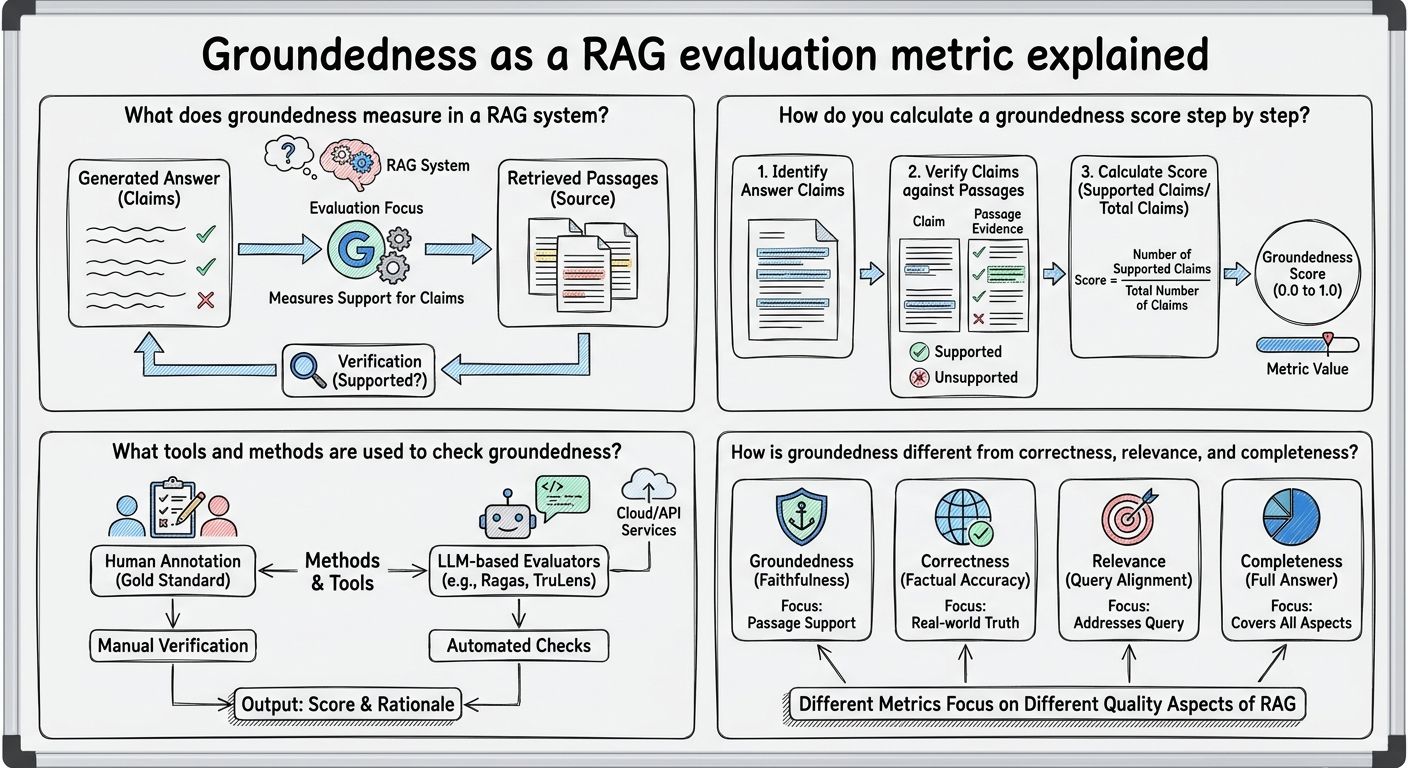
Groundedness measures how much of a generated answer is supported by the source passages a retrieval-augmented generation (RAG) system retrieved for that query. It is also called faithfulness. RAGAS and MLflow use "faithfulness," TruLens and Microsoft Azure use "groundedness," and the two names mean the same thing.
The RAGAS documentation states that "a response is considered faithful if all its claims can be supported by the retrieved context." The Microsoft Azure Architecture Center says groundedness "validates that the response isn't using information other than what exists in the context."
Groundedness does not ask whether an answer is true in the world. It asks whether the answer stays inside its evidence. That makes groundedness a primary way RAG evaluation catches hallucination: a claim the retrieved passages do not support is a hallucination in this sense, even if it happens to be accurate.
A groundedness score is calculated claim by claim in three steps. Step 1: split the generated answer into individual factual claims. Step 2: check each claim against the passages that were retrieved for the query. Step 3: divide the number of supported claims by the total number of claims, which gives a score from 0 to 1. TruLens describes the same idea as separating "the response into individual claims" and independently searching for evidence that supports each one in the retrieved context.
The RAGAS faithfulness page gives a worked example. The retrieved context says Einstein was born on 14 March 1879. An answer saying he was "born in Germany on 20th March 1879" makes two claims, and the context supports only one of them, so the answer scores 0.5.
There is no published benchmark for a "good" groundedness score, so teams set their own threshold. Because language model output varies from run to run, the Azure Architecture Center recommends "using a target range instead of a single target."
Groundedness is usually checked in one of three ways: a classifier model, an LLM acting as a judge, or human review on a golden dataset.
Classifier or NLI checks use natural language inference, a model that decides whether one passage supports another. Azure AI Content Safety groundedness works this way, and Vectara's HHEM-2.1-Open is a small open-source classifier that RAGAS supports for the claim-checking step.
LLM-as-judge means a language model splits the answer into claims and rules on whether each is supported. RAGAS, TruLens, and the Microsoft Foundry Groundedness evaluator take this approach. The Foundry evaluator scores on a 1 to 5 scale with a pass or fail threshold. On judge reliability, Zheng et al. (NeurIPS 2023) found GPT-4 as a judge agreed with human preferences over 80% of the time, close to how often humans agree with each other, though that study measured chat quality rather than groundedness.
Human review on a golden dataset means people grade answers on a fixed, labeled set of questions. It calibrates automated judges and measures completeness and correctness, which need ground truth. Groundedness itself can run without one: the RAGAS paper presents the method as reference-free, working "without having to rely on ground truth human annotations."
Groundedness scores whether an answer is supported by its retrieved sources, which makes it different from correctness, answer relevance, context relevance, and completeness.
Groundedness vs. correctness. A grounded answer can still be wrong if the retrieved source is wrong, and a correct answer can be ungrounded if the model answered from its training data. Faithfulness measures support, not global truth.
Groundedness vs. answer relevance. Answer relevance asks whether the response addresses the user's question. An answer can be fully grounded and still off-topic.
Groundedness vs. context relevance. Context relevance asks whether the retrieved chunks fit the query, so it scores the retrieval step, while groundedness scores the generation step. Context relevance, groundedness, and answer relevance together form the TruLens RAG triad.
Groundedness vs. completeness. Microsoft Foundry puts it this way: "Groundedness focuses on the precision aspect of the response," while response completeness "focuses on the recall aspect," meaning whether the answer misses critical information compared to a ground-truth answer.
Groundedness depends on source content because the metric confirms that an answer matches its sources, not that the sources are right. TruLens says the RAG triad protects against hallucination only "up to the limit of its knowledge base," and that if the vector database "contains only accurate information, then the answers provided by the RAG are also accurate." If two sources disagree, an answer can be perfectly grounded in the wrong one.
The stakes are real. A Stanford RegLab study of RAG-based legal research tools from LexisNexis and Thomson Reuters, published in the Journal of Empirical Legal Studies, found they hallucinated between 17% and 33% of the time, despite being marketed as
Citations make groundedness checkable. When each retrieved passage points back to a specific source, a reviewer or judge model can trace a claim to its evidence instead of guessing. When groundedness scores come back low, the Azure Architecture Center advises evaluating "whether you need to add data to your collection, adjust your chunking strategy or chunk size, or fine-tune your prompt."
Sanity does not score groundedness. It works on the source side, making the content agents retrieve consistent and traceable, which is what a groundedness check relies on. Sanity is the AI Content Operating System, and for RAG that means the content agents ground answers in is modeled, governed, and served from one place.
Sanity Context Knowledge Bases (currently an opt-in Beta) are pre-built indexes over material you choose, served to agents through Context MCP. Each entry is a Markdown document written from the Knowledge Base's sources, with citations back to the original source, so an answer can be traced to an entry and the entry to its source. During a build, the Knowledge Base detects conflicting claims and raises an issue that shows the claims side by side with where each came from. The documented example is a help center saying returns are accepted within 30 days while a product page says 45. You resolve the issue by choosing which claim is ground truth, and when the conflict comes from Sanity content, you fix the content in the dataset and the next build inherits the correction.
Agents can also query structured content in the Content Lake directly through Sanity Context's GROQ mode, using a query tool that runs GROQ against the dataset. The retrieved context is then specific documents with stable IDs and typed fields rather than loose text chunks, which gives an evaluator a precise source to check each claim against.
Unlock New Possibilities with Sanity
With Groundedness as a RAG evaluation metric under your belt, it's time to see what Sanity can do for you. Explore our features and tools to take your content to the next level.
Last updated: