RLCD (Reinforcement Learning for Calibrated Decisions) definition
Reinforcement Learning for Calibrated Decisions (RLCD) is a reinforcement learning post-training method in which the reward is tied to whether a model's stated probability matches how often its answer turns out to be correct, rather than to human preference ratings or automatic verification. The term was coined by TypeSafe AI for its Jev model in September 2026; the objective is public, the mechanism is not.
RLCD is the training objective TypeSafe AI says it used for Jev: reward the model for probabilities that match reality, not for text a human rater likes. The objective follows from the output. When a model returns a typed decision plus a number, calibration is the product. It is a training method, so no content tool implements it, including Sanity; what a system like Sanity affects is the other half, the state you hand the model to judge.
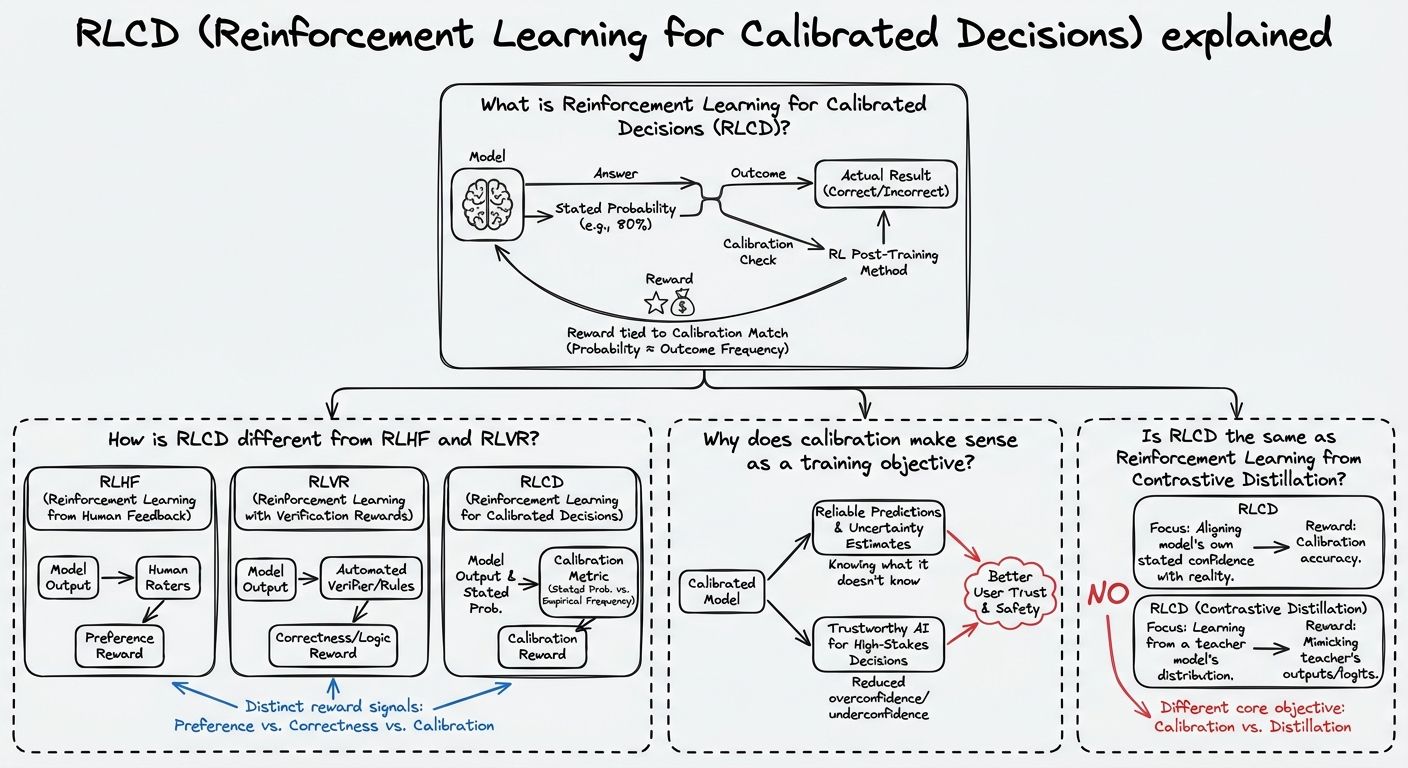
RLCD (Reinforcement Learning for Calibrated Decisions) is the reinforcement learning post-training objective that TypeSafe AI says it used to train Jev, the model it released on 15 September 2026 and describes as the first "System One model." Instead of rewarding a model for producing an answer a human rater prefers, RLCD rewards the model for attaching probabilities that are honest: a decision returned at 0.8 should be right about 80% of the time across many such decisions.
TypeSafe's documentation, quoted by systemonemodels.org, frames it as training the model "to return decisions and calibrated probabilities instead of generated text." Its launch post describes the target as "answers with epistemically honest probabilities on System One tasks."
One caution worth stating up front: RLCD is a vendor-coined method name, not an industry standard. There is no paper, no published reward function, no dataset description, and no released calibration figure. Everything known about RLCD comes from TypeSafe's own launch materials and has not been independently reproduced.
Calibration makes sense as a training objective for RLCD because of what the model actually produces. A model that returns a typed decision plus a probability is not writing for a reader. It is a component inside a control flow, and its number gets compared against a threshold so the surrounding code can branch: auto-approve, escalate, reject.
Accuracy alone does not make a threshold meaningful. A classifier that is right 90% of the time but reports "99% confident" on everything gives you nothing to gate on, because every case looks identical to your if-statement. A weaker model that says 70% and is right roughly 70% of the time is the one you can build automation around, because the number sorts cases into ones you can handle unattended and ones a person should see.
So when the product is a probability rather than prose, calibration is not a refinement layered on top of accuracy. It is the thing being sold. That argument is TypeSafe's, and it holds together on its own terms regardless of whether Jev delivers on it.
RLCD, RLHF, and RLVR differ in what the reward measures. RLHF (Reinforcement Learning from Human Feedback) rewards responses that human raters prefer, as described in the InstructGPT paper (Ouyang et al., 2022). It produces generated text, and TypeSafe's own primer names sycophancy and mode dropping as its side effects, arguing that "an output can be compelling to a person without being reliable enough for unattended automation."
RLVR (Reinforcement Learning with Verifiable Rewards) rewards outputs a program can mechanically check: the test passed, the arithmetic came out right. It underpins reasoning models such as DeepSeek-R1 and Tulu 3. It works wherever correctness is cheaply decidable, and it says nothing about how sure the model should have been.
RLCD abandons preference and verification alike and targets the honesty of the stated probability, with a typed answer and a distribution as the output rather than text. The reward signal itself is not published; TypeSafe states the target, not the mechanism. Note who is drawing the contrast: TypeSafe says RLHF was co-invented by its cofounder Diogo Almeida, which makes the change of objective a stated position rather than unfamiliarity with the alternative.
No. RLCD is a genuine acronym collision, and the older claim on those four letters belongs to Reinforcement Learning from Contrastive Distillation, published by Kevin Yang, Dan Klein, Asli Celikyilmaz, Nanyun Peng, and Yuandong Tian at ICLR 2024 (arXiv:2307.12950, first submitted 24 July 2023).
That method aligns a language model to natural-language principles without human feedback by generating a pair of outputs from two contrasting prompts, one written to encourage a principle and one to violate it, using the pair as a synthetic preference label, training a preference model on those pairs, and then improving the base model with reinforcement learning. It is a preference-data-generation technique in the RLHF family, it produces text, and it is aimed at alignment. The authors report it outperforming RLAIF and context distillation on harmlessness, helpfulness, and story outline generation at 7B and 30B scales.
TypeSafe's RLCD, coined roughly three years later, discards preference entirely and optimizes probability calibration on typed decisions. Same letters, unrelated methods, and the 2023 paper is by far the better documented of the two.
A smaller naming wrinkle: TypeSafe writes it as Reinforcement Learning "for" Calibrated Decisions, while TechCrunch's 18 September 2026 report quotes Almeida saying "from." Both spellings are attested.
RLCD does not make a model more accurate, and it is not what prevents a model like Jev from returning off-schema output. Those two confusions are the ones that break the concept.
Accuracy is how often the model is right. Calibration is whether its confidence tracks its accuracy, and the two are independent properties. TypeSafe does not claim RLCD improves Jev's accuracy. Nor does calibration say anything reliable about the single answer in front of you: TypeSafe's own wording is that these rates "describe groups of predictions, not a guarantee about any single answer." A 0.93 on one decision is a number whose meaning is only recoverable across a population of similar decisions.
The guarantee that the output is always schema-valid comes from the architecture, not from RLCD. The output space is constrained in advance to valid values, so a type error is structurally impossible. That is a guarantee about format, not correctness: the model can still return the wrong valid answer. RLCD governs how much you should trust the probability attached to it.
One more boundary. An independent reimplementation on GitHub (`eve-rlcd`) uses a reward proportional to the gradient of the Brier score. That is somebody else's guess at a plausible formulation, not a disclosure from TypeSafe, which has named no scoring rule anywhere.
RLCD only governs the probability a model attaches to its answer. What that answer is about is the state you pass in, and a calibrated probability about the wrong slice of content is still useless. TypeSafe reports a 32,000-token state budget for Jev, so what goes into that window is a design decision rather than an afterthought.
This is where the shape of your content matters. Sanity stores content in the Content Lake as structured JSON documents rather than rendered pages, and a GROQ projection names the fields you want and returns only those, so you can hand a decision model the specific field or block a question concerns instead of a whole page of markup and navigation. Sanity describes itself as a Content Operating System for the AI era, and this is the part of that claim doing the work here: the structured foundation is what makes a precise state extractable at all.
To be clear about scope: Sanity does not train models, implement RLCD, or have any announced support for System One models. The relationship is architectural, not integrational.
Unlock New Possibilities with Sanity
With RLCD (Reinforcement Learning for Calibrated Decisions) under your belt, it's time to see what Sanity can do for you. Explore our features and tools to take your content to the next level.
Last updated: