Small language model (SLM) definition
A small language model (SLM) is a language model with few enough parameters, typically a few billion or fewer, to be trained, adapted, and served cheaply and quickly, often on a single GPU or on a consumer device, and usually specialized for a narrow task rather than open-ended conversation. There is no fixed size cut-off; "small" is relative to the frontier models of the moment.
A small language model is a language model sized to be cheap and fast enough to run on modest hardware, usually by giving up general breadth in exchange for reliability on one narrow task. What makes a small model workable on a given step is a bounded input and a bounded answer space. In Sanity, content is stored as typed fields and blocks with references to taxonomy documents, so a task can be handed the one field it concerns plus a schema describing valid answers.
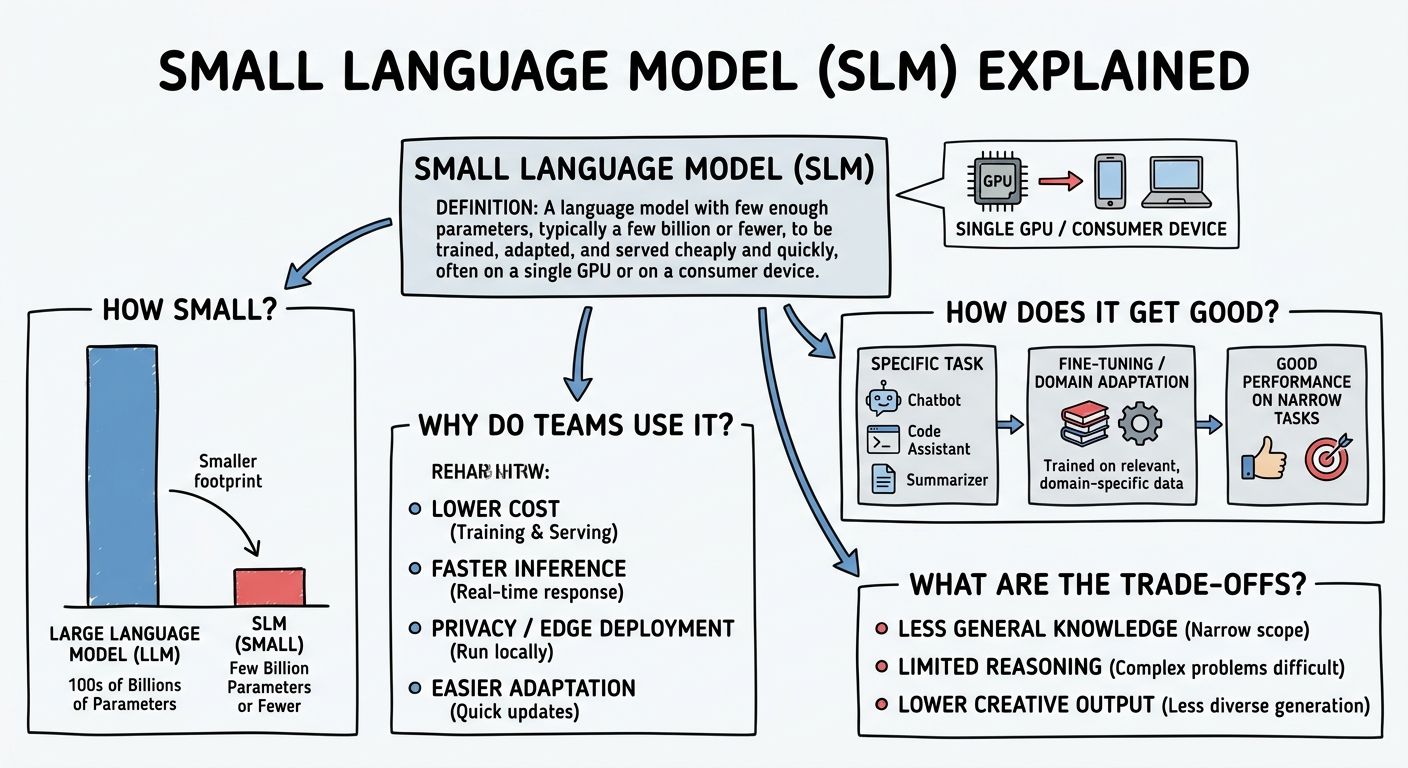
There is no agreed threshold for a small language model (SLM), and published definitions disagree openly. IBM puts the range at a few million to a few billion parameters, against large models at hundreds of billions or trillions. TechTarget says a few million to several billion, and its comparison table widens that to between 500 million and 20 billion. Wikipedia says SLMs typically have fewer than forty billion parameters. Other glossaries decline to name a number at all, on the grounds that the label is relative and
The practical definition is a deployment test rather than a number. If the model fits on the hardware you have and serves at the latency and price your step needs, it is small for you. A parameter is one of the learned numbers inside the model, and the count sets both how much memory the weights occupy and how much arithmetic happens per generated token, which is where cost and latency come from.
Concrete published sizes give a feel for the range. Hugging Face's SmolLM2 family ships at 135 million, 360 million, and 1.7 billion parameters. Microsoft's Phi-4-mini is 3.8 billion. Apple's on-device foundation model is described at approximately 3 billion parameters, a clean case of the deployment constraint setting the size.
Teams reach for a small language model when a step is repetitive, narrow, and high volume, because at that shape the breadth of a large model is paid for and not used. TechTarget's advantages list for SLMs covers cost-effectiveness, energy efficiency, faster training and deployment, more hardware options including CPU-only deployment, easier customization, lower latency, improved accuracy on domain-specific tasks, and privacy benefits from running locally or in a private cloud so sensitive information stays under the organization's control.
The mechanics behind the cost and speed are worth understanding rather than taking on faith. Fewer parameters mean fewer arithmetic operations per token and less video memory for the weights. Quantization, storing weights at lower numerical precision such as 8-bit integers instead of 32-bit floats, cuts memory further and speeds up inference. A model that fits on a single accelerator avoids being split across several machines, and more concurrent requests fit on the same hardware. None of this is free: IBM and TechTarget both note that compressed models usually need fine-tuning afterwards to recover accuracy lost in compression.
Predictability matters as much as price. A model doing one bounded job, with a schema telling it what the valid answers are, behaves more consistently than a general model asked to improvise, and consistency is what lets a step run unattended.
A small language model usually gets good at a task through specialization rather than scale, by one of two routes. Knowledge distillation trains a small student model to imitate the outputs of a larger teacher model, with the teacher's weights typically frozen, as IBM describes. Fine-tuning continues training the model on examples of the specific job it will do, which is why SLMs are so often described as domain-specialized.
Distillation appears to help small models disproportionately. Research presented in Findings of ACL 2025 reports large gains for small student models and only marginal gains for larger ones, which is part of why the technique is associated with the small end of the size range in the first place.
Specialization can close the gap with a much larger general model on a narrow job, and the amount of labeled data required can be modest. A paper at EMNLP 2025 frames this as a break-even point, finding roughly a hundred labeled examples enough for a specialized small model to match a general large one on text classification. That result is specific to classification-style tasks, so treat it as an anchor for narrow, repetitive judgments rather than a general law.
The trade-off with a small language model runs in one direction: less general knowledge and weaker reasoning outside the task it was built for. TechTarget's limitations list names narrower scope across topics, limited capacity for complex understanding because fewer parameters restrict how much contextual nuance the model can capture, heavier dependence on the quality of the training data, difficulty scaling to broad general deployments, and a need for real machine learning expertise to customize well.
That shapes where an SLM belongs. Classification, extraction, routing, tagging, short summarization, and structured judgments over a known domain are good fits. Open-ended research, multi-step reasoning across unfamiliar material, and anything where the question could be about almost anything are not.
Two common confusions are worth clearing up. First, a small language model is not the same thing as a compressed large one: distillation, pruning, quantization, and low-rank factorization are ways to arrive at a small model, but plenty of SLMs are trained small from the start. Second, size and openness are separate questions. An SLM can be an
Small language models are one piece of a wider shift away from sending every step to a single general model and toward choosing the right model for each step. The clearest published statement of this is Small Language Models are the Future of Agentic AI (arXiv:2506.02153, submitted June 2025, revised September 2026), which argues that agentic systems mostly ask language models to perform a small number of specialized tasks repetitively and with little variation, and that SLMs are sufficiently powerful, inherently more suitable, and more economical for many of those invocations. The same paper argues that where general conversational ability really is needed, heterogeneous systems invoking several different models are the natural choice.
The cascade is the best-known pattern for mixing sizes. You try the cheap small model first, accept its answer when a quality signal clears a threshold, and escalate only the remainder to a larger model, so the small model absorbs the volume and the large one handles the hard minority. The pattern was formalized alongside prompt adaptation and model approximation in FrugalGPT (arXiv:2305.05176), and later work such as cost-saving cascades with early abstention refines when to escalate.
Size is not the only axis in play. Decision models, including the System One models that return probabilities over a fixed answer space instead of prose, are not generative at all: you pass state and typed questions, and get values back. A small language model is still a text generator, just a smaller one. Sanity, as the AI Content Operating System, sits on the input side of all of this, because typed fields, references to taxonomy documents, and document revisions give any model on any step a clean, bounded input and a defined answer space.
Unlock New Possibilities with Sanity
With small language model under your belt, it's time to see what Sanity can do for you. Explore our features and tools to take your content to the next level.
Last updated: