Open-weight model definition
An open-weight model is a machine-learning model whose trained parameters are published for download, so anyone can run it on their own infrastructure instead of only calling it through the provider's hosted API. The licence attached to those weights, not the fact that they are downloadable, determines what use is you.
An open-weight model is a model whose trained parameters, the learned numbers that turn an input into an output, are published for anyone to download, run, inspect, and usually fine-tune, rather than kept behind the maker's API. Which model you call becomes a smaller decision when the content feeding it is already structured: because Sanity stores content as typed fields and references to taxonomy documents rather than prose blobs, swapping an open-weight model for a closed one changes the call site, not the content model.
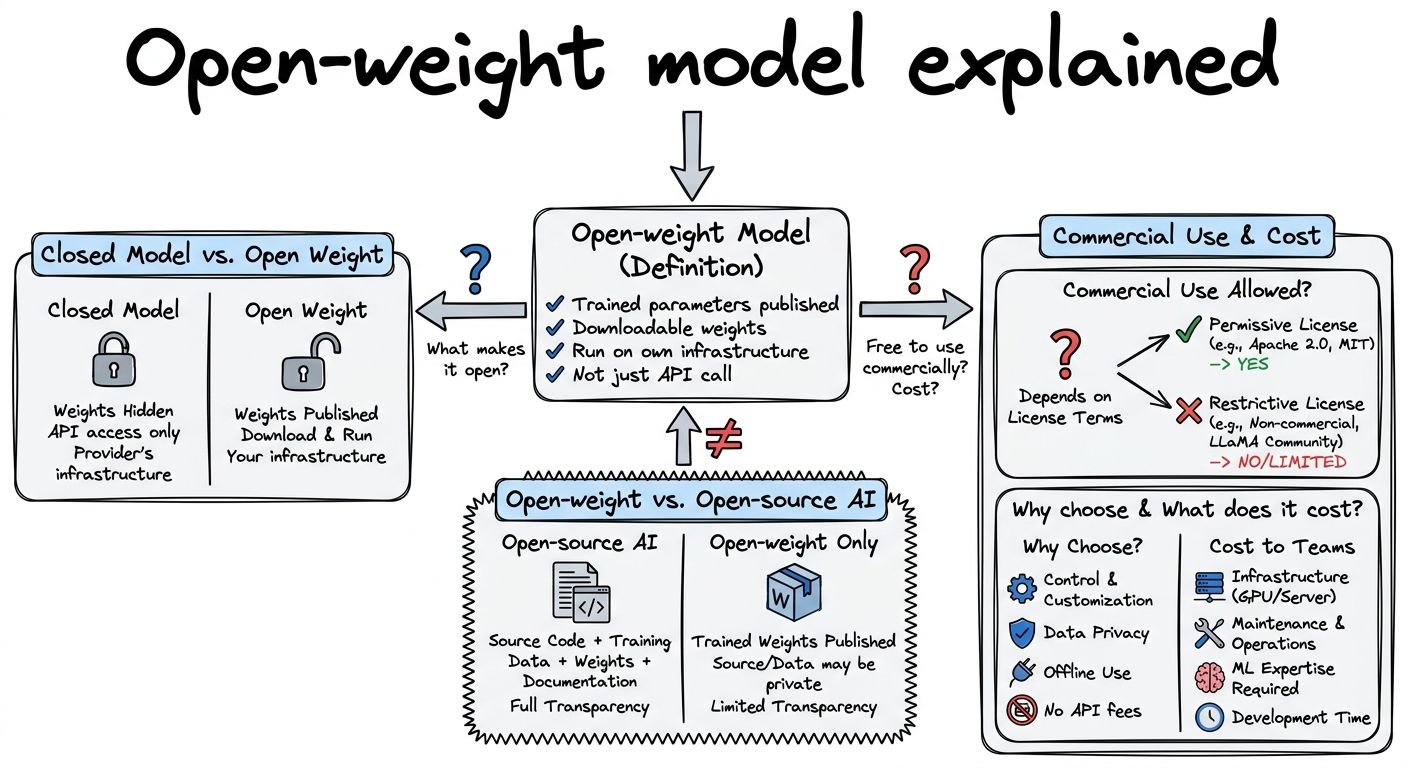
A model is open weight when the publisher releases the weight files themselves, so you can download them, load them into an inference engine, and run the model on hardware you choose. A closed or API-only model keeps the weights with the provider, and you interact with the model by sending requests to an endpoint the provider operates.
The weights are the trained parameters. The Open Source Initiative defines AI weights as "the set of learned parameters that overlay the model architecture to produce an output from a given input," and defines an AI model as the architecture, the parameters, and the inference code needed to run it. A weights release is therefore a release of one of those three pieces, sometimes alongside the inference code, and sometimes not.
Widely cited examples of the open-weight category include OpenAI's gpt-oss models, published as gpt-oss-120b and gpt-oss-20b under the Apache 2.0 licence plus a usage policy, Meta's Llama models, and several of Mistral's models. Models on the closed, hosted side are reached only through an endpoint. TypeSafe AI's Jev, released on 15 September 2026 as the first System One model, is one current example: it takes state plus typed questions and returns probabilities over a fixed answer space, and it is reachable through TypeSafe's API and through AI gateways rather than as a download.
Open weight is not a size class. A model can be open weight and very large, or open weight and small enough to run on a laptop. That is separate from the large language model and small language model distinction.
No. An open-weight model and open-source AI are different things, and conflating them is the most common mistake people make with the term. Publishing weights says nothing about whether the training data, the data provenance, or the training code were published alongside them.
The Open Source AI Definition 1.0, released by the Open Source Initiative in October 2024, sets out the four freedoms (use, study, modify, and share) and then specifies what has to be released as the "preferred form to make modifications": Data Information, meaning a description of the training data detailed enough that a skilled person could build a substantially equivalent system; Code, meaning the complete source used to train and run the system under OSI-approved licences; and Parameters, meaning the weights themselves. The OSI states that "Open Source models" and "Open Source weights" must include the data information and code used to derive those parameters.
Measured against that definition, a release that gives you the weights alone does not meet it. The weights are downloadable, which is what "open weight" claims, and nothing more is claimed. Plenty of useful, widely deployed models sit in exactly that position, so the distinction is descriptive, not a criticism.
Not automatically. Open weight describes distribution, but the licence attached to a given open-weight model decides what you may legally do with it. The terms have to be read per model, not assumed for the category.
Three published examples show the range. OpenAI's gpt-oss-120b and gpt-oss-20b carry the Apache 2.0 licence together with a gpt-oss usage policy. Meta's Llama Community Licence adds a scale clause: an entity whose products or services had more than 700 million monthly active users in the month before the model's release date must request a separate licence from Meta, and attribution requirements plus an acceptable use policy also apply (Llama Community License). Mistral splits its catalog, publishing Mistral 7B under Apache 2.0 while Mistral Large 2 is offered under the Mistral Research License for research and non-commercial use, and Codestral under the Mistral AI Non-Production License, announced on 29 May 2024.
The practical rule: check the model card and the licence file for the exact model and version you intend to ship, including any separate usage policy, before you build a product on it.
Teams choose an open-weight model for reasons that follow from having the files. They run inference on infrastructure they control, which matters when data must not leave a boundary. They fine-tune on their own data and keep the resulting artifact. The cost structure shifts from per-token billing to capacity they own or rent. And a set of weights already downloaded cannot be retired out from under an application the way a hosted model can be: OpenAI, for instance, publishes model shutdown dates and migration guidance for its hosted models, which is the concrete version of the deprecation risk open weights avoid.
The costs are equally concrete. You operate the serving stack. Parameter count and quantization determine how much GPU memory the model needs, batch size and utilization determine cost per token, and the serving stack plus the hardware determine latency. The economics depend on your traffic shape rather than on a published price. You also track a release cadence set by someone else, and you take on the evaluation and safety work a hosted provider would otherwise absorb. The NTIA's July 2024 report, Dual-Use Foundation Models with Widely Available Model Weights, is the non-vendor treatment of both sides, including the point that publishing weights is difficult to reverse.
No. Downloading an open-weight model and running it yourself is one deployment option, not the only one. Open-weight models are commonly offered as managed endpoints by specialist inference providers and by hyperscalers. Microsoft's documentation, for example, describes serving Fireworks AI open-model inference inside Microsoft Foundry. AI gateways add another layer: OpenRouter routes a single model ID across several providers serving the same model.
So a team can adopt an open-weight model without touching a GPU. What the published weights buy you in that arrangement is optionality. The same files run somewhere else, including on your own hardware, so a price change, a capacity problem, or a provider you no longer want to depend on is a migration, not a rewrite.
Structured content narrows what any model, open weight or closed, has to infer, because the input arrives already typed and the set of acceptable answers is already enumerated. A model asked to classify an article against a free-text list can return anything. A model asked to pick from a taxonomy that exists as documents in a repository has a bounded answer space.
Sanity is the AI Content Operating System, the intelligent back end for companies building AI content operations at scale, and that structure is how it keeps model choice reversible. Content is stored as JSON documents whose `_type` comes from the schema and whose fields are typed by that schema (documents), relationships are modeled with the reference type pointing at named document types, with strong references enforcing that the referenced document actually exists (reference type), and every document carries a revision ID so the History API can return the document exactly as it stood at a given revision or time (History API). The practical effect: you can reproduce the input a model was shown, and you can point a different model at the same bounded input without reshaping your content.
Discover More with Sanity
Now that you've learned about open-weight model, why not start exploring what Sanity has to offer? Dive into our platform and see how it can support your content needs.
Last updated: