Taxonomy drift definition
Taxonomy drift is the gradual mismatch between a fixed set of labels and the content those labels are meant to describe, caused either by the taxonomy changing (terms added, merged, renamed, or retired) or by the content moving on while the label set stays frozen.
Taxonomy drift is the gradual mismatch between a fixed set of labels and the content being labeled, either because the taxonomy changed or because the content did. In Sanity, taxonomy terms can be modeled as their own documents that other content references, so a renamed or merged term keeps its identity and revision history, and you can query which documents still point at the old label instead of guessing how far the drift has spread.
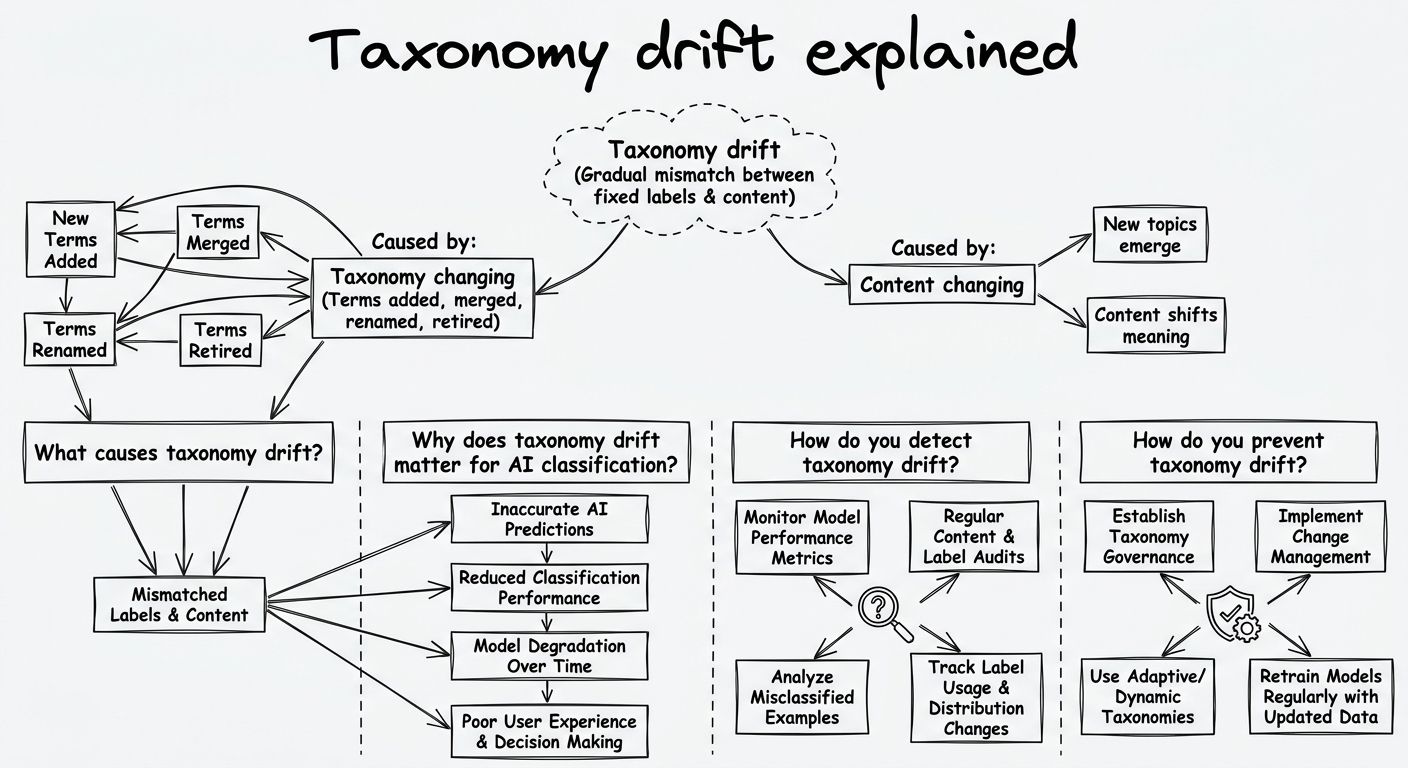
Taxonomy drift has two causes, and they pull in opposite directions. The first is change in the taxonomy itself: someone adds a term, merges two overlapping ones, renames a category for clarity, or retires a label nobody uses. The second is change in the content: a product line expands, a support team starts handling a new kind of request, an editorial team invents a format, and the existing labels stop describing what is actually there.
Both causes produce the same symptom. Something that was true when the label set was written is no longer true, and nothing in the system announces it. A classifier keeps returning answers. A report keeps rendering. The numbers look plausible, which is why drift tends to be discovered late, usually when someone notices that a category has an implausible share of the content.
A third, quieter cause is drift in meaning without drift in wording. The label "Enterprise" can stay spelled the same for years while the definition people apply to it shifts. Nothing in the schema changed, so no migration was triggered, but two batches of content labeled in different years now mean different things.
Taxonomy drift matters for AI classification because a classifier can only return a label from the set it was given, so when the set is wrong it does not fail loudly, it chooses the nearest wrong option and reports it with confidence. This is true of a prompted language model asked to choose a category, a fine-tuned classifier, and a decision model that returns probabilities over a fixed answer space.
The risk is sharpest for models designed to choose from options. TypeSafe AI's Jev, released on 15 September 2026, is described as a "System One model": you pass state plus a typed question such as a Choice, and it returns probabilities over a fixed set of answers with no prose and no rationale. Constraining output to schema-valid values is a guarantee about format, not correctness. A choice can be perfectly well-formed and still wrong, and with no rationale attached there is nothing in the output that tells you the option set was the problem.
Taxonomy drift also poisons anything downstream that trusts the labels. Faceted search filters return incomplete result sets. Personalization rules fire on categories that no longer mean what the rule author meant. Retrieval pipelines that filter by label before ranking silently exclude relevant content. The label looked like metadata, so nobody audited it.
You detect taxonomy drift by measuring the shape of the classification output rather than reading individual labels, because drift shows up as the distribution changing before anyone notices a single bad answer. Three signals are worth watching.
The first is the "other" rate, which only works if your label set has an explicit "other" or "none of these" option. Without it, content that fits nothing gets forced into the nearest label, and the drift stays hidden. With it, a rising share of "other" directly shows that reality has outgrown the options.
The second is low-confidence rate. Models that return probabilities rather than a single answer let you track how often the top two options are close together. A category where the model is habitually torn is usually a category that has split in two, or one whose boundary has moved.
The third is share-of-volume per label over time. A term that was 5 percent of content last quarter and 30 percent this quarter has either genuinely grown or become a dumping ground. Either way, it needs a human review.
You prevent taxonomy drift by treating the label set as versioned content with a single source of truth, not a list pasted into a prompt, or hard-coded in an application. Five practices do most of the work.
First, always include an explicit "other" or "none of these" option, and treat choosing it as a successful outcome, not a failure. A model that can say "none of these apply" gives you a drift alarm. A model that cannot will always answer, and often wrongly.
Second, derive the option set at runtime from the taxonomy source of truth instead of duplicating it. When the list lives in two places, the copy in the classifier is the one that goes stale.
Third, version the label set alongside the content model, so a change to the taxonomy is a deliberate migration with a before and an after, not an edit nobody recorded.
Fourth, store the label set version on every classification result. Without it, you cannot tell which decisions were made under which definitions, and you cannot scope a relabeling job.
Fifth, relabel affected content in controlled batches after a taxonomy change, checking a sample by hand before running the rest. Reclassifying everything at once removes your ability to compare old against new.
Structured content reduces taxonomy drift by making the taxonomy itself queryable, so label history, and the scope of a migration, are facts you can look up, not guesses you have to reconstruct. The key move is storing each taxonomy term as its own document with a stable identifier, then having content reference that document instead of copying its name into a text field.
With references in place, renaming a term is a one-document edit, not a find-and-replace across thousands of records. Merging two terms becomes a traceable operation rather than an overwrite. The question "which documents still use the retired label" has a queryable answer, which is the difference between a scoped relabeling batch and a guess.
Sanity is the AI Content Operating System, and the reason it matters for classification is architectural: typed fields, references to taxonomy documents, and document revisions are what give a model a clean, bounded state and a defined answer space. A decision model asked to pick from options is only as good as the options, and the options are only trustworthy if something owns them.
Explore Sanity Today
Understanding taxonomy drift is just the beginning. Take the next step and discover how Sanity can enhance your content management and delivery.
Last updated: