
WinnerPath two
A wine cellar that remembers what you used to believe
by Ken W AlgerConsumer & lifestyle
A wine collection that learns your taste and helps you drink your best bottles before they're past their prime.
ShowcasedPath twoResearch, science & evidence
Lets a lab member rule on conflicting protocol values, turning each ruling into a lab rule its agent follows.
by neromtoobadM.Tech biology student in Lagos
What it does
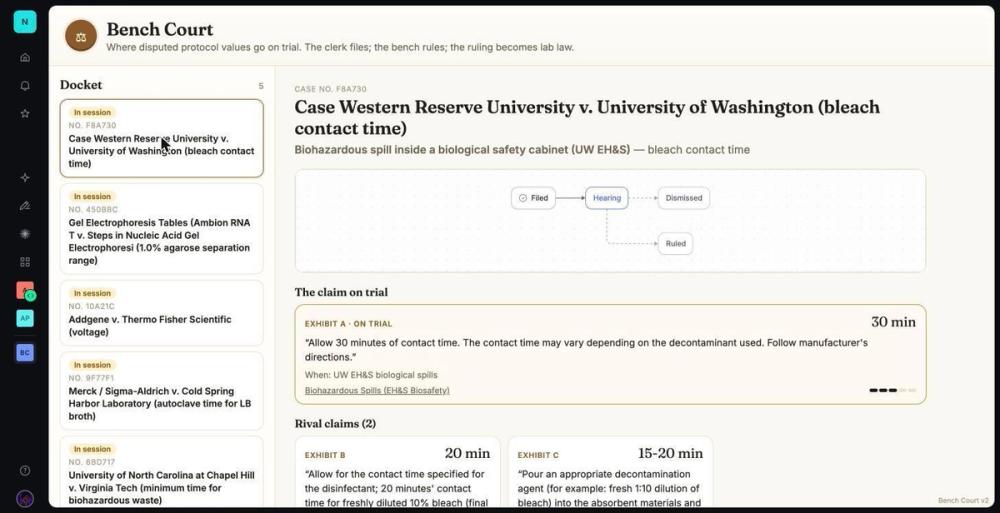
Each disputed protocol value, such as how long bleach sits on a spill, becomes a case named after the two sources. A clerk agent groups the conflicting claims, writes a brief with a recommendation, and opens the case.
A person reviews the exhibits in a courtroom app inside the Sanity Dashboard and picks sustain, overrule, both apply, or dismiss. The ruling is saved as a lab rule, which the builder's Aliquot protocol agent applies ahead of any outside source.
The problem
Safety offices disagree on values like bleach contact time (15 to 30 minutes) or autoclave duration (30 or 60 minutes). Some lab member ends up choosing, and the choice often lives in one person's memory or on a lost printout. Without a record of who decided, on what evidence, nobody can check or reuse the decision.
What they built
46 sources, 92 claims, about 30 real disagreements; 5 cases filed by the clerk agent.
claim
One protocol value quoted from a named source, the subject of a case.
labRule
A ruling: rule text, severity, overridden claims, verdict, brief, case name, and workflow instance link.
bench-court workflow instance
One case: its stage, brief, verdict, ruling, actors, and full history.
The stack
The hard part
The workflow runs filed, then hearing, then ruled or dismissed. The clerk agent can only fire the action that submits a brief; the ruling action belongs to the hearing stage, which a person triggers from the courtroom app.
Every ruling becomes a labRule that records its case, verdict, and workflow instance. Aliquot's GROQ precedence step reads lab rules first, so a decision in the courtroom changes the answer a researcher gets at the bench.
WinnerPath two
by Ken W AlgerConsumer & lifestyle
A wine collection that learns your taste and helps you drink your best bottles before they're past their prime.
WinnerPath two
by FarisCommunity & civic
A shelter where the animals are New York City potholes. Find one that needs care, adopt it, and follow the city's progress on fixing it.
Team favoritePath two
by Andrei AlbaConsumer & lifestyle
Is it rude here? An etiquette guide with no verdict field: locals vote on each custom, and when they disagree the site shows the split instead of picking a side.

