
WinnerPath two
A wine cellar that remembers what you used to believe
by Ken W AlgerConsumer & lifestyle
A wine collection that learns your taste and helps you drink your best bottles before they're past their prime.
WinnerPath twoCommunity & civic
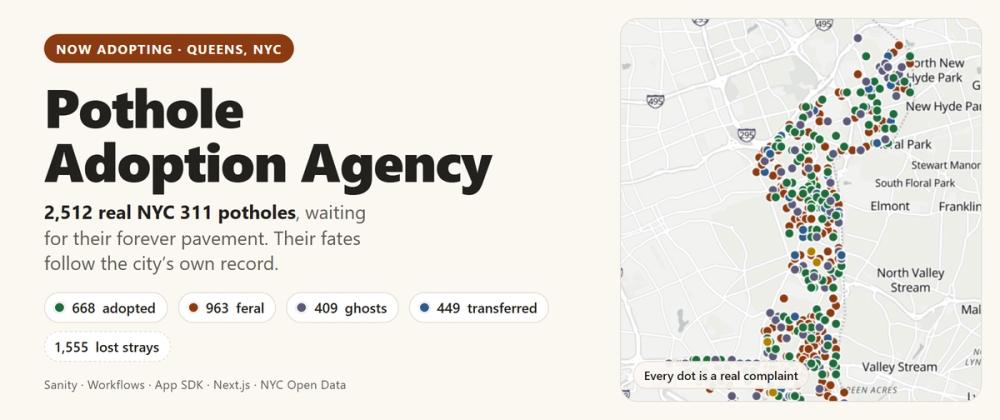
A shelter where the animals are New York City potholes. Find one that needs care, adopt it, and follow the city's progress on fixing it.
by Faris
What it does
Visitors browse a gallery of potholes presented as shelter animals, filter by outcome, and open a pet to read its history and follow a link to the original city record. Strays without coordinates are listed by street, and potholes inspectors could not find sit in a ghost hall.
Visitors can leave an adoption note, which stays private until a person approves it. A public sync log shows when data last updated and which city phrases are still unmapped.
The problem
The 311 record holds the answer, but it is messy. Most complaints have no point location, only a stretch of street. Resolution wording varies, duplicates close within a minute and distort averages, and many open tickets wait for months. Turning this into something people want to read without inventing locations, outcomes or details means every gap in the data has to be shown as it is, not smoothed over.
What they built
2,512 Queens Community Board 13 pothole complaints, synced in full, with about 5,000 documents in the dataset.
complaint311
One 311 row exactly as published, its SHA-256 hash and the source row URL.
pothole
The pet: name, temperament, guarded bio, rounded location, outcome and an append-only event history.
resolutionMapping
One exact city resolution phrase mapped to an outcome, with a person's rationale.
clusterDecision
A proposed merge of complaints, its review workflow and the person who decided.
adoption
A visitor's note, private while pending and public only after a person approves it.
syncRun
One sync run's counts, watermark and the hash of each raw page saved.
The stack
The hard part
A deterministic sync maps each closed complaint to an outcome only through exact matches against person-written phrase mappings. Unknown wording lands in a public Unmapped bucket, and open complaints turn feral after 60 days through a tested workflow.
Gemini may restyle bios, but a fact guard rejects any changed date, number, street or reworded city note. Because raw records stay separate from interpretation, any pet can be checked against its source row, and a re-sync never overwrites a person's decision.
WinnerPath two
by Ken W AlgerConsumer & lifestyle
A wine collection that learns your taste and helps you drink your best bottles before they're past their prime.
Team favoritePath two
by Andrei AlbaConsumer & lifestyle
Is it rude here? An etiquette guide with no verdict field: locals vote on each custom, and when they disagree the site shows the split instead of picking a side.
ShowcasedPath two
by neromtoobadResearch, science & evidence
Lets a lab member rule on conflicting protocol values, turning each ruling into a lab rule its agent follows.

