
WinnerPath two
A wine cellar that remembers what you used to believe
by Ken W AlgerConsumer & lifestyle
A wine collection that learns your taste and helps you drink your best bottles before they're past their prime.
ShowcasedPath twoGames & creative
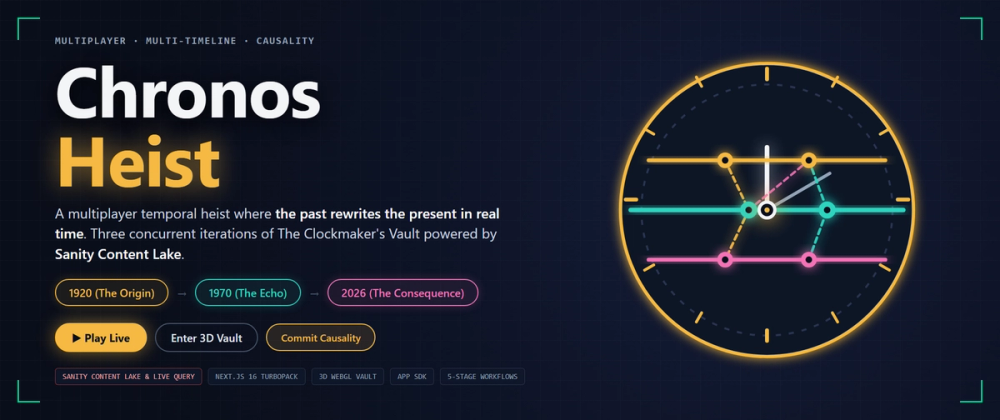
A browser mystery game where actions taken in a 1920 vault change the same room in 1970 and 2026.
What it does
Players explore one vault room in three eras through a 3D browser view, solving small puzzles such as a rotary safe and an oscilloscope tuner. Hiding an object in the past changes what appears in later eras without a page reload.
A game master view shows each action's estimated impact and lets a person approve sealing the timeline. A force-directed graph shows how objects in different eras depend on one another.
The problem
Time-travel puzzles depend on a change in one period showing up correctly in others. Holding rooms and objects as local component state or fixed tables makes those cross-era links hard to define, inspect or update while players are in a session. The builder wanted the world and its causal rules stored as shared, editable content so every connected view updates the moment the past changes.
What they built
3 eras, 3 rooms, 10 schema types.
era
One time period: 1920, 1970 or 2026.
room
A room in one era, with linked rooms, hidden compartments and spatial coordinates.
gameObject
An interactable object, flagged when it affects causality.
temporalAction
One player action committed in a given era.
causalityLink
A dependency from a past object to a later object or room, with change type and probability.
workflowTransition
A step in the five-stage review flow that ends with a sealed timeline.
The stack
The hard part
When a player acts, a server action commits a temporalAction document. A server-side engine reads the causalityLink documents to work out which later objects or rooms change, then patches them.
Live queries broadcast those patches, so the 3D scene for 1970 and 2026 re-renders hidden compartments without a refresh. Because the rules are content, they can be viewed and edited in Studio, including in a custom graph tool.
WinnerPath two
by Ken W AlgerConsumer & lifestyle
A wine collection that learns your taste and helps you drink your best bottles before they're past their prime.
WinnerPath two
by FarisCommunity & civic
A shelter where the animals are New York City potholes. Find one that needs care, adopt it, and follow the city's progress on fixing it.
Team favoritePath two
by Andrei AlbaConsumer & lifestyle
Is it rude here? An etiquette guide with no verdict field: locals vote on each custom, and when they disagree the site shows the split instead of picking a side.

