
WinnerPath two
A wine cellar that remembers what you used to believe
by Ken W AlgerConsumer & lifestyle
A wine collection that learns your taste and helps you drink your best bottles before they're past their prime.
ShowcasedPath twoBusiness ops & commerce
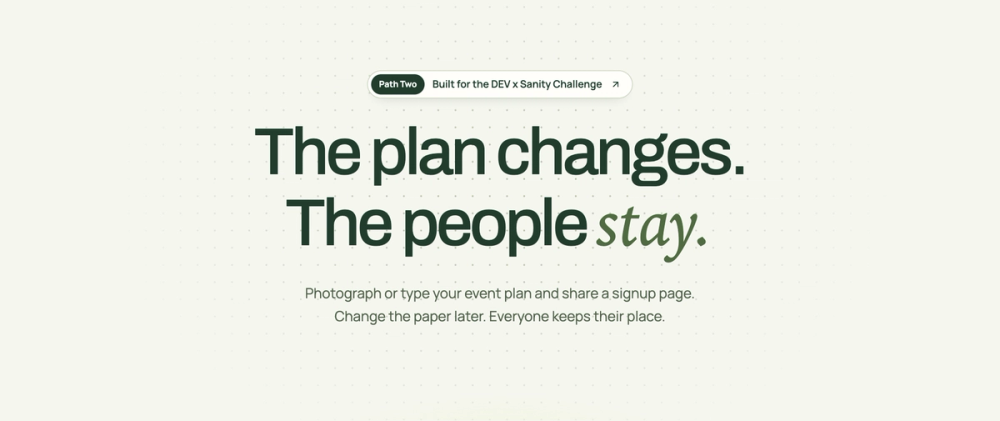
Lets meetup organizers change a session plan from a photo or text without losing guests' existing bookings.
What it does
Organizers upload a photo of a plan or type one, review what the reader extracted, and approve it. Guests join a games night, workshop or meetup without an account and find their bookings under Your places.
When the plan changes, approval waits on a check of seats and time slots. Session and registration IDs stay the same, so nobody rebooks. A paper time machine scrubs through saved plan versions and shows where each booking sat.
The problem
Small events often run off a paper plan that keeps changing: a table swaps, a room is added, a session moves. If moving a session replaces it, everyone booked into it is dropped. Reading a handwritten or crossed-out plan with a vision model adds risk, since the model can misread titles or guess seat limits without warning.
What they built
Bounded to small gatherings: up to 300 active and 1,200 lifetime registrations each.
inkshiftRegistration
One guest booking, pointing at the session it belongs to.
inkshiftSession
A session such as a game, pointing at the space it currently uses.
inkshiftSpace
A table or room that sessions are assigned to.
inkshiftProposal
A proposed plan change, including planBefore, the plan it replaced at apply time.
inkshiftEvent
Private aggregate and source of truth: spaces, sessions and bookings, guarded by one document revision.
inkshiftPublicEvent
Public schedule App SDK reads anonymously: space labels, capacities and booked counts.
The stack
The hard part
The event aggregate holds spaces, sessions and bookings and is the app's source of truth; linked documents are mirrors for inspection. Each booking or approval patches it with ifRevisionId and writes linked records and the public projection in one transaction. A stale write fails whole with a 409.
Moving a session only changes its space reference, so registrations stay attached. Workflows checks are advisory, so the server rechecks revisions, seats and time slots before approving.
WinnerPath two
by Ken W AlgerConsumer & lifestyle
A wine collection that learns your taste and helps you drink your best bottles before they're past their prime.
WinnerPath two
by FarisCommunity & civic
A shelter where the animals are New York City potholes. Find one that needs care, adopt it, and follow the city's progress on fixing it.
Team favoritePath two
by Andrei AlbaConsumer & lifestyle
Is it rude here? An etiquette guide with no verdict field: locals vote on each custom, and when they disagree the site shows the split instead of picking a side.

