Everything *[NYC] 2025 recap: A day of AI, Content Operations, and Culture
The AI space is drowning in telling. We spent a day showing. Watch the talks to see what's actually working in production.

Knut Melvær
Principal Developer Marketing Manager
Published
Sanity's first developer conference, Everything *[NYC] happened on a Tuesday at Pioneer Works in Brooklyn, a massive industrial space built in the 1860s. Back then, they made railroad tracks and parts for steam engines. Second industrial revolution stuff. The infrastructure that rewired the global economy.
Today it's a cultural center for avant-garde art and experimental performances. The venue's history was an intentional backdrop to what we are witnessing. Another industrial shift, this one powered by AI.
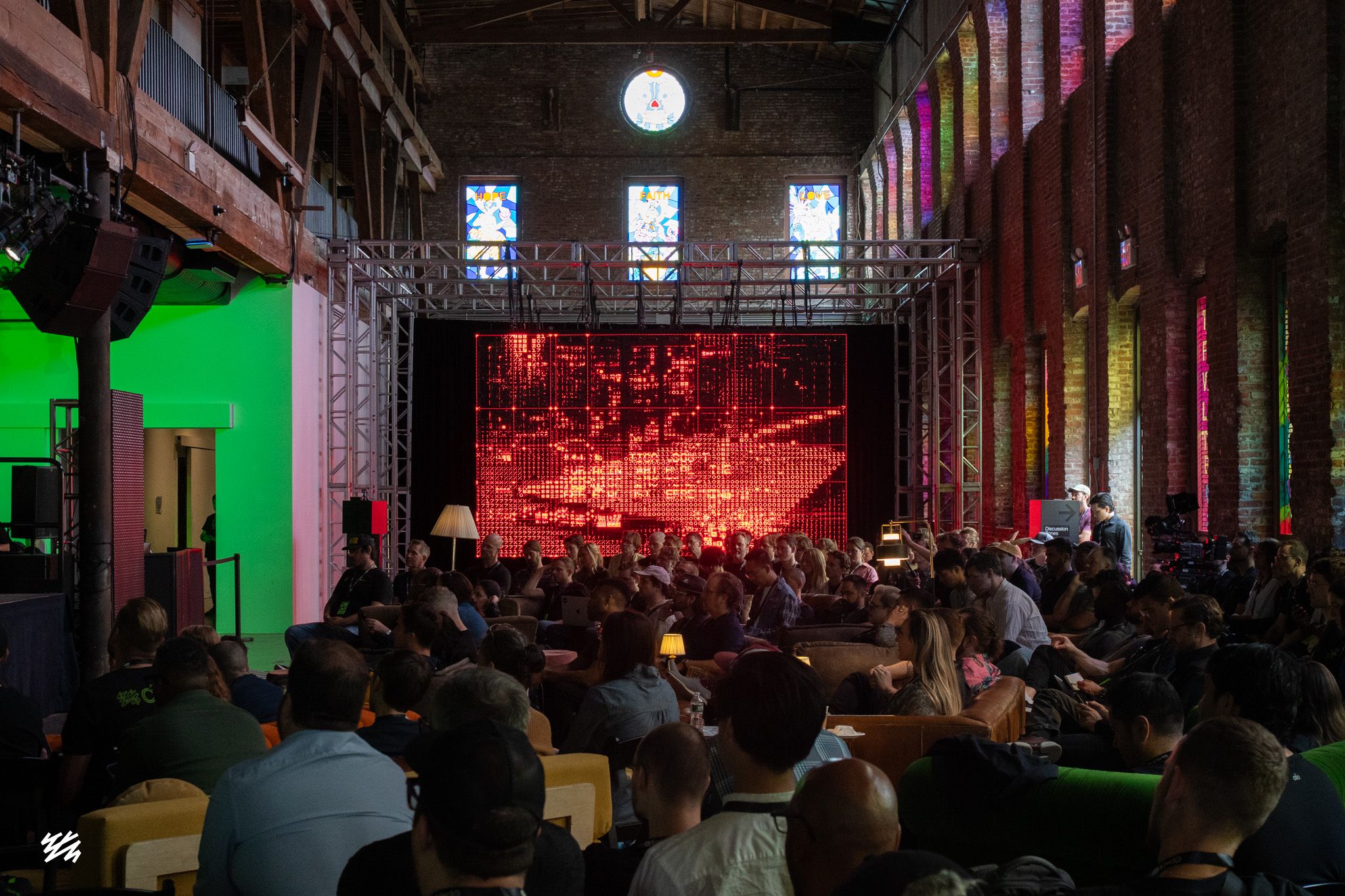
Together with a room packed with Sanity builders, we had 13 hours of a single focused track, with real demos and production stories about AI in
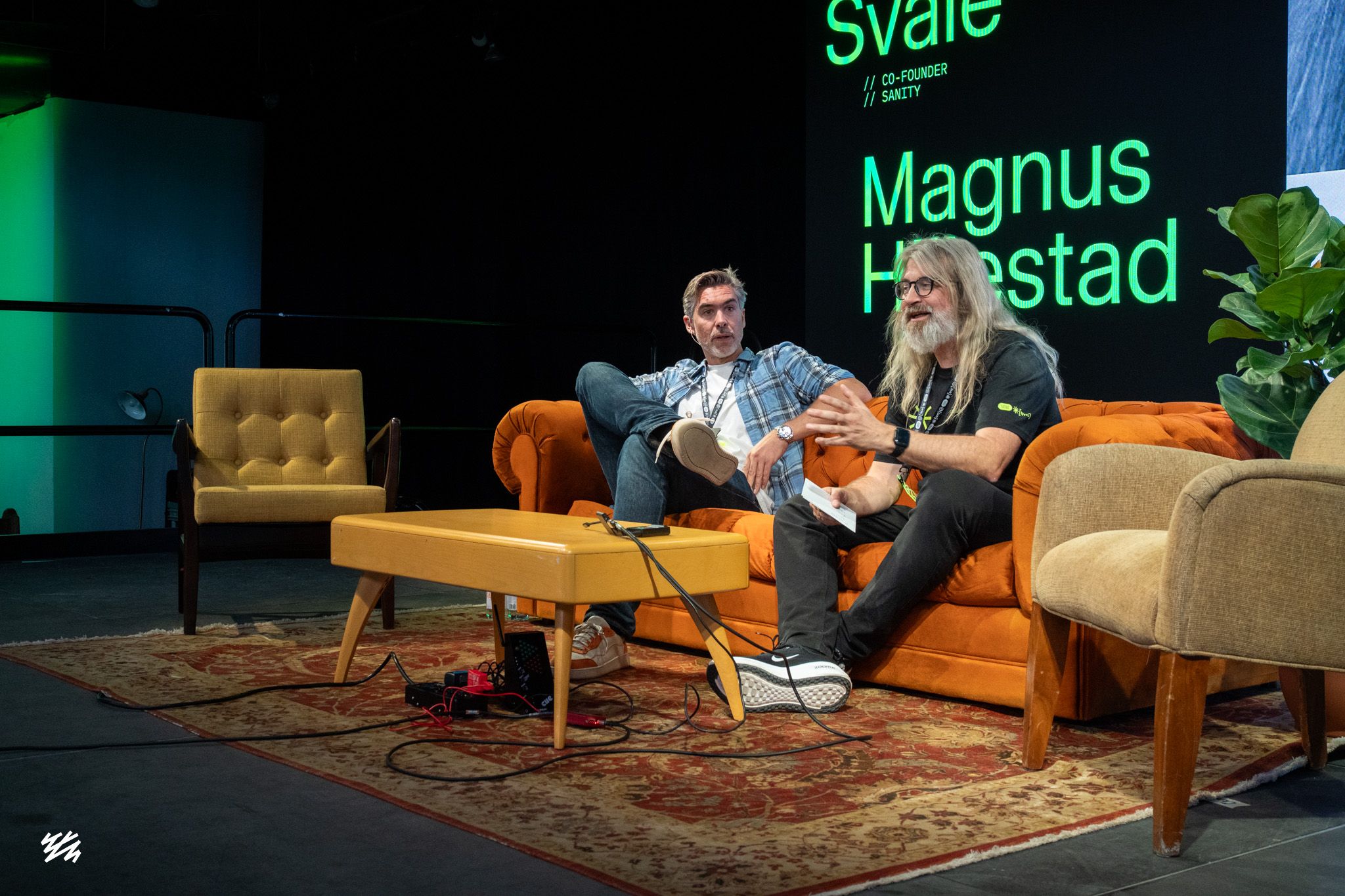
The AI space is drowning in telling. We wanted to show. So we brought friends from Complex, Mejuri, The MET, Braze, BAGGU, and loveholidays on stage to share what they're actually running in production with Sanity. And our team demonstrated how this stuff actually works, from translation workflows with Agent Actions to specialized editorial tooling built with our App SDK.
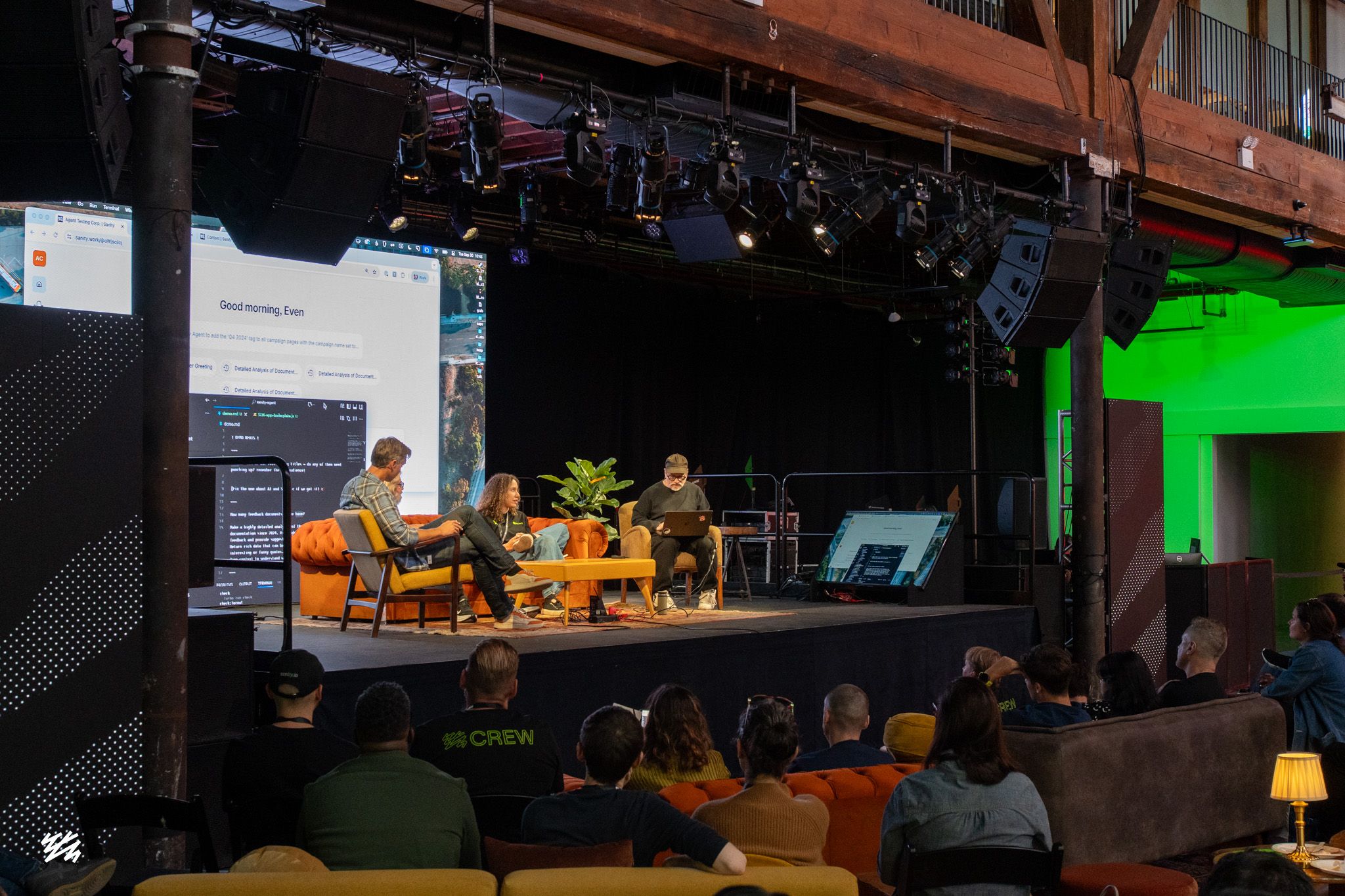
Fortunately, the demo gods where benevolent. Like when Even and Carolina made the Content Agent go through 21,000 document feedback agents to figure out what we should fix first. Pioneer Works was built for heavy machinery. This qualified.
You can now watch all these talks on YouTube.
What wasn't captured on video: the conversations between sessions, the debates in the sofas facing the stage, people's reflections walking between the AI-powered LED screens of Bjørn Staal's installation, trying to figure out how it was reacting to what speakers were saying.
But we'll do this again. Watch for the next Everything.
Magnus Hillestad (CEO, Co-founder) & Simen Svale Skogsrud (CTO, Co-founder)
David Annez (Head of Product - Applications)
Even Westvang (Co-founder) & Carolina Gonzalez (Sr. Software Engineer)
"Adventure is just the result of bad planning."
Magnus and Simen opened with a quote from Norwegian explorer Roald Amundsen. Real pioneers prepare. Being prepared isn't boring, it gives you velocity.
Their argument: we're not in an AI bubble, we're in an industrial revolution. Act 1 makes old things cheaper. Act 2 rewires how businesses work. Companies building for Act 1 are winging it,
David then demonstrated what that looks like. In 8 minutes, he built AI-powered workflows for content translation, audio generation, and custom applications. All working code, no slides.
Even and Carolina closed the set with a live demo of Sanity's Content Agent analyzing 21,000 documentation feedback documents, conducting web research, and generating applications based on specific content needs. The demo worked. People were impressed.
Sean Grove (OpenAI, Netlify)
"All of us should have dozens of agents in our pocket running, working for us right now."
Sean Grove delivered what might've been the conference's thesis: "Specifications are the new code."
His argument wasn't subtle: We're about to have waves of tokens washing through data centers, trillions of dollars invested in making AI faster, cheaper, more capable. The question isn't whether this is happening, it's whether you know how to harness it. AI's real power is amplification, not replacement. When machines can build anything, articulating what's worth building becomes your competitive advantage.
Sean walked through the "token-powered future" where we all become conductors of thousands of agents. Domain expertise matters more, not less. You can't outcompete agents on skill, but you can direct them.
Michael Jones (lovehollidays) & Aleksey Baksheyev (Complex NTWRK)
"We process more packages than there are grains of sand on all the beaches of the world. And we do that to help our customers find their one perfect holiday."
Both CTOs came to share production AI battle stories, not theory. loveholidays processes two quadrillion packages annually and scaled from managing 2,000 hotel descriptions to 60,000 with AI content that outperformed human-written copy on conversion. The content team didn't grow. The platform did.
Complex is omni-platform in the truest sense. Billions of video views, number one on social, constantly fishing where the fish are. They unified editorial and social workflows so one writer ships articles, Instagram stories, and X posts from the same research.
Both companies use Sanity as their control plane, where humans observe, intervene, and guide rather than get replaced. Aleksey's advice on building momentum: "Start showing small wins. Find routine work someone's doing continuously and automate it, talk about it. Just accumulate these tiny wins until you have the momentum."
Lauren Herdman (Mejuri), Lynn Burke Roland (The Met), Aaron Emery (Sanity) & Evelina Wahlstöm (Sanity)
"Why do we have a style guide if nobody's going to use it?"
That question from Lynn at The Met was a perfect example of how applying AI to (seemingly) small things can be impactful. She explained why AI is terrifying at a 155-year-old institution. If a computer reads something as a man instead of a woman, that completely changes the meaning of an artwork. Integrity matters. So they move carefully, pushing just outside the comfort zone.
The live demos showed what intentional AI looks like. We saw how The Met could apply their 10-page style guides automatically before publish using field-level actions. Mejuri uses a similar approach to suggest campaign placements across product pages.
Aaron walked through the code live, showing how close to out-of-the-box these implementations are thanks to Agent Actions. Both companies started narrow to build stakeholder trust and prove value before scaling. What stood out: these weren't companies throwing AI at problems to see what sticks. They identified specific friction points, built targeted solutions, with measurable impact.
You can also find the code from stage on GitHub.
Simeon Griggs (Principal Educator)
"If Sanity hasn't shipped it yet, you can do it yourself."
Simeon manages Sanity Learn as a team of one, handling 100,000 learners, certifications, and
He walked through five apps live. A feedback processing system with sentiment analysis, a content auditing dashboard that pulls analytics, an AI review tool that checks for curse of knowledge issues before learners encounter them.
The demos were practical, not flashy. Someone solving real problems, showing his work. "I don't want humans to have to be the first ones to do a review pass on the content," he said while the AI streamed back suggestions. Sometimes it gave him 30 things, sometimes two. What made this compelling wasn't the AI itself, but watching someone use Sanity's building blocks to create exactly what he needed.
Carolina Gonzalez with workshop participants
"It's way more fun and motivating to fill in the [image] alt text if you have Klippy yelling at me."
We ran a workshop the day before focusing on Functions and Agent Actions. Five teams were picked to demo what they built in one day with real codebases. BAGGU built a two-step OG image generator. Lucho built a bidirectional Supabase-Sanity user sync dashboard. Matt from Braze built translation workflows that recursively traverse document references and manage protected phrases. The room was giggling as Vilde from Kult Byrå demoed Klippy, a real-time brand guideline validator with an reborn-from-the-90s animated character that scolds editors for bad images.
The developers walked through their code while explaining how they built the content operations improvements. No polish, just working implementations solving real business challenges with a touch of fun™.
Bjørn Staal (Artist in residence)
"What would it look like to be inside the mind of an artificial intelligence?"
Throughout the day, four massive LED screens displayed words, images, and videos, seemingly picking up on what speakers were saying. We didn't understand how until our artist-in-residence Bjørn (also known as _non_figurativ_ on the web) explained it at the end. He built mem_brane as a self-referential AI consciousness, chaining LLM calls together in an endless loop, flipping roles so the AI thinks it's replying to someone else when it's actually talking to itself.
The installation worked. It gave physical form to an AI's stream of consciousness. It wasn't distracting, but an interesting meditative place to rest ones gaze as we contemplated the things said from the stage in our own strange loops of thought.
Everything demoed is available now. Build custom dashboards that surface exactly what your team needs. Automate translations that maintain your voice across languages. Apply style guides automatically before content goes live. Generate images based on your brand guidelines. Create feedback loops that improve your documentation in real time.
The tools are App SDK, Functions, Agent Actions, and Content Agent. The implementations are up to you. Share what you build in the Discord. We want to see what you make, especially with Content Agent before it goes GA.
Everything NYC was our first developer conference. It won't be the last.