Citations and provenance in AI answers definition
Citations and provenance in AI answers are the practice of linking each part of a generated answer back to the specific content it was drawn from, usually by returning identifiers, URLs, and the exact passages used alongside the retrieved text. Citations show the reader where a claim came from; provenance records the chain of custody of the underlying source.
To build citation-first retrieval-augmented generation, carry source metadata through the whole pipeline rather than adding it at the end: attach a stable identifier, a URL, and the exact passage to every retrieved chunk, require the model to cite those identifiers inline, and verify each citation after generation. In Sanity, every document has a permanent document ID and discrete fields, so an agent cites a specific field of a specific document rather than a guessed location in a page of HTML.
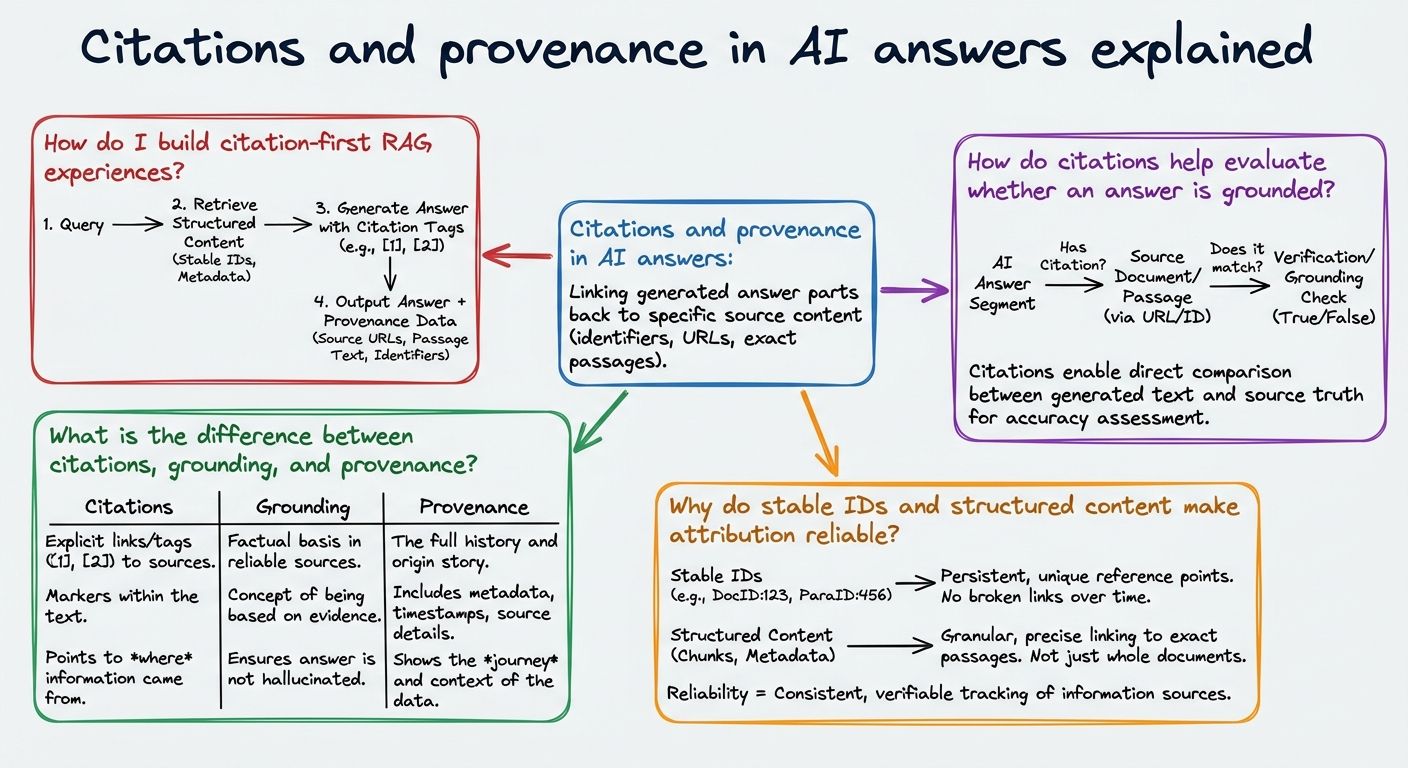
Building a citation-first retrieval-augmented generation (RAG) experience means designing the pipeline so that an answer without sources is impossible to produce, rather than treating sources as a display option. Five steps make that work.
First, index with identity. When you split content into chunks for retrieval, store a stable identifier, the field or section the chunk came from, a human-readable title, and a public URL alongside the chunk text. A chunk with no identity can never be cited later, no matter how good the model is.
Second, pass the metadata into the prompt. Give the model each retrieved passage with its identifier visibly attached, and instruct it to cite that identifier inline after any sentence that uses the passage.
Third, constrain the output format. Ask for structured output where claims and citation identifiers are separate fields, so you are parsing data rather than guessing at a model's footnote style.
Fourth, verify after generation. Check that every identifier the model returned actually appears in the set you retrieved, and that the cited passage supports the sentence attached to it. Drop or flag anything that fails.
Fifth, render the source. Show the title, the link, and ideally the quoted passage, so a reader can check the claim in one click. Citations and provenance in AI answers only build trust when the reader can follow them back.
Citations, grounding, and provenance answer three different questions about an AI answer. Grounding is the act of giving a model real source content to answer from instead of relying on its parameters alone, which is what retrieval-augmented generation does. Citations are the visible trail showing which part of that source content supports which part of the answer. Provenance is the record of where the underlying content itself came from, who created it, when it changed, and what happened to it along the way.
An answer can be grounded and still uncited, if the system retrieved good sources but never told the reader which ones it used. An answer can carry citations that are wrong, if the model attached an identifier to a sentence the source does not actually support. Citations and provenance in AI answers are what turn grounding from an internal design choice into something a reader or an auditor can check.
The word provenance also has a narrower, media-specific meaning. The C2PA specification, maintained by the Coalition for Content Provenance and Authenticity, defines a way to attach tamper-evident metadata to images, video, and audio describing how an asset was made and edited, including whether generative AI was involved.
Citations make groundedness measurable, because they tell an evaluator exactly which passage is supposed to support each claim. Without a citation, checking an answer means searching the entire corpus for something that might back up a sentence. With one, the check becomes a narrow comparison between one sentence and one passage.
That narrowing is what makes automated evaluation practical. A common pattern is to take each claim in the generated answer, pair it with its cited passage, and ask a separate model or a human reviewer whether the passage entails the claim, contradicts it, or says nothing about it. Claims that cite nothing, or cite a passage that says nothing about them, are the unsupported ones.
Citations and provenance in AI answers also give you a second, cheaper signal: citation validity. Before judging whether a passage supports a claim, you can check whether the cited identifier exists at all and whether it was in the retrieved set for that question. Fabricated or out-of-set identifiers are a clear failure that needs no human judgment to catch.
Attribution is only as reliable as the address you are citing, and stable identifiers give you an address that does not move. A document ID that stays constant through edits, renames, and URL changes means a citation stored today still resolves to the right content next year. A citation pointing at a character offset in a scraped page breaks the next time someone adds a paragraph.
Structured content, meaning content stored as discrete fields with their own types and names rather than as one blob of markup, makes the address more precise as well. If the source of a claim is the warranty field of a product document, the citation can say so, and a reader can be sent to exactly that fact. If the source is a chunk of an HTML page, the best the system can offer is a link to the page and a hope that the reader finds the relevant line.
Chunking rendered HTML creates a second problem: the chunk boundaries have nothing to do with meaning. Navigation, cookie notices, related-article teasers, and boilerplate footers get mixed into the same chunk as real content, so a model can cite a passage that is technically retrieved and substantively irrelevant. Content that is already divided into meaningful fields chunks along lines an author would recognize.
Sanity supports citations and provenance in AI answers through three things an agent can cite against: permanent document IDs, structured fields, and Content Source Maps. Every document in the Content Lake has an ID that stays with it across edits, so a citation recorded at answer time still points at the same document later. Fields are discrete and named, so a retrieval pipeline can record which field a passage came from rather than just which page.
Content Source Maps trace rendered output back to the specific document and field that produced it, which is the same lineage question a citation asks. The mapping that lets an editor click text on a page and land on the field behind it is the mapping an agent needs to say where a claim came from.
This is the practical argument for treating content as an operational system rather than a publishing destination. Sanity is the AI Content Operating System, the intelligent back end for companies building AI content operations at scale, and citation-first retrieval is one of the things that becomes straightforward when content has identity and structure before it is ever rendered.
Unlock New Possibilities with Sanity
With Citations and provenance in AI answers under your belt, it's time to see what Sanity can do for you. Explore our features and tools to take your content to the next level.
Last updated: