Content provenance definition
Content provenance is the verifiable record of where a piece of content came from and what happened to it: who or what created it, when, with which tools or models, and every edit, crop, or transformation applied since. It answers the question of origin and history, not the question of accuracy.
Content provenance is the verifiable record of an asset's origin and edit history: who made it, when, with what tools or models, and what changed along the way. That record exists only if the system holding the content captures it. In Sanity, every document edit is stored as a discrete revision with an author and timestamp in the Content Lake, so the trail of who changed which field, and when, is queryable rather than reconstructed after the fact.
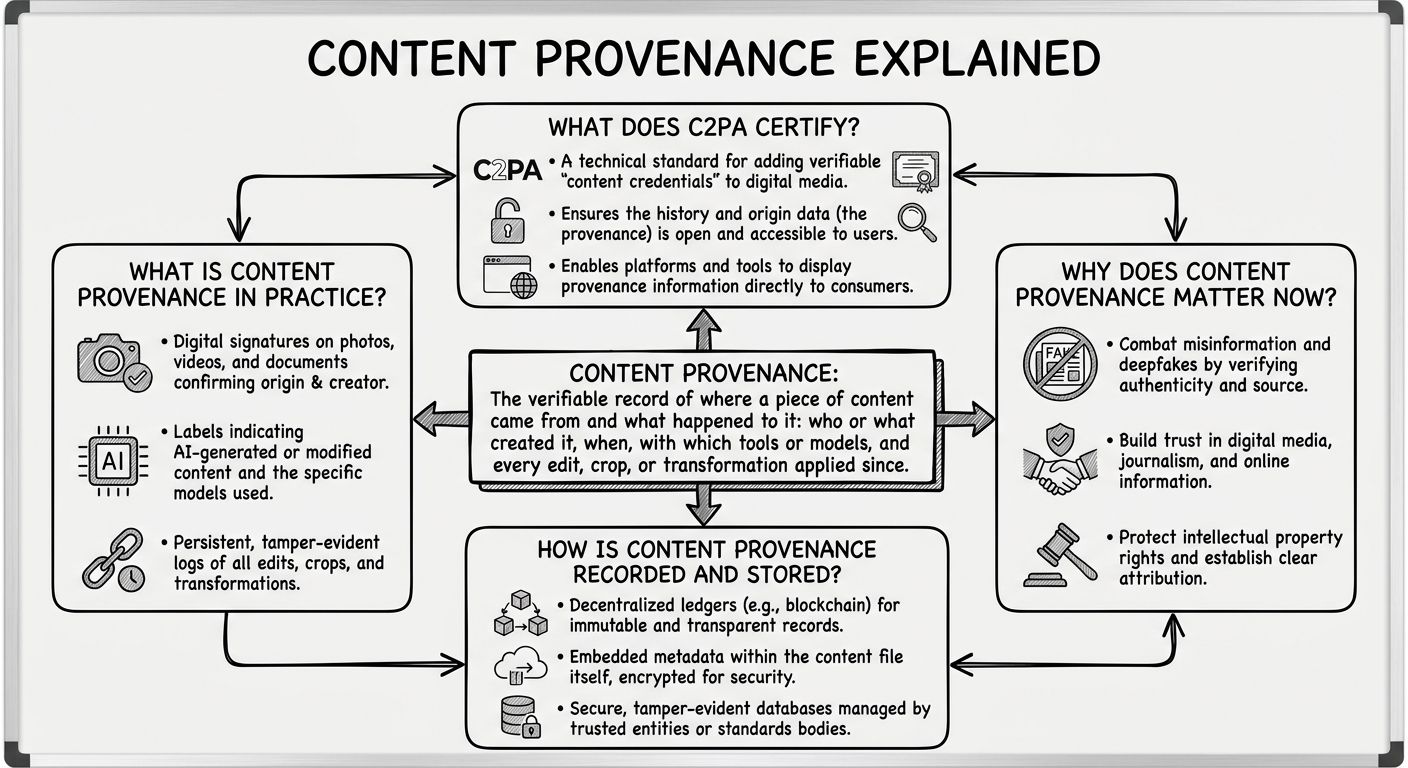
Content provenance in practice is a chain of statements attached to a piece of content, and each statement says something checkable about its history. A photograph might carry statements that it was captured by a particular camera model on a particular date, imported into an editing tool, cropped, color corrected, and exported. An article might carry statements that a draft was generated with the assistance of a language model, edited by a named person, reviewed by a second person, and published on a given date.
The important word is verifiable. A caption saying "AI-generated" is a label, not provenance, because anyone can type it and anyone can delete it. Provenance becomes useful when the statements are bound to the content itself, usually with a cryptographic signature, so that a reader or a system can check whether the record has been tampered with and whether the content still matches the record.
Provenance is also distinct from accuracy. A provenance record can tell you that an image came from a specific news agency's camera and has not been altered since. It cannot tell you whether the caption describes what the image shows. Origin is checkable; truth is a separate judgment.
What the signature actually asserts is narrow, and it is worth stating plainly. It asserts that a specific signer, identified by a certificate, made a specific set of claims about this specific file, and that neither the claims nor the file have changed since signing. It does not assert that the signer is honest, that the depicted scene is real, or that the content is free of bias. A convincingly staged photograph can carry a perfectly valid C2PA manifest.
That narrowness is a feature. By certifying a small, checkable property (this file, this history, this signer), C2PA gives downstream readers and platforms something they can evaluate automatically, and leaves the harder editorial judgment to humans.
Content provenance matters now because generative models made it cheap to produce media that looks like a record of something that happened. When synthetic images, audio, and text are indistinguishable from captured ones at a glance, the question shifts from "does this look real" to "can I check where this came from." Detection after the fact is not evidence; provenance captured at the point of creation is.
There is a second, quieter reason that has nothing to do with deepfakes. As organizations put AI into their own content pipelines, they need to answer internal questions: which pages were drafted by a model, which were reviewed by a person, which quote a source that has since been retracted, and which need to be pulled if a model turns out to have been trained on licensed material. Those questions are unanswerable without a per-asset history.
The pattern we see is that teams reach for provenance only after an incident, and then reconstructing who changed what becomes forensic work. It is cheaper to record the history as content moves than to infer it later from backups and memory.
Content provenance is recorded in two broad places: embedded inside the asset file, and stored alongside the content in the system that manages it. Embedded provenance, like a C2PA manifest baked into a JPEG, travels with the file wherever it goes, which is its strength. Its weakness is that many platforms strip metadata on upload, and any re-encode that is not provenance-aware can break the chain.
Stored provenance lives in the repository. A content management system that keeps immutable revisions records the same facts in a different shape: a document identifier, a field path, an old value, a new value, an author, and a timestamp. That record cannot be stripped by a third-party platform because it never leaves the repository, but it also does not travel with a published image to someone else's website.
Serious setups use both. The repository holds the authoritative history and the audit trail, while embedded manifests carry a durable, signed summary out into the world. The practical test for either is the same: can you take an arbitrary published asset, ask where it came from, and get an answer that does not depend on someone remembering?
Content provenance needs a content model granular enough that a change can be attributed to something specific. If an entire page is stored as one opaque blob of HTML, the most a system can say is that the blob changed. If the same page is modeled as discrete fields with defined types, a title, a set of body blocks, an author reference, a hero image, and a list of source citations, then the history can say that the second paragraph was rewritten by a named person on a named date while the citations were untouched.
This is why structured content with semantic clarity is the foundation, not a nice-to-have. Provenance is only as precise as the units it can point at. Structured content in Sanity is stored as typed fields in the Content Lake rather than as rendered markup, which is what makes field-level history and queryable revisions possible in the first place, and it is the same property that lets AI-assisted workflows write into a specific field under review rather than overwriting a page wholesale.
For teams building AI into content operations at scale, that granularity is the difference between a provenance story and a provenance system. Sanity's position as the Content Operating System for the AI era rests on modeling content precisely enough that every downstream question, including where did this come from, has a structural answer.
Discover More with Sanity
Now that you've learned about content provenance, why not start exploring what Sanity has to offer? Dive into our platform and see how it can support your content needs.
Last updated: