Content classification definition
Content classification is the practice of assigning a piece of content to one or more categories from a defined set, such as topic, audience, content type, sensitivity level, or terms in a taxonomy. The label set is fixed in advance, which is what separates classification from open-ended tagging or summarization.
Content classification assigns a piece of content to one or more categories from a predefined set: a topic, an audience, a content type, a sensitivity level, or a term in a taxonomy. The quality of the result depends on how clean the input and the answer space are, which is where structured content matters. In Sanity, the AI Content Operating System, typed fields and references to taxonomy documents give a classifier a bounded set of valid labels and somewhere queryable to write the answer.
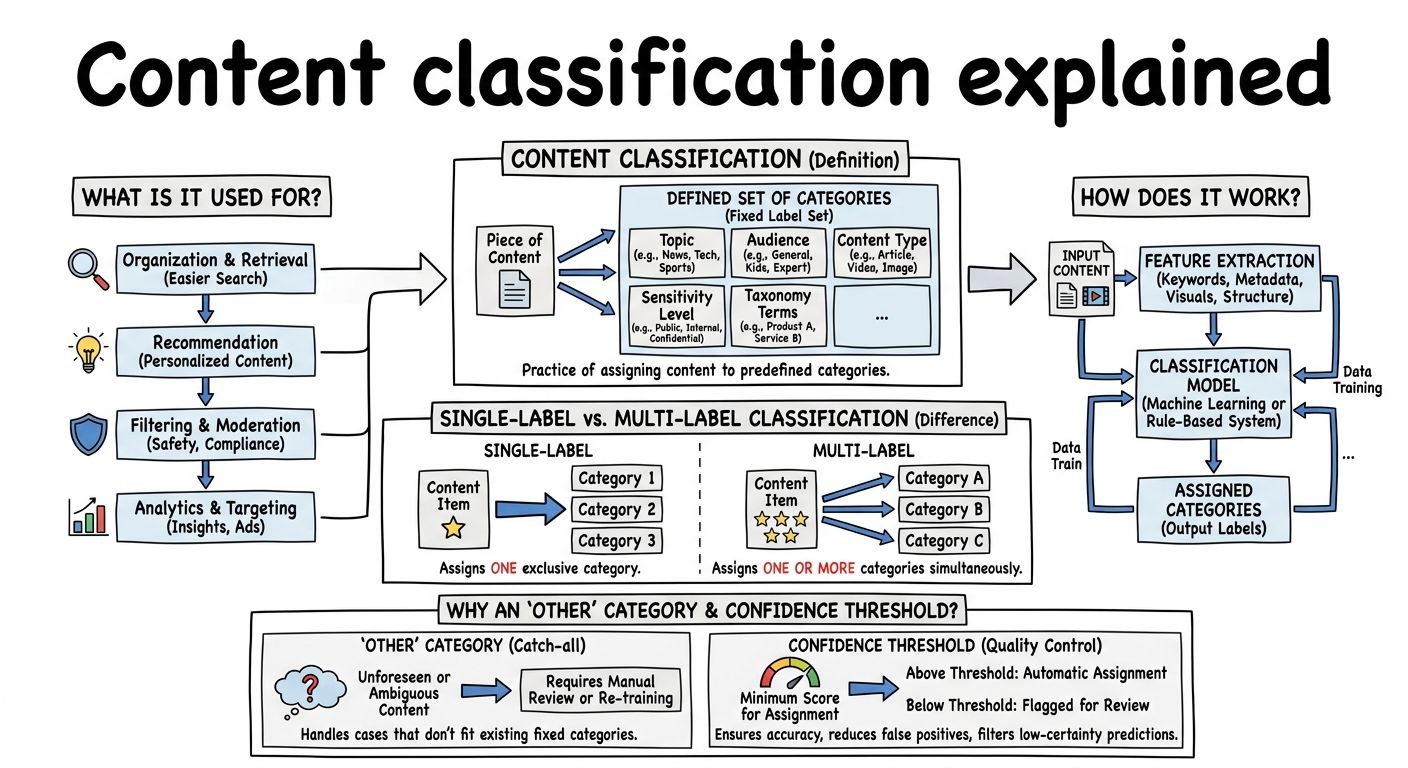
Content classification is used anywhere a system needs to know what a piece of content is before it can do anything else with it. Common jobs include routing a support ticket to the right queue, deciding which collection or folder an uploaded asset belongs in, tagging an article with topics so it can be surfaced in related-content modules, labeling a page by buyer persona or funnel stage, and flagging content as sensitive so it is excluded from a public index or a retrieval pipeline.
The common thread is that classification produces a label, not a paragraph. A label is cheap to store, cheap to filter on, and cheap to audit later. That is why classification sits underneath so much content operations work: search facets, personalization rules, compliance review, and access control all depend on something having decided which bucket a document goes in.
It also underpins metadata enrichment, where a system fills in descriptive fields on a document that a human did not type. Classification is the part of enrichment that picks from a closed list, as opposed to generating free text like an alt text description or a summary.
In content classification, single-label means each item gets exactly one category, and multi-label means an item can carry several at once. Choosing between them is a modeling decision you make before you build anything, and getting it wrong is expensive to undo.
Single-label fits categories that are genuinely exclusive. A document is a blog post or a case study, not both. A ticket goes to one queue. Because the options are mutually exclusive, the system can pick the highest-scoring option and move on, and a reviewer only ever has one answer to check.
Multi-label fits categories that overlap naturally. An article can be about pricing and about security and about one named product. Here the system scores each candidate label independently and keeps everything above a threshold, which means you also have to decide how many labels is too many. A piece tagged with fifteen topics is usually no more findable than one tagged with three.
A related distinction is flat versus hierarchical. A flat label set is one list. A hierarchical one has parents and children, so classifying into a child term implies the parent, and you have to decide whether the system is allowed to stop at a parent when it is unsure which child applies.
There are four broad approaches to content classification, and production systems usually combine them rather than picking one.
Rules match patterns: a keyword, a regular expression, a source URL, a file type, a field that is already filled in. Rules are transparent, instant, and free to run, and they are the right answer for anything deterministic. They break on anything that needs judgment, and the rule set grows until nobody can reason about it.
Trained classifiers learn from labeled examples. You give the model a few thousand documents that humans have already categorized, and it learns the boundary between categories. This works well when you have the labeled data and the categories are stable, and poorly when the taxonomy changes, because changing the label set means retraining.
LLM prompting asks a general text model to pick a category and return it. The appeal is that it needs no training data and handles a new label set the moment you paste it into the prompt. The cost is that the model generates text, so it can return a label that is not in your list, phrase it differently each time, or wrap it in an explanation you then have to parse. Constrained decoding and structured output modes reduce this but do not eliminate the need to validate the answer against your actual label set.
Decision models are built to return a choice rather than prose. System One models, a category exemplified by TypeSafe AI's Jev, released in September 2026, take a state plus a typed question and return probabilities over a fixed answer space, with no generated text at all. The architectural point is that the answer space is part of the request, so the output is a distribution over your categories rather than a string you have to coerce into one.
Content classification systems need an "other" option because a fixed label set will always meet content it was not designed for, and without an escape hatch the system is forced to put that content somewhere wrong. A classifier with no "other" does not fail loudly. It quietly misfiles the edge cases, and the error only shows up months later when someone wonders why a category contains a handful of items that have nothing in common.
Confidence thresholds are the second half of the same problem. Most classification methods return a score alongside the label, and that score is a routing instruction. Above a high threshold, apply the label automatically. Below a low threshold, apply nothing and queue the item. In between, apply the label but mark it as unreviewed so a human can confirm it. Where you set those cutoffs is a business decision, not a technical one: classifying marketing topics tolerates far more error than classifying whether a document contains personal data.
This is the practical form of human-in-the-loop. The point is not that a person checks everything, which defeats the purpose of automating. The point is that the system knows which decisions it is unsure about and sends only those to a person. A steady stream of items landing in "other" or below threshold is also the most useful signal you have that the taxonomy itself needs a new term.
Classification labels go stale because the taxonomy underneath them changes, and the documents already classified do not update themselves. A term gets renamed, two categories merge, a product line is retired, or a new one splits off from an existing term. Every document carrying the old label is now describing a category that no longer means what it did. This is taxonomy drift, and it is the main reason classification quality decays without anybody doing anything wrong.
The structural defense is to stop storing labels as free text. If a document's category is the string "Developer tools", renaming that category means finding and rewriting every occurrence, and any typo or casing variant is invisible to the search. If the category is instead a reference to a taxonomy document, the label is a pointer, the name lives in one place, and renaming it updates every classified document at once. That is also what makes the relationship queryable in both directions, so you can ask which documents carry a term and which terms a document carries without string matching.
The same logic applies to the classifier's input. A model asked to pick from a
Practically, the maintenance loop is: watch what lands in "other" and below threshold, add or split terms when a pattern emerges, reclassify the affected documents, and keep the old term as a deprecated alias until nothing points at it.
Discover More with Sanity
Now that you've learned about content classification, why not start exploring what Sanity has to offer? Dive into our platform and see how it can support your content needs.
Last updated: