Content federation definition
Content federation is an architectural pattern in which content held in several separate systems is made queryable through a single unified API, without copying or migrating it out of the systems that own it. A federation layer maps one schema across the sources, routes each part of a query to the system that owns it, resolves entities that appear in more than one place, and returns one combined response.
Content federation makes content that lives in several separate systems queryable through one API, without copying it into a central store first. The defining move is that a record holds a pointer instead of a copy. In Sanity, you model that pointer as a field in the document schema and resolve the live values from the owning system at render time, so price and stock stay current instead of the content repository becoming a second, stale record of them.
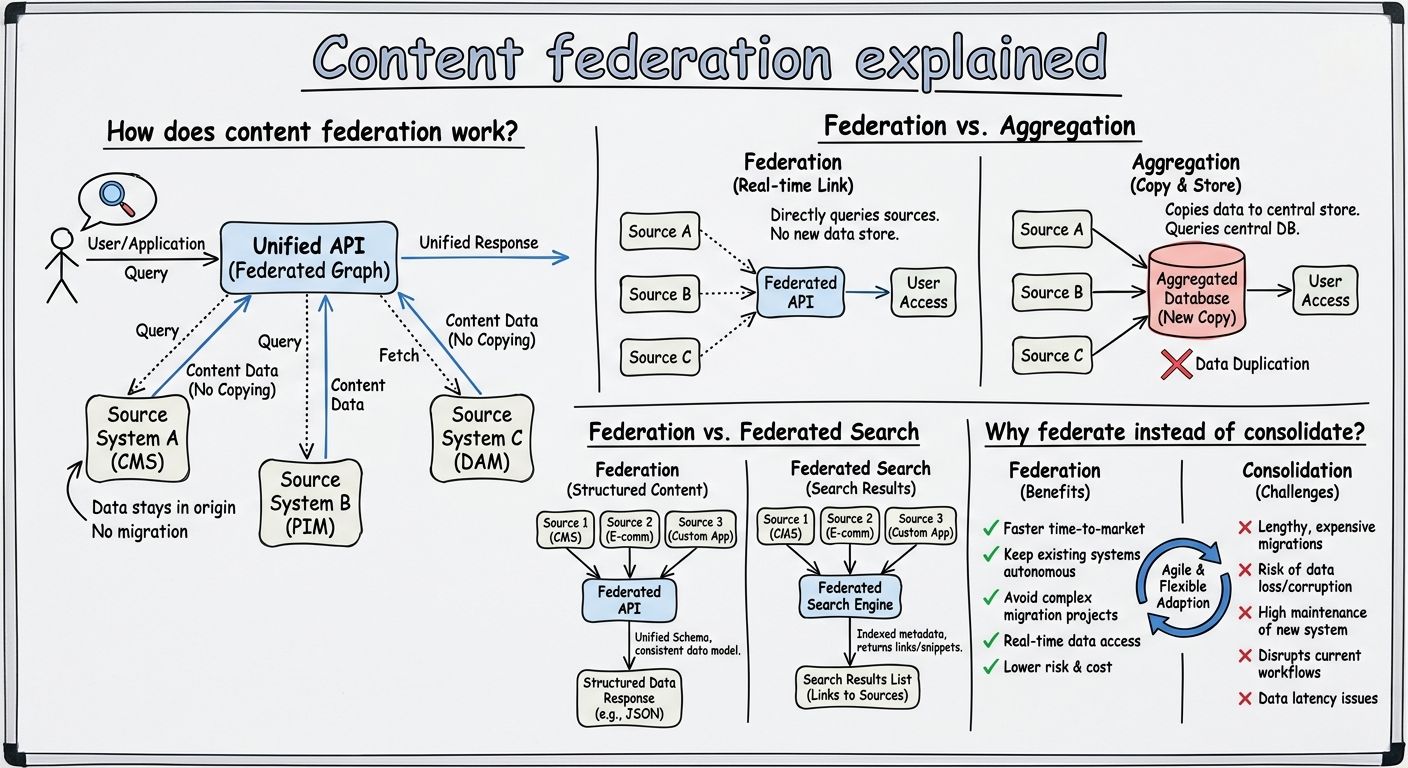
Content federation works by putting a federation layer, usually a gateway, between the applications that ask for content and the systems that hold it. The gateway publishes one unified schema, accepts a query written against that schema, splits it into sub-queries, sends each one to the system that owns that piece of data, and assembles the answers into a single response. The requesting application never learns how many systems were involved.
Four jobs make that possible. Query decomposition and routing decide which backend answers which part of the request. Entity resolution stitches together records that describe the same thing in different systems, such as a product that exists with one identifier in commerce, another in the content repository, and a third in pricing. Caching stores the composed response keyed on the query so repeated requests do not hammer every backend. Graceful degradation, meaning timeouts and circuit breakers, returns a partial response when one source is slow or down rather than failing the whole request. These characteristics are laid out in more depth in this architectural breakdown of content federation.
The idea is older than any content management product. In 1990, Amit Sheth and James Larson defined a federated database system in ACM Computing Surveys as a collection of cooperating database systems that stay autonomous and possibly heterogeneous, integrated virtually rather than physically consolidated. Content federation applies that definition to content repositories.
Content federation leaves content in the system that owns it and resolves it at query time, while content aggregation copies or syndicates content into one target system so it can be served from there. Data locality is the test: aggregated content physically lives in the target system, federated content stays remote and is fetched live.
The distinction extends to two neighboring patterns. Content synchronization keeps a copy in the target system and reconciles it on a schedule or a webhook, which means the copy can drift between syncs and you now maintain two records of the same fact. Content migration moves content permanently and retires the old source of truth. Content federation is explicitly the alternative to migrating, because the point of the pattern is to avoid the migration.
There is one more thing a federation gateway does that a simple aggregator does not: it has to resolve conflicts between sources, merge relationships that span them, and enforce one consistent access-control policy at the gateway rather than trusting each backend to do it separately.
Content federation and federated search both fan a request out to multiple systems, but they return different things. Federated search broadcasts a query to several sources in real time and merges the result sets into a ranked list for a person to read. Content federation returns structured, composable data that an application renders. Put simply, federated search federates results, while content federation federates the schema.
Federated search also goes by several other names for the same family of techniques. NISO's Metasearch Initiative treats metasearch, parallel search, broadcast search, and cross-database search as the same concept. What unites them is that each source is queried separately at request time instead of being imported into one central index.
GraphQL Federation (with a capital F) is a third thing again. Apollo Federation, introduced in 2019 and built with Netflix, is a specification for composing independently owned GraphQL services, called subgraphs, into one supergraph served by a gateway. It is a common implementation technology for content federation, not a synonym for it. Content federation predates it and can be built over REST sources too.
Teams federate content because the number of systems holding content keeps growing and consolidating them all is expensive, slow, and often politically impossible. AIIM's 2023 State of the Industry research, published December 27, 2023, found the average number of content systems inside an organization rose from 3.14 to 4.95 over ten years, and that organizations running seven to ten content systems grew from 3.6% in 2013 to 14% in 2023.
The practical driver is usually volatility. Price, stock levels, seat availability, and account entitlements change constantly and are owned by the commerce platform, the ERP, or the booking provider. Copying them into a content repository means accepting that the copy is wrong between syncs. Content federation lets editorial content live where editors work while those volatile values resolve from the system that is authoritative for them.
This is also the oldest framing of the pattern. IBM's enterprise content management documentation for Content Federation Services describes content remaining in its original repositories while being made uniformly accessible, with the federated item storing a reference to the external repository rather than a copy of its contents. IBM Redbooks covers the same architecture in Federated Content Management with IBM Solutions.
Content federation trades storage problems for runtime problems. Because nothing is copied, nothing goes stale, but every request now depends on every federated source being available, fast enough, and tolerant of your request volume. That is why the pattern literature spends so much of its attention on caching, circuit breakers, and partial responses: the failure surface moves to read time.
Some things a local copy makes easy also get harder. Full-text search across everything, point-in-time snapshots, offline builds, and editorial workflow over content you do not own are all more difficult when the content is remote. In the systems we have worked on, nobody federates everything. The workable pattern is to federate the volatile data and own the editorial content locally.
Sanity's own developer guide on integrating external data names the two options plainly and is candid about the cost of each. A sync plugin creates a document per external item and keeps it current with a webhook or a cron job, which adds infrastructure and means the Studio schema must be kept in step with the external data. An input plugin stores the external item as a field value on an as-needed basis, so the document holds the identifier and the live values are resolved from the owning system, which is the reference-not-copy half of federation expressed in a schema. Within Sanity, cross-dataset references apply the same principle across projects and datasets, letting shared global content live once and be linked into many brands or tenants rather than duplicated into each one.
Sanity fits a federated content architecture as the system that owns structured editorial content and links out to the systems that own everything else. Sanity is the Content Operating System for the AI era, the intelligent backend for companies building AI content operations at scale, and in a federation it plays the role of one authoritative, well-modeled source rather than a gateway that proxies other vendors' APIs at request time.
Three mechanisms carry most of the weight. Schema fields that hold an external identifier let a document point at a record in commerce or an ERP and resolve the live values at render time. Functions, small single-purpose pieces of code running on Sanity's cloud infrastructure that react to content changes, cover the synchronization case when a copy really is needed, since they can read and write the dataset, traverse references, and call external services. Cross-dataset references cover federation between Sanity projects and datasets.
For agent retrieval specifically, Knowledge Bases address federation's hardest problem, which is reconciling sources that disagree. A Knowledge Base is a pre-built index over material you choose, belonging to an organization and able to draw on sources from more than one project. When a help center says returns are accepted within 30 days and a product page says 45, a build raises the conflict with both claims shown side by side and their sources, and you record which one is ground truth. Two caveats matter: Knowledge Bases are in beta and opt-in, and a build materializes the index ahead of time rather than proxying queries live, so it reconciles sources in advance instead of federating them at request time.
Unlock New Possibilities with Sanity
With content federation under your belt, it's time to see what Sanity can do for you. Explore our features and tools to take your content to the next level.
Last updated: